16 October 2026
Famous hunters and their rifles
I am an avid reader of African hunting literature. Over the years I have devoured books written by men such as W.D.M. Bell, Ian Nyschens and others, and I have often wondered what happened to the rifles these men had used, especially when the rifles they wrote about so passionately appeared almost like central characters in their writings. – BY JOHAN VAN WYK
Well, I am happy to report that some of these famous rifles are still around. Therefore, please join me on a short trip down memory lane with a legendary rifle or two.
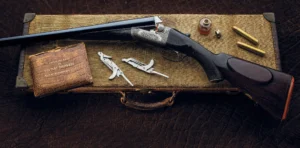
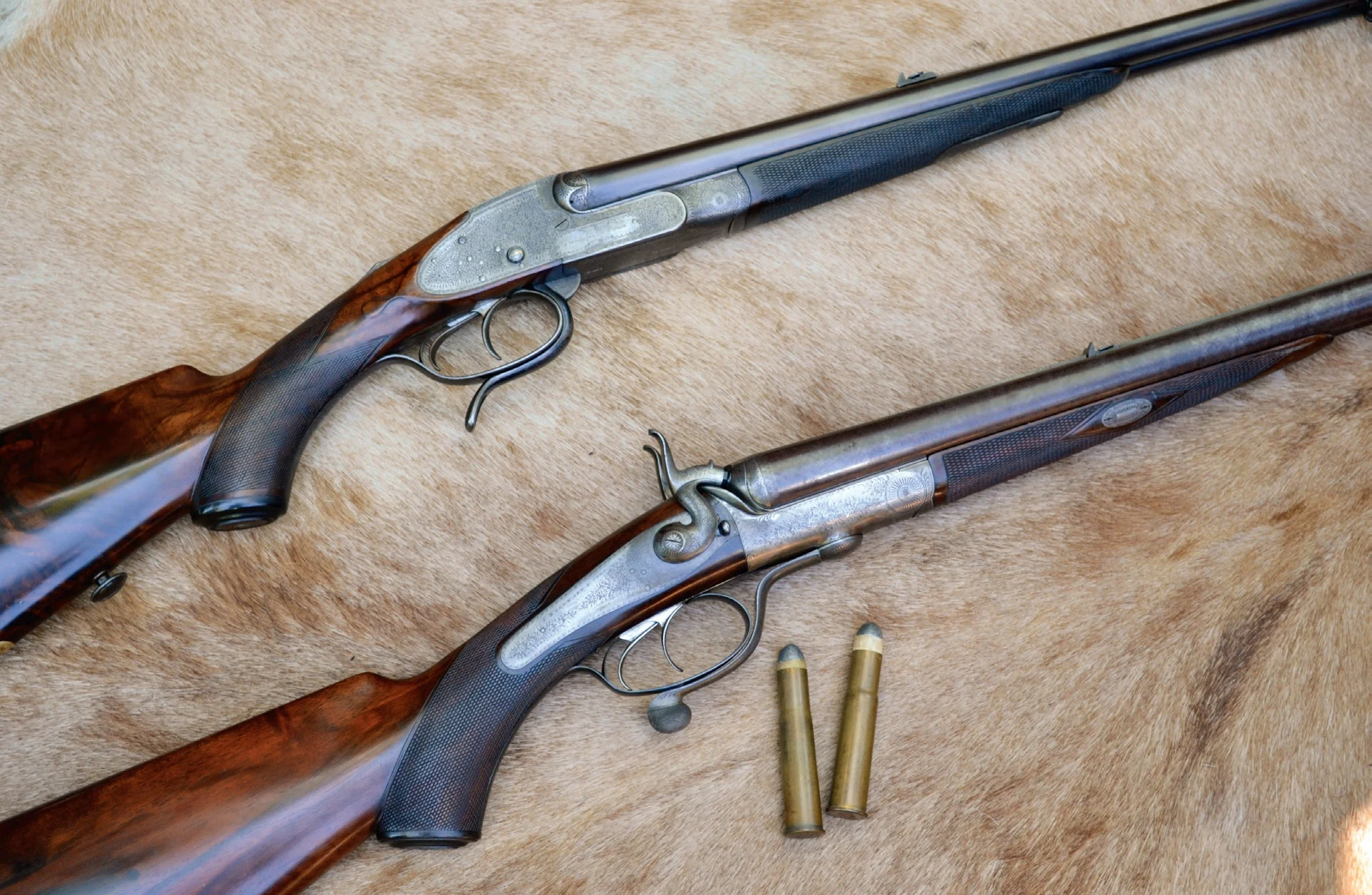
Sutherland’s .577 NE is made on a Westley Richards detachable-lock box-lock action, better known as a drop-lock action. Note the fact that there are no pins through the action, making it stronger than a conventional box-lock action. Also note the spare set of locks next to the rifle.
JIM SUTHERLAND
James “Jim” Sutherland was born in Scotland in 1872, and at various times kept himself busy as a boxer, labour overseer, soldier for the Germans during the Maji-Maji Rebellion in 1905 (for which he was awarded the Iron Cross for bravery), intelligence officer for the British Army in the East African Campaign during the First World War and, most importantly, as a professional ivory hunter.
Sutherland wrote a charming book about his earlier elephant-hunting exploits that was published in 1912 as The Adventures of an Elephant Hunter, and he made no bones about the fact that he preferred large-bore rifles above all else. In fact, Sutherland’s favourite elephant rifle was a Westley Richards .577 NE, and as the whereabouts of the rifle is known to us, it is worth taking a closer look at.
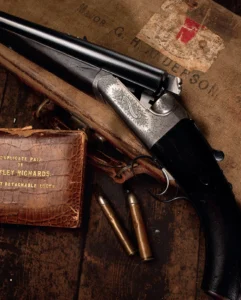
Ivory hunter Jim Sutherland’s Westley Richards .577 NE is today part of the Westley Richards collection in Birmingham. In addition to Sutherland, other famous African hunters such as Tony Henley and Major Andy Anderson also used this rifle in Africa.
Sutherland ordered his .577 NE from Westley Richards in September 1906. It was fitted with 26” barrels, ejectors, had an overall weight of 14lbs 1oz, and was described in the ledgers as “best quality”.
In a departure from the usual double triggers normally found on most double rifles, it was fitted with a single-trigger mechanism, but what really makes it stand out from other rifles is the fact that it was made on what Westley Richards described as a “hand-detachable lock” box-lock action, better known as a “drop-lock”.
Westley Richards’ drop-locks were always made as best-quality guns and rifles only. As the name implies, the lockwork can be removed for inspection or cleaning purposes by opening a latch on the underside of the action. However, what sets the drop-lock apart from other box-locks is the fact that there is no need for pins through the action body to support the locks.
This makes the drop-lock a prime candidate for a big cartridge such as the .577 NE, and combined with the ease of maintenance as well as the spare set of locks Sutherland ordered as well, it is hard to think of a better choice for a professional ivory hunter plying his trade in darkest Africa.
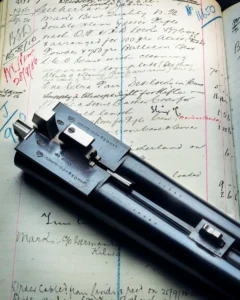
The barrels of Jim Sutherland’s .577 NE photographed on the original ledger entry (dated 1906) for the rifle. Note that it was proofed for use with 100 grains of Cordite and a 750gr bullet.
Jim Sutherland died from poisoning on 23 June 1932 at Yubo in the Sudan. Friends of his later erected a bronze tablet on his grave with the words, “To the memory of that great elephant hunter – JIM SUTHERLAND”, inscribed on it.
This tablet was later removed from the grave by a well-known Spanish big-game hunter and rather ignominiously mounted on the wall above the fireplace of his house in Spain. Luckily, Sutherland’s beloved Westley Richards .577 NE suffered a more dignified fate.
After Sutherland’s passing, it was at times owned and used by other well-known African hunters such as Major Andy Anderson and Tony Henley. Today it has pride of place in the collection of the makers themselves, Westley Richards & Co. Ltd, at their showroom in Pritchett Street, Birmingham. Anthony Alborough-Tregar, the managing director of Westley Richards, was kind enough to supply the photographs of the rifle that accompany this article.
HARRY MANNERS
Harry Manners was born in 1917 and was raised in Lourenço Marques (now Maputo) in Mozambique. He started hunting at an early age and hunted elephants for a living before the outbreak of World War II. In his book Kambaku (Rowland Ward Publications, 1986), Harry describes how he tried various different rifles and cartridges, including a .30-06 with military ammunition, before eventually settling on an over-the-counter Winchester Model 70 in .375 H&H Magnum.
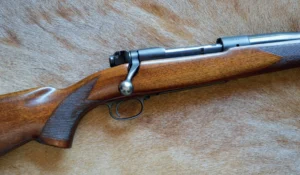
Mozambican ivory hunter Harry Manners settled on an over-the-counter Winchester Model 70 in .375 H&H as his primary dangerous game rifle. This example from the mid-1950s is similar to the rifles that Harry carried in pursuit of elephants for many years. He used his Winchester to shoot the fourth-largest elephant of all time.
Harry Manners would use a total of four Winchester .375s throughout his hunting career, including a later stint as a professional hunter for Werner von Alvensleben’s Safarilandia, during which he hunted with numerous well-known personalities, including Eleanor and Jack O’Connor.
Winchester’s Model 70 and the .375 H&H cartridge was a very happy marriage right from the start. The Model 70 action (what we know today as the pre-’64 action) had many of the better M98 Mauser features, such as a claw extractor and controlled feeding, and in addition, the rifles themselves were well made and reasonably priced.
The result was a serious big-game rifle that was available at an affordable price to the man on the street, and in the period after World War II, the Model 70 in .375 H&H became extremely popular in Africa. It was so popular it even knocked the 9.3×62 Mauser – hitherto the most popular and affordable big-game cartridge in Africa – from its perch.
Reading through Kambaku, it is clear that Harry’s travels in search of ivory virtually took him throughout the length and breadth of Mozambique. He hunted in excess of a thousand elephants and holds the record for the biggest (in terms of weight of tusks) elephant ever hunted by a white man and the fourth-largest ever shot: a giant of a bull with tusks weighing more than 180lbs a side that succumbed to a heart shot from Harry’s trusty Model 70 .375 H&H.
This hunt took place in a mountainous area of Mozambique south of the Malawian border, and a photo of Harry posing with the two giant tusks is on the dust cover of Kambaku.
Harry Manners eventually left Mozambique and in later years took up employment in the Kruger National Park, just across the border from his old stomping grounds. He passed away in 1997 but was certainly one of the last men to have sampled life as a true ivory hunter. Just like J.A. Hunter’s name will for me always be synonymous with the .500 Nitro Express, Harry Manners will always be “Mr .375”, and ever since I read Harry’s book as a schoolboy in the late 1980s, I wanted to own a .375 H&H of my own.
JOHN “PONDORO” TAYLOR
One thing that John Howard Taylor was certainly never short of was an opinion! Born in Dublin in 1904 and the son of a surgeon, Taylor departed Ireland for Africa at an early age and joined the British South Africa Police in what was then Rhodesia. The life of a policeman was not for Taylor, however, and he soon turned to the trade that he was to practise for many years: ivory poaching.
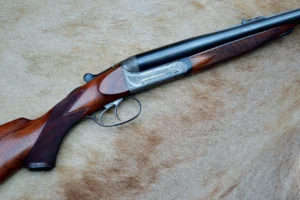
John “Pondoro” Taylor had a soft spot for the two .450/400 NE cartridges. This example dating from the 1920s was made by Webley & Scott for the Army & Navy Stores. It is chambered for the .450/400 (3¼”) NE cartridge, is fitted with ejectors and is made on a specially scaled PHV-1 box-lock action. It is beautifully balanced and weighs less than 10 pounds with 26” barrels: a very potent dangerous game rifle!
Taylor hunted in many African countries but did the bulk of his shooting in Mozambique, not bothering with even a casual greeting as he merrily poached elephants in the Rhodesian section of the Zambezi Valley as well, where he was joined by men like Crawford Fletcher-Jamieson and Ian Nyschens, who also helped themselves to their share of the ivory pickings on offer.
What set Taylor apart from many of his contemporaries is the fact that he had an enquiring mind when it came to firearms and ammunition and was fond of experimenting with various different rifles during the course of his wanderings in search of elephant, buffalo and other big game. In addition, Taylor was a fine writer and authored a total of five books, including African Rifles and Cartridges, which was first published in 1948 – easily his most well-known work and still in print to this day.
When reading John Taylor’s books, it is clear that he had a preference for certain cartridges and tended to sing their praises, sometimes to the point of bordering on the ridiculous. His tale of killing seven eland with one shot from his .375 H&H is well known and still causes chuckles around campfires, but the truth of the matter is that Taylor was a double-rifle man at heart and preferred the products of the better British makers. His all-time favourite was in all probability the two .450/400 Nitro Express cartridges.
The .450/400 NEs (one version used a 3” case and the other a 3¼” case; both fired 400gr bullets at approximately 2 100fps) were standard chamberings by almost everyone in the British gun trade prior to World War II. They were particular favourites in India for use on tigers and the like, but a good many found their way to Africa and soon found favour with big-game hunters over here.
In better-grade rifles, the .450/400s could be made into beautifully handling rifles that weighed under 10lbs with 26” barrels. They packed quite a punch and were powerful enough for elephant.
The Army & Navy .450/400 (3¼”) NE in the accompanying photograph is one such rifle. Made in the 1920s on a scaled-down PHV-1 Webley box-lock action and fitted with ejectors, it is one of the nicer .450/400s I have had the pleasure of handling. I have to give Taylor full marks for having a soft spot for the .450/400s. A rifle such as this one offers a lot of killing power in a beautifully made and balanced package.
Taylor was eventually deported from Africa by the British authorities as a result of, amongst other things, his poaching activities. He died in poverty in London in 1969, a sad end for a man who left behind such a rich legacy in the form of hunting literature.
COL EDWARD JAMES CORBETT
Jim Corbett was born in India in 1875 and quickly developed into a hunter of renown. With the high incidence of man-eating tigers and leopards in India, Corbett was frequently called upon to deal with the troublesome cats and, in this regard, he not only saved the lives of countless people but also experienced some hair-raising adventures.
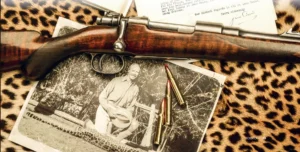
Jim Corbett’s famous old .275 Rigby shown with a photograph of the famous hunter posing with one of the man-eaters he hunted.
Corbett initially used a .500 Black Powder Express double rifle for the problem tigers and leopards but quickly switched to a Jeffery .450/400 NE. He used this rifle to kill the man-eating tigress of Champawat in 1907, a beast responsible for 436 documented deaths.
As a token of appreciation, Corbett was presented with a Rigby .275 rifle, and this weapon would accompany him for the rest of his life on numerous hunting adventures.
Just like the Sutherland .577, Corbett’s .275 is today safely ensconced in the collection of John Rigby & Co in London. Marc Newton, Rigby’s managing director, was kind enough to let me examine the Corbett rifle recently, and it was a thrill to be able to hold the same rifle that Corbett carried in his beloved jungle and to look over the same sights that witnessed so much adventure.
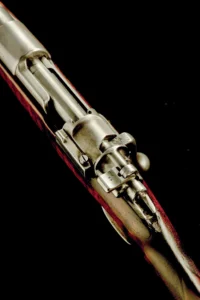
Corbett’s Rigby is made on a commercial intermediate-length M98 Mauser action. Note the amount of wear on the rifle, a testimony to many miles spent in pursuit of big game.
As can be expected, it is a hunting rifle par excellence, slim and dainty and easy to carry. Similar Rigby .275s in the hands of other hunters such as Bell accounted for scores of big-game animals in Africa, and it is a rifle and cartridge combination that is steeped in legend.
Corbett’s .275 was made around an intermediate-length sporting M98 Oberndorf Mauser action and is what is referred to as the No 3 model in vintage Rigby catalogues. It has a magazine capacity of five cartridges and a 23½” barrel.
The overall condition of the rifle can best be described as very worn, and there is very little of the original finish left. Marc also tells me that the barrel is pretty much shot-out, but no matter; few rifles have had the opportunity to give such sterling service under such circumstances, and the Rigby did faithful duty for its original owner. It is enjoying a deserving and well-earned retirement.
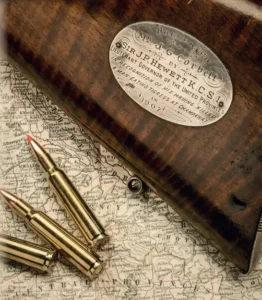
A plaque on the Rigby’s buttstock commemorates the fact that Corbett was given the .275 Rigby as a token of appreciation for hunting down the man-eating tigress of Champawat in 1907.
Notwithstanding the fact that he is best known for his Indian hunting exploits, it is a lesser-known fact that Corbett also did a lot of hunting in Africa. His bungalow in what is now Jim Corbett National Park in northern India houses several African trophies collected over time, and the old .275 no doubt did duty on the Dark Continent as well.
Corbett retired to Kenya after Indian Independence and was laid to rest there in 1955. His name is still held in high regard in India today for his services to his fellow man in India.
There you have it. This was but a glimpse at four famous hunters and their rifles of choice.
(This article was published in the 2019 edition of KOLSKOOT.)
ALSO READ
Buying your first shotgun: What you need to consider