




5 October 2026
The Boer cartridge: 7×57 Mauser
The 7x57mm Mauser changed military thinking on battlefield cartridge ballistics and gained incredible fame as a hunting and combat cartridge. Sadly enough, the days of this iconic cartridge seems to be numbered – by PIERRE VAN DER WALT
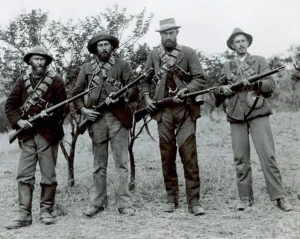
A quartet of Boer burghers pose for the camera, armed with their trusty Mauser rifles chambered for the 7×57. PHOTO: WAR MUSEUM OF THE BOER REPUBLICS, BLOEMFONTEIN
Dawn was breaking in the east, but he could hardly see the rifle’s sights, let alone aim properly. Sixteen-year-old Evelyn Williams was scared. Very scared.
The Khaki cavalry was pouring over the hill from Paul Kruger’s railway line to Lorenzo Marques a few miles to the north, to where he was positioned on the stoep of the Elandsfontein homestead.
His stocktaking seconds before had unnerved him. Only five cartridges remained in the bandolier of his beloved 7×57-chambered M-1895 “Plezier Mauser”, plus four in his rifle. Such was the logistic plight of the Boers at the end of the winter in 1901.
His unit, the Middelburg Commando, had ridden into the area after dark the night before and scattered to their farms to replenish their supplies in the Arnot region east of town. It was great to see his mother (sister to the mother of Commandant Gideon Scheepers) and little siblings after months in the veld. The women and children had a hard time surviving and were as emaciated as the men on commando. They effectively lived off the land, but they had gathered enough for the men of the family to return to war.
Some “joiner” (traitor) must have alerted the British when the commando arrived in the region the previous day. It was the only way the British could have known about the commando’s presence at first light already.
Evelyn was not scared for his own sake. He had made peace with the fact that he would die in battle or be killed by a firing squad upon capture, regardless of having been born in the Transvaal. His father, John Joseph, was Welsh-born and the British did not recognise his ZAR citizenship. Despite international law, the British military would condemn them as traitors to the Crown.
Evelyn silently thanked the fact that they had posted guards and successfully scoured the approaching line for the joiner. He saw him pointing out the lay of the land to a man, presumably the officer in charge.
Given the poor light, Evelyn waited until the Khakis had edged into the 200-yard mark and placed his front-sight bead centre body just on the joiner’s armpit line. He squeezed the trigger and took satisfaction in the thump of the impact. The joiner’s body jerked and a second later, he slowly began toppling from his saddle.
Evelyn’s father’s 7×57 also barked, and the officer dropped as the patrol was scrambling off their horses. Evelyn missed one Khaki in the hasty disembarkation, but he took another as his feet hit the Elandsfontein soil.
The land offered no cover as the grazing was short. The Khakis remained exposed, and Evelyn picked off another six, exposed by bright muzzle flashes in the soft light of late dawn. One cartridge remained.
“Am I going to kill myself or one more of the enemy with the last bullet?” Evelyn thought. He decided on the latter as he was going to die anyhow. Taking one more of the enemy and costing the British time, effort, and ammo when facing his firing squad, seemed the better deal.
Evelyn killed his final Khaki, lowered his head, and listened to his pregnant mother going into labour in the bedroom behind him. Lee-Metford bullets were pouring into the house through the window behind his stoep wall cover. Regardless of what happened to him, he knew that his mother (if she survived the fusillade and giving birth) was destined for Kitchener’s terrible concentration camps.
Evelyn put his useless Mauser against a pillar on the stoep wall and raised his white handkerchief.
“Dad! I’m out of ammunition. I’m surrendering!” he shouted to his father.
“Out too, Ev! Raise the surrender! God have mercy on us. Hope they kill us on this land of hope and love!” came his father’s reply.
Evelyn looked up at the beloved rifle he would never see again, and tears came to his eyes. The firing had ceased. Holding the white cloth above his head, he stood up and watched imminent death cautiously approaching with rifles abreast. A great sadness overcame him as he stood there, helpless.
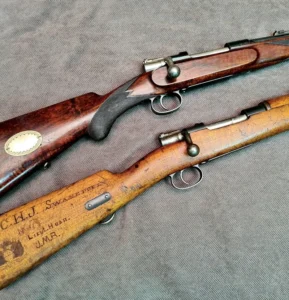
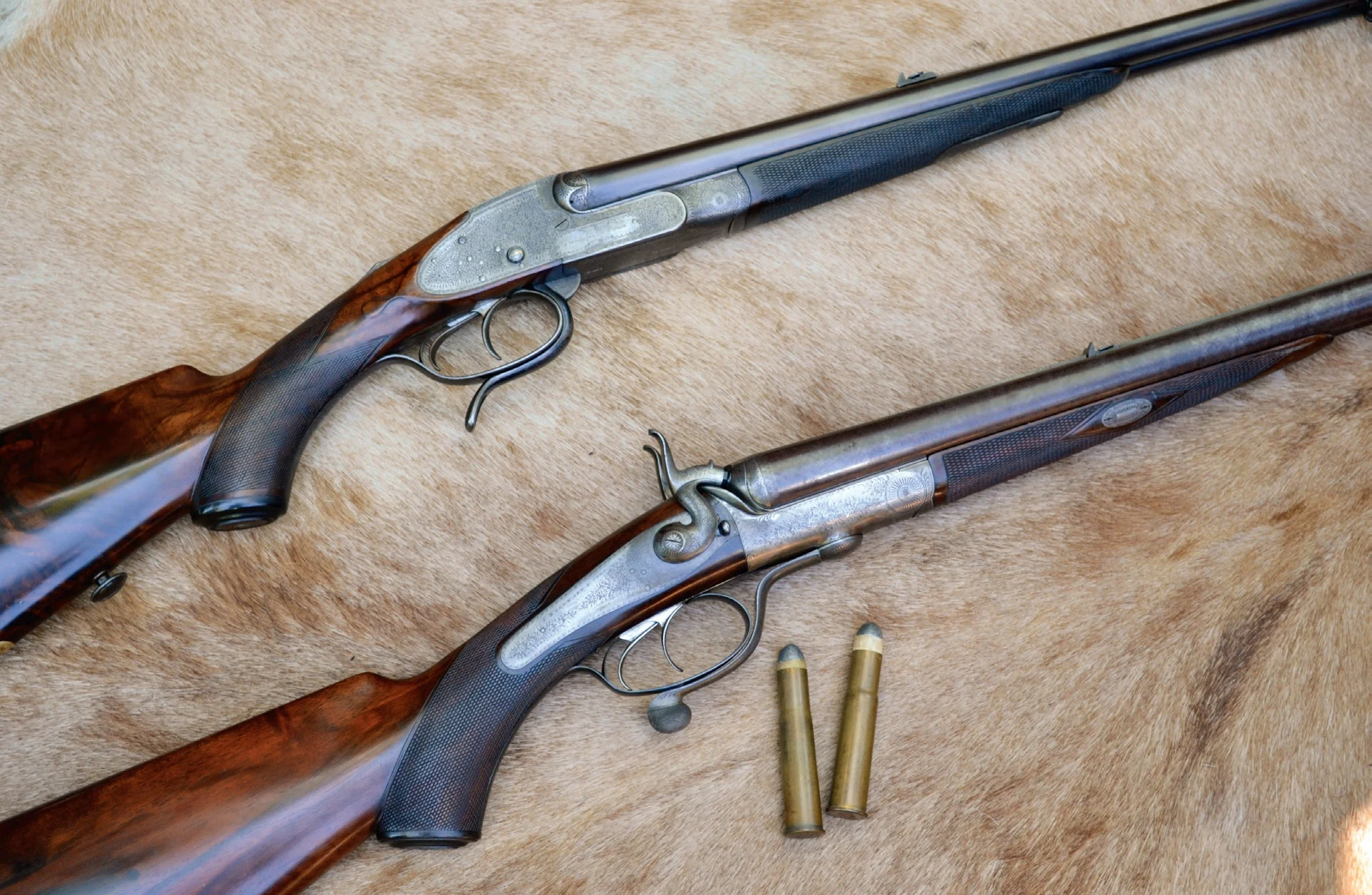
A Plezier Mauser in 7×57, dating from the Second Anglo-Boer War (top). These were sporting rifles and highly prized by their owners. The rifle below is an M96 carbine in 7×57 that had its stock carved. Today, such rifles are valued collector’s items. (Hubert Montgomery Collection)
CARTRIDGE HISTORY
The 7×57 Mauser cartridge of 1892 must surely rank as one of the most interesting cartridges ever. Not only was it one of the earliest cartridges of the geometric form we accept as a matter of course today, but it changed military thinking on battlefield cartridge ballistics and gained incredible fame as a hunting and combat cartridge.
Spain was the first country to adopt the 7mm Mauser as a service cartridge in the Mauser M-93 rifle, with many Latin American countries following suit. So did the two former Boer republics, the Zuid-Afrikaansche Republiek and the Oranje Vrijstaat.
The world’s first wildcatter was the famous Peter Paul Mauser. When he introduced a new cartridge, he necked it up or down, with or without modification, with gay abandon.
The 7×57 Mauser case was not simply a necked-down 8×57 Mauser or so-called DWM #M88 case. It had a marginally larger rim diameter. The basic M-93 hull was listed by DWM as case #380 and came in rimless and rimmed configuration.
Several 7×57 variations of the basic #380 cased cartridge evolved. Although interchangeable, the various rimless versions were provided with different alphabetical postfixes by DWM. Hence, you will find listings such as 380A, 380B, and so forth.
To the best of my knowledge, DWM case version 380L, used in the Serbian Mauser M-99, eventually became the sporting cartridge we are using today.
The 7mm Mauser cartridge had such a massive impact as a combat cartridge that the hunting fraternity could not but take notice. So impressed was John Rigby of the UK with it that he bestowed an English designation (.275 Rigby) upon it and accepted it into his sporting cartridge line-up in 1907.
But how good a cartridge is it really?
CARTRIDGE ANALYSIS
More than 130 years ago, the 7×57 Mauser represented cutting-edge technology, but things have changed since then. What we knew and how we designed and specified cartridges more than a decade ago differ vastly from how it is done today.
However, the anatomical evolution of animal species is much slower than ballistic evolution or advances. What effectively killed earth-based species 130 years ago has not changed one bit within our measuring capability, yet ballistics has evolved in leaps and bounds.
The reality is that the 7×57 Mauser kills earthbound species as effectively as it did 130 years ago – actually better because bullets and ballistic interpretation have improved, and modern optical devices have drastically enhanced our success potential across every historic application range.
Fact is, if I fully employ modern knowledge and equipment, I should “theoretically” achieve better results than in years gone by, all else bar technology remaining constant. Is that really true?
My respectful submission pertaining to hunting and cartridges is an emphatic “yes and no”. Allow me to explain.
If I send an old-technology bullet through an animal’s brain, it will kill that animal as effectively as the most modern, technologically advanced bullet. No amount of known bullet technology advances will make any difference to the outcome.
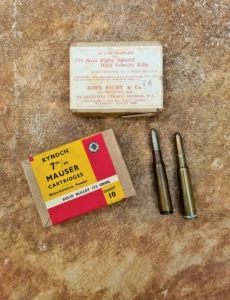
4 The 7×57 Mauser was loaded by just about every ammunition manufacturer at some stage, including the British. These two boxes of (very) vintage ammunition tell a story of their own: The 7×57 was given the designation “.275 Rigby” and chambered in rifles by Rigby and other British makers. Kynoch 7mm ammunition could be safely used in any rifle chambered for the .275 Rigby, and vice versa.
If we switch our attention to body shots and place a specific bullet into the vitals, the animal will die, the rapidity of death being dependent on shot placement, blood vessel damage and haemorrhaging tempo.
A 7mm bullet impacting an animal at 2 400 fps, expanding 100% and passing through the animal, will kill no better or worse, regardless of its weight, sectional density or any other theoretical nonsense perpetrated. It does not matter one bit what the size, shape, capacity or other consideration is from which that bullet is discharged.
By modern standards, the 7×57 has an antiquated, horrible design. It has considerable body taper at 1.53° that is conducive to case stretching. It has more than 130% calibre neck length. And I can carry on.
The truth is, the 7×57 Mauser has never held a benchrest world record for precision (small groups). However, it has an enviable, century-old reputation and record of hitting targets (accuracy). Does this really concern anyone but highly technical reloaders?
Case design, efficiency, longevity or any other consideration are only factors worth considering when handloading. The essence of a cartridge lies in animal performance. Every other consideration falls in the realm of philosophy.
From killing Americans and Englishmen to felling African game of all sizes, the 7×57 Mauser has never been found lacking if the shooter does his part, like my ancestor, Evelyn, for example. The famous Karamojo Bell even liked it for hunting elephant!
It is a big pity that the rifle, cartridge and hunting industries are fickle when it comes to fashion – even more so than the haute couture design houses like Cardin and Versace.
So, when a case design – as the bullet launching platform – falls out of fashion, all ballistics realities and real-life relevance are discarded and sacrificed for a shape that most shooters never utilise or explore.

As a hunting cartridge, the 7×57 is one of the best with mild recoil and good killing power. Here, Australian hunter John Marozzi poses with his trophy kudu, hunted with an FN Mauser in 7×57.
BETRAYAL
After more than 130 years, the 7x57mm Mauser may no longer be the leading technical design, and no large international rifle manufacturer still offers it as it has become unfashionable.
It may also never have held a world-precision record. Yet it remains an accurate, highly effective, medium-game (American and Briton inclusive) cartridge. What is more, it is a fantastic, compact bush-range cartridge with moderate recoil that will not destroy your venison.
A new world has dawned on our industry. Class, quality, durability and collectability in rifle and cartridge design and production have been replaced by short-term interest and disposability.
The contemporary consumer does not buy a rifle for long-term use or as an heirloom and an art piece to be passed on to future generations. Instead, he only buys it as a disposable tool for instant and temporary gratification.
This means that any rifle or cartridge that requires context, style, effort, love and expertise, ethics and dedication will face doom on an increasing level.
(This article was published in the March-April 2022 edition of SA JAGTER/HUNTER)
ALSO READ