





20 October 2026
Hunting in extreme heat: How to outsmart the bushveld summer
Hunting in the hot northern provinces? Learn when to hunt, where to look for game, how to read tracks and water sources, and how to stay safe in extreme heat.
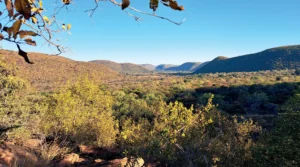
The Waterberg in Limpopo, South Africa, is prime hunting area. However, it can also produce difficult conditions such as extreme heat.
Temperatures in South Africa’s northern provinces soared into the upper 30s Celsius (86 fahrenheit) this week. Hunters and game farmers are also bracing themselves for the forecast “super” El Niño weather pattern, which is expected to peak around December 2026 and continue into early 2027.
These conditions can turn a straightforward walk-and-stalk hunt into a demanding exercise in patience. Success depends less on covering ground than on understanding animal behaviour, reading the terrain and adapting your approach to the heat.
A 2023 study published in Frontiers in Ecology and Evolution, which investigated springbok, kudu and eland in an arid savanna in Namibia, found that springbok activity declined particularly strongly as temperatures rose. Eland also reduced their daytime activity, while kudu appeared less affected during the hottest part of the afternoon. A separate study published in Ecology and Evolution in 2024 found that extreme afternoon heat reduced feeding time and increased resting and rumination in all three species.
These findings offer useful insight into how game responds to heat, but they do not establish a universal hunting timetable. Vegetation, water availability, disturbance, terrain and conditions on an individual property all influence animal movement.
The practical lesson is to let fresh evidence guide your decisions rather than relying on the clock alone.
START BEFORE SUNRISE
Early morning is often productive because temperatures are lower and many animals are feeding or moving between feeding areas and cover. Arrive early enough to be ready when there is sufficient light to identify your quarry safely.
Glass open clearings, the edges of thicker bush and natural routes between feeding and resting areas. Not every animal will be standing in the open. A flick of an ear, the flash of a horn or a change in the shape of a dark patch beneath a tree may reveal an animal that would otherwise go unnoticed.
Use the cooler conditions to stalk without unnecessary exertion. Move slowly, make use of available cover and pay attention to the wind. A direct route that carries your scent towards the quarry can ruin an otherwise promising opportunity.
KNOW WHERE TO LOOK
Thickets, dense stands of trees and patches of vegetation with a closed canopy provide shade and shelter. Kudu, in particular, can be difficult to spot when resting in thick cover, where their colouring blends into the vegetation.
Rather than pushing blindly through dense bush, work the edges quietly. Look for tracks entering the thicket, fresh droppings, browsed vegetation and trails connecting cover with feeding areas.
Open grassland, clearings and lightly wooded areas offer opportunities to glass for game, particularly during cooler periods. Use available cover to watch their edges rather than crossing the middle of an open area, where your movement may be easy to detect.
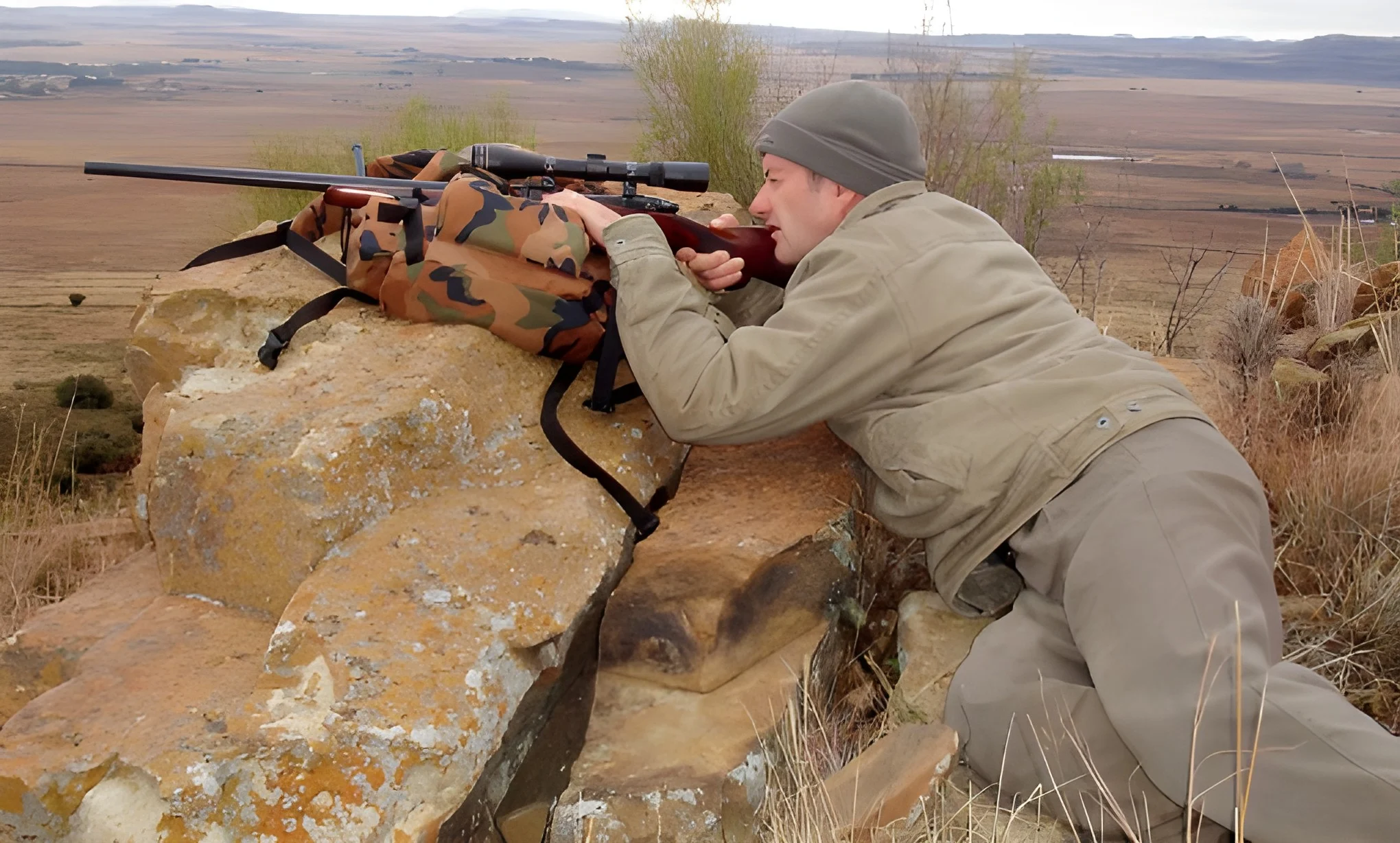
Rocky outcrops and koppies can provide useful vantage points, depending on the terrain and wind direction. From a suitable position, you may be able to glass several areas without walking through each one. Look for natural funnels, such as narrow openings between thickets or routes between rocky slopes and dense bush.
These features are potential hunting locations, not guarantees. Recent sightings and fresh sign will help you determine where to concentrate your efforts.
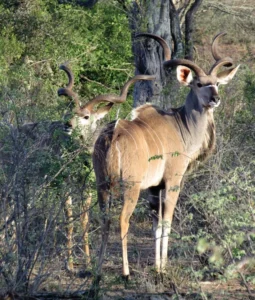
Two kudu bulls in the Mpumalanga Lowveld. The kudu’s behaviour is less affected by heat.
READ THE SIGNS THE BUSH LEAVES BEHIND
In extreme heat, fresh sign can be more useful than covering kilometres of ground.
Tracks reveal which species are present and the direction in which they have travelled. Compare the clarity of impressions with older tracks nearby, but avoid relying on appearance alone to estimate their age. Wind, rain, soil type and animal traffic all influence how quickly tracks deteriorate.
Droppings, broken branches, browsed shrubs and disturbed grass provide additional clues. A combination of signs generally tells you more than a single track.
For kudu, look for browsing activity and tracks leading into dense cover. Impala and blue wildebeest may use established trails between grazing areas and shelter, while warthogs may feed in open ground before retreating to cover or burrows. These patterns vary with habitat, food availability and disturbance.
Build a picture of where game is feeding, where it finds shelter and which routes connect these areas. Compare your observations throughout the day to avoid repeating unproductive walks.
IS LATE AFTERNOON WORTH THE WAIT?
Late afternoon can provide another opportunity as temperatures begin to ease. Animals may resume feeding or move between cover and open ground, although the timing and extent of this activity vary by species and property.
However, also keep in mind low light makes it harder to identify animals and assess a safe, ethical shot. Know the applicable legal shooting hours, and never shoot unless you can positively identify your quarry and place the shot safely.
Observe from a position that offers a good view without exposing unnecessary movement. Use binoculars to scan openings and shaded areas, and check the wind before starting a stalk.
Air movement can change with terrain and temperature, so monitor it as you move. If your scent is drifting towards the animals, reconsider your route rather than pressing on regardless.
SHOULD YOU HUNT DURING THE MIDDLE OF THE DAY?
The hottest hours are often better spent resting, observing and planning than undertaking long, strenuous walks.
Study a map of the property, review tracks found during the morning and identify promising areas for the afternoon. If you have seen animals entering a particular thicket or drainage line, plan an approach that avoids unnecessary disturbance.
Where conditions permit, quiet observation from a shaded vantage point may reveal animal movement without requiring an extended walk. Binoculars also allow you to monitor promising areas while conserving energy for a potential stalk later.
The research on springbok, kudu and eland supports adapting hunting activity to the heat, but it does not prove that all game on South African hunting farms will be inactive at midday. Local observations should guide your decisions.
WIND, NOISE AND SCENT STILL MATTER
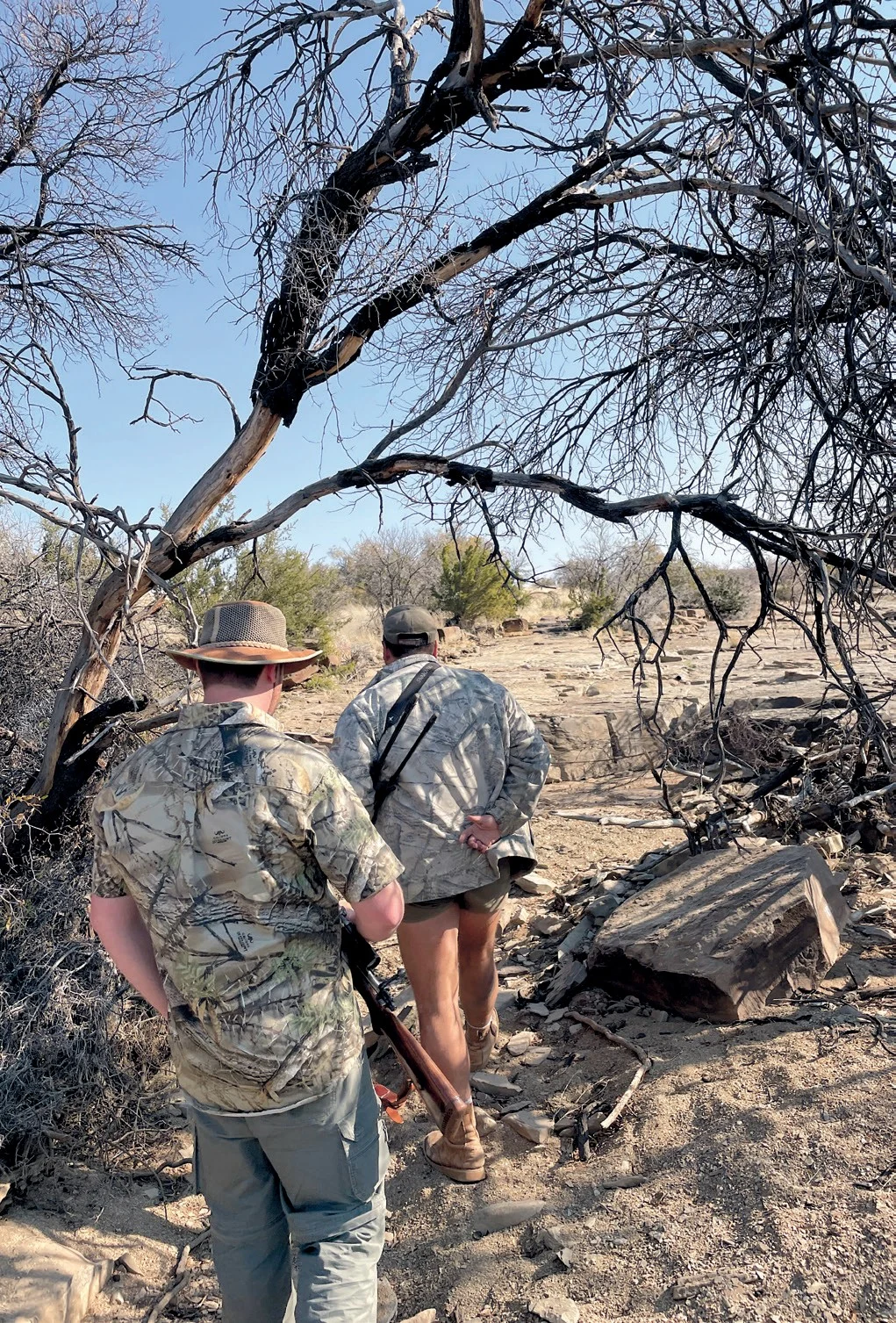
Careful fieldcraft remains essential, particularly when encounters are less frequent. Walk slowly, pause often and avoid brushing against dry branches, kicking loose stones or moving noisily through dry grass when a quieter route is available.
Limited visibility in thick bush can tempt hunters to move too quickly. A measured approach gives you more time to identify animals, assess their behaviour and avoid disturbing them unnecessarily.
If the wind changes or an animal becomes alert, stop and reassess. Continuing regardless may turn a promising encounter into a missed opportunity.
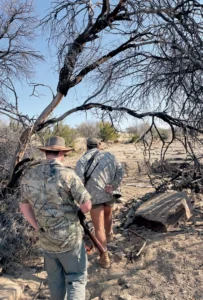
Protect yourself if you plan to walk-and-stalk in extreme heat.
MANAGE HEAT BEFORE IT MANAGES YOU
Hunting in extreme heat carries real risks. Dehydration, heat exhaustion and heatstroke can develop during strenuous activity, particularly when hunters underestimate how much fluid they lose through sweating.
South Africa’s National Department of Health addresses these risks in its National Heat Health Action Guidelines. The guidance supports practical precautions such as drinking sufficient fluids, reducing strenuous activity during extreme heat, seeking shade and recognising signs of heat-related illness.
Drink water regularly rather than waiting until you feel thirsty. Carry more than you expect to need, and plan your route so you can return to a vehicle or camp without becoming stranded far from assistance.
Wear lightweight, breathable clothing that protects against the sun, thorns and insects. A hat, suitable footwear and sunscreen are useful additions. Include a small first-aid kit and a reliable means of communication in your equipment.
Take regular breaks in the shade, particularly when walking uphill, carrying heavy equipment or tracking an animal over difficult ground. Watch your hunting partners as well as yourself.
Headache, dizziness, unusual weakness, nausea and heavy sweating may indicate heat exhaustion. Stop the hunt, move the affected person into shade and begin cooling and rehydration if they are fully conscious and able to drink.
Confusion, collapse, seizures or altered consciousness are medical emergencies and may indicate heatstroke. Seek emergency medical assistance immediately and begin rapid cooling while help is arranged. Do not leave the affected person alone or continue hunting.
No animal is worth putting a life at risk. If official weather warnings or conditions on the ground make hunting unsafe, postpone the outing.
ADJUST YOUR EXPECTATIONS TO THE SPECIES AND CONDITIONS
A strategy that works for impala on an open property may be ineffective for kudu in dense bush or warthog in terrain with suitable burrows. Impala and blue wildebeest may be easier to glass when feeding in open areas, while kudu often make use of thick vegetation. Warthog activity varies according to habitat, shelter and local conditions.
The scientific evidence reinforces the importance of these differences. The 2023 study investigated springbok, kudu and eland in Namibia, while the 2024 study examined how the same species allocated their time to feeding, resting and other behaviours during extreme heat. Neither study establishes a definitive timetable for impala, wildebeest or warthog on South African hunting properties.
Conditions also differ between farms. A property with several reliable water sources and abundant shade offers different opportunities from a dry area where animals must travel further to meet their needs.
Speak to the landowner or professional hunter about recent sightings, current conditions and where your quarry has been active. Local knowledge is particularly valuable during prolonged hot spells, when animal behaviour may differ from what you would expect in cooler weather.
THE WINNING STRATEGY: HUNT THE CONDITIONS, NOT THE CLOCK
Extreme heat changes the pace of a hunt, but it does not mean the bush is empty. It calls for patience, careful observation and selective movement.
Start early, use the late afternoon wisely, glass from suitable vantage points and let fresh tracks and other signs guide your decisions. Treat water sources, shaded resting areas and natural travel routes as clues rather than guarantees.
Above all, stay hydrated, recognise the limits imposed by the weather and never allow the desire to fill a hunting tag to override safety or ethical hunting practices.
In the northern provinces, patience and sound fieldcraft will often serve you better than kilometres walked. When the bush is at its hottest, the hunter who understands when to move — and when to sit still — may be the one who makes the most of the day.