







30 September 2026
Sabatti shotguns – value for money from Italy
BY BRIAN REILLY – Chances are excellent that if you entered a gun shop anywhere in the world, approached the shotgun rack blindfolded and stuck out your hand, the gun you grabbed would be of Italian manufacture. Granted, the Brits still turn out excellent guns, as do the Belgians, Germans and other European manufacturers, but almost all at staggering prices.
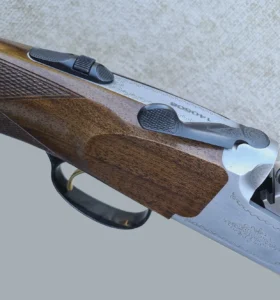
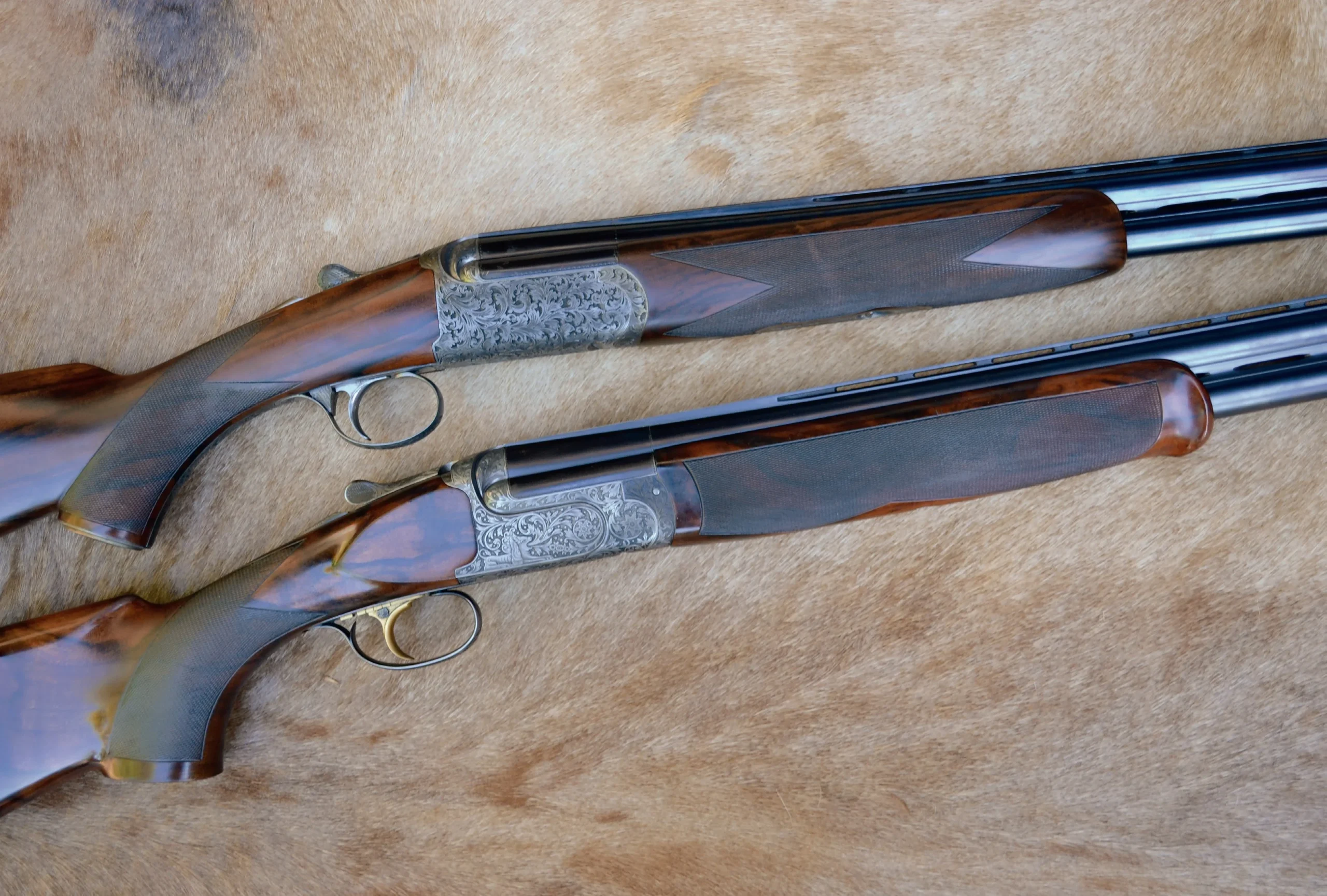
The Sabatti Falcon is aimed at those looking for an all-round gun that will do the job in the field as well as on the clay range.
The Japanese also produce excellent copies of John Browning’s over-and-under, and American-made guns tend to favour the American market. The Spanish also churn out shotguns of a wide variety and quality. Those originating down the order from some other countries always seem to lack quality, particularly their steel, and some are therefore not very hard-wearing.
It would be true to say that the Italians dominate the market in over-and-unders. However, we need to delve a little deeper before getting to the subject of this article: the latest offerings from Sabatti, located in Via Alessandro Volta, Gardone Val Trompia, Brescia, Italia – an area synonymous with Italian gunmaking.
The Italians have been making guns in the same place since the 1700s, but it was after the Second World War that they began their rise to prominence in the over-and-under market, with the USA being the prime customer.
Early post-Second World War Italian manufacturers made over-and-under actions based on the Browning B25 action but with side hinge pins or modified Kersten actions mimicking the German Merkel action. By the 1960s, variations of these two became universally known as “guild” actions. These were, by definition, common and familiar and appeared on any number of guns from origins not clearly defined but derived from somewhere in this part of Italy.
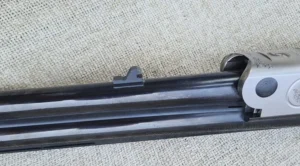
The blueing on the barrels was well done and should last a long time.
EXCEPTIONS TO THE RULE
There were some exceptions to this, namely Beretta, who, with their S55 design with tapered locking pins on either side of the breech, produced a very shallow action employed to this day. Even their higher-end SO and ASE guns used a modified Greener/Kersten lock-up system.
This was combined with the monobloc barrel construction system pioneered by Beretta in the 1920s, soon to be adopted by other Italian manufacturers. It greatly simplified barrel construction and led to them dominating the over-and-under market.
Of course, the Americans were not averse to stamping their names on guns made in Italy, with Weatherby guns made by Zoli. When quality issues arose, they shifted to SKB in Japan, and today, their guns are made by Fausti. This pattern was followed by Atlas Arms, LL Bean, Abercrombie & Fitch and Sig-Arms, to name but a few, all following the same route.
Beretta have gone their own way in action development, and many high-end Italian manufacturers like Perazzi, Gamba, Famars, Perugini & Vissini, and more recently, Kemen, still use versions of the 1916 Boss “everlasting” actions with their bifurcated lumps and pivoting-on-action-body hinge pins as opposed to Woodward’s 1910 original design with hinge pins on the barrels. Top-end British firms are also not averse to having their over-and-under guns made in Italy.
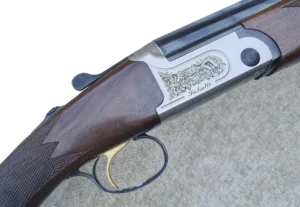
The Sabatti Adler is meant as a field gun, and its light weight reflects this. The selector switch/safety combination on the Sabattis strongly reminds one of the similar arrangement on the Beretta guns of a decade or two ago.
FOCUS ON SABATTI
Back to the topic: we recently received two of the newest Sabatti offerings to test: the Adler and Falcon models.
They both feature Anson & Deeley-type boxlock actions with “A tassello inferior” – essentially a Browning-style bottom lock with the action height reduced by having the hinge pins or trunnions at the side of the action rather than the full bottom hinge pin of the Browning.
The big difference between the two is that the Adler’s action is machined from 7075 aluminium alloy to create a light field gun, referred to as the “mountain gun”, which conjures up ideas of chasing greywings all day. The Falcon’s action consists of high-strength steel.
An interesting aside is that the 7075 aluminium alloy was developed in secret by Sumitomo in Japan in 1935 and reverse-engineered by the Americans in 1943 after examining downed Japanese aircraft. It became the industry standard in 1945 for all aircraft manufacture.
Today, it comprises about 6% zinc, 2,5% copper and 1% magnesium, as well as traces of silicon, iron, manganese, titanium, chromium and other metals.
Both guns can be had in several options: straight or pistol grip stock, single-selective or double triggers, with the Falcon available in 12- and 20-bore with 3″ (76 mm) chambers, while the Adler also comes in 28-bore and .410-gauge with 2¾” (70 mm) and 3″ (76 mm) chambers respectively.
In the 12s we received, the Adler was a full pound (455 grams) lighter. Both had 28″ (71 mm) monobloc barrels and I could not find an option for a different barrel length.
The Adler we tested was a single-trigger, non-ejector with interchangeable chokes and weighed in at 2,6 kg (5 lbs 12 oz); astonishingly light for a modern 12-bore.
The length of pull was 37,5 cm (14¾”), with the stock having a 5 cm (2″) drop at heel with very little pitch or cast. This should fit most adult male shooters.
The gun comes with multi-chokes and this one was fitted with ⅜ (0,714″) in the bottom barrel and ¾ (0,696″) in the top barrel.
Both had ventilated, full-length ribs, the bores were chrome-lined and, as always, Italian guns always have exceptional blueing. The checkering was crisp and, by all accounts, done by hand with a matt oil finish and attractive though limited rolled and hand-finished acanthus-scroll engraving.
The Falcon weighed in at 6¾ lbs with similar stock dimensions and finish and, if anything, slightly less engraving. The triggers were crisp and released at 4¾ lbs (2,2 kg).
Clearly, these guns have different applications – the Adler is a light field gun to be carried all day while the Falcon is your multi-role 12-bore over-and-under for the odd round of clays and hunting, with the steel action clearly designed for heavier use and better longevity.
With the guns, we received a range of Eley’s new clay cartridges that will be the subject of another review article. I adjourned to Wattlespring Gun Club with the Sabattis for that most unpleasant of work – testing the guns on the range!

Brian testing the Sabatti guns at the Wattlespring Gun Club to the east of Pretoria.
The sporting range operational on the day was not the easiest – it had the five stands on top of a container. There were two very technical birds that most shooters would struggle with.
With my Browning, I would expect to average a 22 on this range, and with either gun, I was able to get to 19 fairly easily – not bad going for new and unfamiliar guns.
The ejectors on the Falcon functioned flawlessly and were well timed. The safety selector is the spitting image of the old Beretta S56E selector, which has a habit of moving ever so imperceptibly off its mark and rendering the gun completely safe. One has to develop the habit of actively thumbing it to the stop every time.
The Adler, with its light weight, did wallop the shoulder a bit and one would certainly feel it if you shot a round or two on the clay range. Granted, lighter loads are available, but I would consider this gun a field gun only.
In summary, both guns, being priced at retail at around R30 000 for the Adler and R31 000 for the Falcon, would be considered entry-level but perfectly serviceable over-and-under guns with not much below them, pricewise, other than second-hand options.
Looking at the market, the Sabattis were in the same league as some of the other entry-level guns available from Italy, Spain and Turkey. As a matter of fact, the only thing I could find that was less expensive was the new Webley & Scott 900B, which, by all accounts, is also made in Turkey, as is the ATA.
For the first-time buyer, I would suggest one take a long, hard look at the Falcon as an option for an all-round shotgun. The Adler would make a good field gun but is perhaps a touch too light for regular use on the sporting clay range.
(This article was published in the January-February 2025 of SA JAGTER/HUNTER)