










7 September 2026
George Gibbs and the .505 Rimless Magnum
BY JOHAN VAN WYK – The firm of George Gibbs is well known not only for making best-quality rifles and shotguns, but also for some significant developments in the field of firearms.
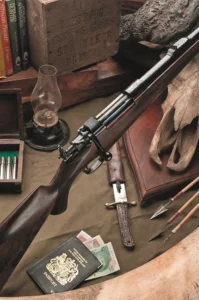
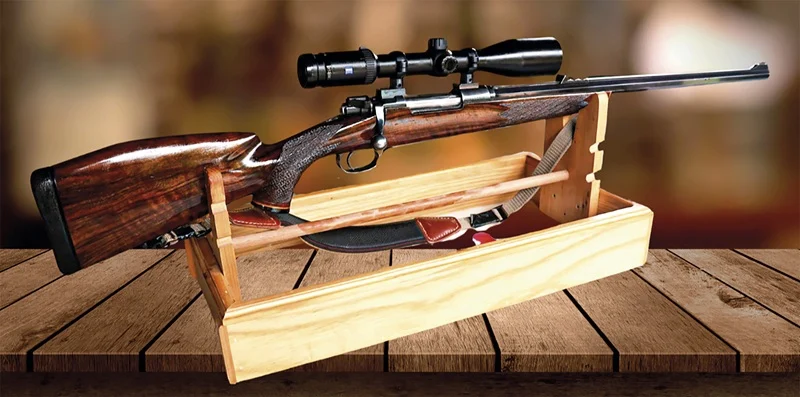
A modern .505 Magnum by George Gibbs Ltd. The rifle was manufactured using a Granite Mountain M98 Magnum Mauser action. (Photo courtesy of M. Crudgington/George Gibbs Ltd.)
The firm dates to 1830 when it was known as J&G Gibbs, located at 4 Redcliffe Street, Bristol. Thereafter, Gibbs moved several times. In 1835, the firm became the sole property of George Gibbs, and in 1858, it was relocated to 29 Corn Street. In 1906, a London branch was opened at 35 Saville Row, right in the heart of fashionable London.
Due to demand, a company agent, Col. Townley, was appointed as branch manager in Vancouver, British Columbia, circa 1920. In 1929, however, almost certainly due to the onset of the Great Depression, the London branch was closed and all remaining stock was sold off to John Rigby & Co. Simultaneously, Gibbs relocated again to a new address in Bristol, situated at 37 Baldwin Street.
During World War II, these premises were bombed by the Luftwaffe during the Blitz, resulting in the loss of much of the company’s ledgers and other records. Somewhere along the line, bankruptcy and a move to yet another address also featured.
SUCCESSFUL COLLABORATIONS
In 1872, a Scottish gamekeeper by the name of John Farquharson patented a design for a single-shot, falling-block action. A year later, George Gibbs became the co-owner of the patent and started making military, target match shooting and hunting rifles on the Gibbs-Farquharson action.
Even though fewer than a thousand original Gibbs-Farquharson actions were made, Gibbs spared no expense, and some of the target match shooting and hunting rifles are absolute works of art. Workmanship was of the highest quality and on par with anything produced in Britain at the time. Today, original Gibbs-Farquharson rifles are very rare and much prized by collectors the world over.
The 1870s were good years for George Gibbs. During this period, he collaborated with Thomas Pitt, the factory foreman, and in 1873, they entered a joint patent for “improvement in Breech Loading firearms”. Their design was for a lever-cocking action, and they set up in business as Gibbs & Pitt, a union which lasted until 1890.
Approximately 10 000 guns and rifles were made on the Gibbs & Pitt action by Gibbs and other makers, and they are encountered from time to time on the used-gun market.
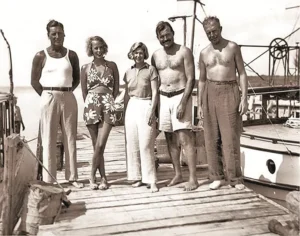
Bror von Blixen-Finecke, standing on the far right, next to his friend Ernest Hemingway. Blixen was a keen user of the .505 and Hemingway wrote about the cartridge in several of his books and short stories.
MADE FOR BIG GAME
The development of the Mauser M98 Magnum action in 1899 at the behest of John Rigby & Co. for their rimmed .400/350 NE cartridge not only revolutionised bolt-action design but opened new possibilities in cartridge design.
After moving on from the .400/350 NE, Rigby introduced their very successful .416 Rigby in 1911. The .416 fired a 410-grain bullet at 2 371 fps for just over 5 000 ft-lbs of muzzle energy, thus matching the popular .450-.470 NE class of double rifle cartridges in terms of muzzle energy.
Mauser engineers adapted the Magnum Mauser action with a special magazine and floorplate, enabling a magazine capacity of four .416 Rigby cartridges. The .416 Rigby was and remains a very popular cartridge to this day, and the Magnum Mauser action was a vital cog in the whole process.
Rigby, however, weren’t the only gunmakers interested in the Magnum Mauser action. Since Rigby were Mauser’s agents in Britain at the time, they had first choice of Mauser’s products and sold actions to other makers at a premium. This did not deter altogether, however, and makers such as Holland & Holland, W.J. Jeffery & Co. and Westley Richards sold rifles chambered for the .375 H&H Magnum and .404 Jeffery cartridges during this time.
When less expensive, military-surplus, standard-length M98 actions became freely available, however, these were quickly opened up for use with the .375 and .404. For cartridges like the .416 Rigby, a longer action was required, and the M98 Magnum was a prerequisite.
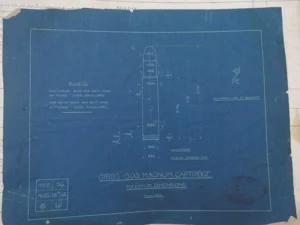
The original blueprints for the .505 Magnum cartridge dated 18 August 1913. (Photo courtesy of M. Crudgington/George Gibbs Ltd.)
In blueprints dated August 1913, George Gibbs, with the help of Eley-Kynoch, the British ammunition manufacturer of the time, listed specifications for a new cartridge called the .505 Rimless Magnum that fired a 650-grain bullet as well as a 525-grain bullet, loaded with 90 grains of cordite in the latter instance, in both steel-jacketed solid and soft-nose configurations.
Along the way, a load with a 600-grain bullet powered by 80 grains of cordite was also tried, but it was found to have excessive recoil and poor penetration. This is presumably why the 650-grain load was also dropped along the wayside.
Although the first two batches of 10 rifles appear to have been proofed for a 600-grain load, the 525-grain load at 2 300 fps from a 26″ barrel was eventually settled on. With a more pointed bullet with less bearing surface, the recoil was stiff but manageable, and the .505 Rimless Magnum was off to a good start.
The Gibbs .505 Rimless Magnum is one of the largest cartridges ever housed in a bolt-action rifle and the largest cartridge ever housed in the Magnum Mauser action. It has an 80 mm case with a base diameter of 15,34 mm and an overall cartridge length of 97,79 mm.
Such a big cartridge stretched even the limits of the M98 Magnum action, and it is the largest commercial cartridge ever housed in Mauser’s largest action. Gibbs used the No. 20 Magnum Mauser action for the .505, the same action that Rigby chose for the .416 Rigby. The magazine capacity was three cartridges.
At the time of its introduction, the .505 Magnum was the most powerful bolt-action cartridge in existence. Its 525-grain load delivered a hefty 6 168 ft/lbs of muzzle energy, over 1 000 ft/lbs more than the .470 NE with its 500-grain bullet, and produced a stiff 87 ft/lbs of recoil from an 11 lb rifle.
The cartridge’s intended market was, without any doubt, the game fields of Africa with their abundant herds of elephant, buffalo and other big animals.
Before the new cartridge could be used properly on the Dark Continent, however, something more important intervened: war. World War I put the brakes on the British gun trade. Many factories switched over to wartime production to help the war effort and the demand for sporting rifles and cartridges naturally dropped to virtually zero during the war years.
It was only after the end of hostilities in 1918 that the demand for sporting rifles began to pick up again. Notwithstanding hostilities, approximately 30 Gibbs .505 rifles were made and sold prior to World War I.
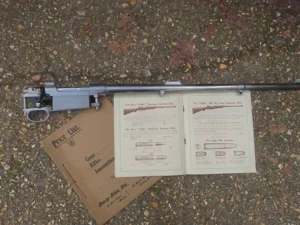
Another modern Gibbs .505 Magnum in the making. (Photo courtesy of M. Crudgington/George Gibbs Ltd.)
POST-WORLD WAR I
Original Gibbs .505 Rimless Magnum rifles are big, sturdy pieces of equipment intended to function in the rough and tumble of the African bush. All the ones I’ve seen were fitted with massive 26″ barrels and stocks from dense, heavy walnut with long, sturdy fore-ends for gripping the rifle securely under recoil.
Interestingly, I have yet to see an original .505 fitted with a strengthening cross-bolt through the recoil lug of the stock for additional strength. This is because they have a massive recoil lug tinned onto the barrel, giving between 4″ and 6½” of solid wood without the weakening of the magazine box to take the recoil.
A few of the rifles I have come across had clearly seen A LOT of work over the years – in one case, so much work that we couldn’t even measure the twist rate of the barrel as there wasn’t much of the rifling left! Yet none of them had a cracked stock, so the combination of strong wood and good inletting certainly worked well in the long run.
The front sling swivel was mounted on the barrel, just like it should be on a quality British bolt-action rifle intended for dangerous game. One standing, wide-V backsight with two folding leaves was standard fit as well.
Another idiosyncrasy I have noted on most of the original Gibbs .505 rifles I have come across is that the square bridge of the Magnum Mauser action was filed off to give the rifles a rounded bridge, just like the military-surplus Mauser M98 actions used by most makers.
This was done on the pre-World War I rifles, but the inter-war rifles retained the square bridge. The original Gibbs .505 rifle in the accompanying photographs dates from the late 1920s and retained the square bridge.
I am at a loss to explain why this was done on the original pre-World War I rifles, but one reason is that there was no need for the square bridge, which was put on the sporting Mauser actions to facilitate the fitting of a scope mount into the square bridge.
Many African game departments were faced with the dilemma of dealing with overpopulations of elephant, buffalo and other big, dangerous animals during the inter-war period. Double rifles were available for purchase but were an expensive option, so the choice fell on the less expensive bolt-action rifle.
The .425 Westley Richards became popular in some countries, notably Uganda and Tanganyika (Tanzania), while other countries opted for the .404 Jeffery. The Kenya game department had at least five rifles in .505 Gibbs on their books after World War II, and the Bechuanaland game department bought 10 rifles in .505 Gibbs just before World War II.
Mark Crudgington, the current owner of George Gibbs Ltd., was kind enough to confirm both the number of rifles and the fact that he has evidence that lots of 10 000 cartridges at a time were bought directly from Gibbs and shipped to Africa after World War II.
Several professional hunters used rifles in .505 Magnum as their backup rifles. In modern times, Kevin Robertson immediately springs to mind as a user of the .505, as does Richard Harland. During earlier times, J.A. Hunter often used the .505, rating it highly, as did John Taylor.
Bror von Blixen-Finecke, a Swedish nobleman and professional hunter who was married to the author Karen Blixen from 1914 to 1925, also owned a .505. Blixen’s rifle, which was actually owned by Dick Cooper, a wealthy hunting client of Blixen’s, had a peep sight fitted and was at one time in the possession of W. Keith Neal.
Neal sold this rifle and a Jeffery .600 NE, also used by Blixen, to Holland & Holland in the mid-1970s. Both rifles are now in the USA, with the owners blissfully unaware of who previously owned them!
As Blixen was a friend of Ernest Hemingway, the latter wrote about the .505, and in the process started a few urban legends that unfortunately endure to this day.
In 1936, Hemingway’s The Short Happy Life of Francis Macomber was released. It is the story about a safari in Africa, a love triangle and a sad ending. Hemingway armed the professional hunter in the story, Robert Wilson, with a .505, and the rifle is woven into the storyline almost as an additional character.
On other occasions, Hemingway wrote about the .505, specifically the prodigious recoil allegedly developed by the cartridge, in terms that were downright frightening. Broken collarbones, shoulder dislocations and other serious injuries were apparently almost a given when shooting the .505.
Although the cartridge develops a stiff recoil, I have yet to hear of anyone suffering from a broken collarbone after having shot a .505. I have fired my share of .505s, all loaded with 525-grain Woodleigh bullets at the factory-standard 2 300 fps or thereabouts, and I can heartily confirm that although the recoil is stiff and I wouldn’t have liked to shoot the rifles from the bench, it is not unbearably so.
Loading the .505 with heavier 600-grain bullets is popular with some, but this option increases recoil rather dramatically.
What is not always appreciated is the fact that the .505 Magnum is a very accurate cartridge. When the newly constituted Kynamco needed a test rifle for their newly manufactured .505 ammunition, Gibbs provided a .505. Three shots landed under an inch from the bench at 100 metres using the open sights!
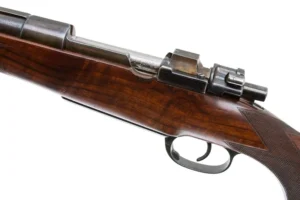
Just like the original Gibbs rifles, the Hoffman .505 Magnum is made on an M98 Magnum Mauser action.
COMPETITION
The first real competition for the .505 came from W.J. Jeffery & Co. in 1927. The 12.7×70 Schüler, introduced by the German firm of August Schüler, had been in production for several years when W.J. Jeffery & Co. decided to introduce the cartridge in Britain as the .500 Jeffery.
Whereas Kynoch loaded .505 Rimless ammunition for Gibbs, Gibbs retained it as a proprietary cartridge, which meant that ammunition and rifles were only available from them. Ammunition for the .500 Jeffery was loaded only by G.C. Dornheim (GECADO) in Germany.
Some regard the .500 Jeffery as an improvement over the .505 Magnum as it was loaded with German flake powder instead of bulky cordite, thus making a shorter cartridge that could fit into a standard-length M98 action a possibility.
The .500 Jeffery did take over the .505’s title as the most powerful bolt-action cartridge of the time, and it did fire a 535-grain bullet as opposed to the .505’s 525-grain bullet, but Jeffery insisted on making their .500s on Magnum M98 actions, just like the .505.
Be that as it may, it is doubtful whether any critter ever felt the difference in 10 grains of bullet weight and the slightly increased muzzle velocity that the .500 offered. The fact of the matter is that both the .505 and the .500 are immensely powerful cartridges that were, for the day, in a class of their own.
ACROSS THE ATLANTIC
The .505, despite being a proprietary cartridge, soon made passage across the Atlantic. James V. Howe, formerly of Griffin & Howe, started making up rifles in .505 soon after joining the Hoffman Arms Co. in Cleveland, Ohio.
He also began reloading for the .505, using the components at hand, presumably bullets sourced from Britain and loaded with HiVel #2 propellant.
When tested by the Frankford Arsenal ballistics laboratory in the mid-1920s, even Howe’s punchiest loads, a 525-grain bullet fired at 2 455 fps over the chronographs of the day, were found to deliver less than 46 000 psi of chamber pressure. The .505’s roomy case with its plentiful case powder capacity certainly allowed for upping the velocity when required.
Both Griffin & Howe and the Hoffman Arms Co. made up small numbers of rifles in .505 on Magnum Mauser actions. The rifle in the accompanying photographs is such a .505 and was made in the late 1920s by the Hoffman Arms Co.
The .505 was therefore certainly a known quantity in the USA, and there was enough of a market for the cartridge to warrant custom rifle makers turning them out, albeit on a modest scale.
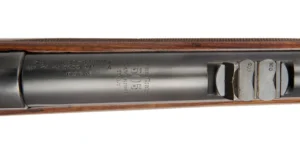
The calibre description and proof marks indicate that the rifle was proofed for a service load of a 525-grain bullet and 90 grains of cordite propellant.
POST-WORLD WAR II HEADACHES
The destruction of the Mauser factory by French occupation forces after World War II cut off the supply of Magnum M98 actions, causing immediate headaches for the makers of rifles chambered in cartridges like the .416 Rigby and .505 Magnum.
In the early 1950s, a Polish/French engineer by the name of Polonsky made the Brevex Magnum action on captured Mauser Werke machinery in two versions: the M300 with a bolt face and magazine tailored to the .375 H&H and similar cartridges, and the M400 for the .416 Rigby and .505 Magnum.
Only a few hundred Brevex actions of both descriptions were ever made, however, so they ran out after a few years.
Notwithstanding many years of production, only 75 or so original Gibbs .505 Magnum rifles were made up to 1965. The original ones are therefore rare and highly collectable, provided you can find one for sale.
In the modern era, Gibbs have used the Brno ZKK-602 action, Brevex actions and original Magnum M98 actions, as well as new actions by Granite Mountain Arms and Mayfair Engineering.
Also used as a one-off was the rarest of all: a Magnum Mauser action made entirely by Lewis Horwood of George Gibbs Ltd. and built into a rifle for an Arab client in the 1990s.
Today’s George Gibbs Ltd. can even provide a vintage but new Vickers barrel in .505″ if a customer so desires.
In Europe, makers such as Francotte, Mahillon and Dumoulin occasionally turned out .505 rifles, but these are few and far between. Finding a suitable action to house the massive .505 cartridge has always been the biggest limiting factor, as has been the cost aspect.
Magnum Mauser actions of any description have never been plentifully available, and they are all frightfully expensive.
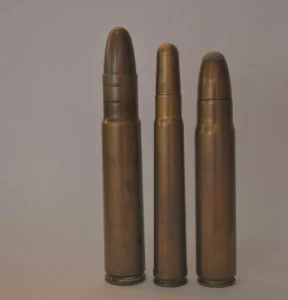
Left to right: .505 Magnum cartridge, .375 H&H Magnum cartridge (for comparison) and .500 Jeffery cartridge.
THE .505 MAGNUM TODAY
Besides a handful of custom loading operations, ammunition for the .505 is loaded by Hornady and Norma. Hornady uses their DGS and DGX bullets, while Norma offers a 600-grain Woodleigh soft-nose loading in conjunction with a 540-grain monometal solid option.
Cases are available from Bertram in Australia, and bullets in .505″ can be had from Woodleigh, Swift, Norma, Barnes, Hornady and a few others.
Reloading dies are another huge headache. RCBS, CH4D and Hornady manufacture dies for the .505, but they are hard to come by at the best of times and priced to match.
To the best of my knowledge, the only source of .505 factory rifles in .505 was CZ. However, the CZ-550 action is no more, and those who desire a .505 today are left with the option of a newly built rifle or searching for a second-hand rifle of sorts.
Many moons ago when I was a gun-struck South African schoolboy, word reached my father that an old-time elephant hunter with an “elephant gun” farmed just outside town.
My dad made a few phone calls, and one Sunday morning, we drove over to meet the elderly gentleman.
As it turned out, he and his family made annual pilgrimages to the vast hunting fields of Mozambique and Angola from the late 1940s into the early 1960s. Elephant for ivory and buffalo for meat were the primary quarries.
When I asked him what guns he used, he looked at me for a moment, briefly left the room and returned with a battered old Winchester Model 70 African in .458 Winchester Magnum, the first Winchester chambered for the .458 cartridge.
The old-timer explained that he was forced to buy the .458 when ammunition for his “big rifle” became scarce in South Africa in the 1950s.
When I asked him what his “big rifle” was, he handed me the old .458, left the room again and came back with a home-made leather bag that clearly contained a large rifle.
Unwrapping the bag, he slowly and carefully took out his “big rifle” – an original Gibbs .505 Magnum rifle, complete with the scars of a life lived in the African bush.
It didn’t have much blueing left on the metal and the stock was full of dents and scratches, but the old man handled the rifle like an extension of his right arm.
I couldn’t help but notice the smile on the old hunter’s face as he slowly worked the bolt and lifted the .505 to his shoulder. It was clear that his “George Gibbs .505”, as he called it, was an old friend.
That to me summed up the Gibbs .505 Rimless Magnum perfectly.
The cartridge was designed to take on the biggest and most dangerous of game animals. It was meant for use by dedicated hunters with a steady nerve and an appreciation of what it took to successfully hunt the big stuff and keep both your own hide and that of your client intact.
It is and always has been a specialised tool, but I suspect the .505 will be with us for many years to come.
Many thanks to Mr. Mark Crudgington, owner of George Gibbs Ltd., located in Pewsey, Wiltshire, in the United Kingdom, for his help with this article.