



11 September 2026
Bwana Bob-Robert Ruark – small-town boy who made it big
BY JOHAN VAN WYK – The world of African hunting literature has provided us with many talented writers over the years.
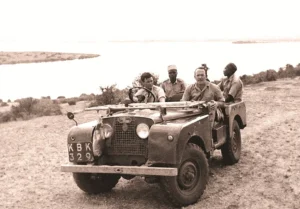
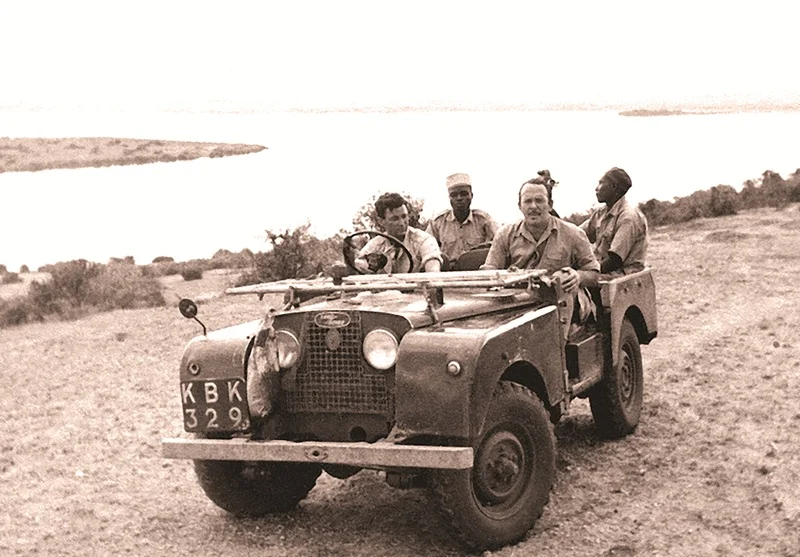
Harry Selby and Bob Ruark with Selby’s trackers. The Land Rover was the standard safari vehicle in those days.
Ernest Hemingway was the first to kindle the spirit of would-be hunting visitors to the African continent with his classic Green Hills of Africa. Hemingway also wrote a myriad of articles and short stories based on his travels while on safari in East Africa and elsewhere, and works such as The Short Happy Life of Francis Macomber and The Snows of Kilimanjaro will be with us for a long time yet.
In more modern times, Peter Hathaway Capstick’s Death in the Long Grass, first published in 1977, rekindled American enthusiasm for African hunting during a time of serious unrest and uncertainty in many parts of Africa. Capstick wrote several more books, but this one is by far the best known and continues to sell well to this day.
Notwithstanding the successes of Hemingway and Capstick, my submission for the most entertaining writer about Africa must go to another American author, Robert Ruark. Ruark came from humble beginnings and eventually rose to become one of the highest-paid columnists as well as an acclaimed novelist in later years. While his career may have taken off like a rocket, Ruark’s end was tragic and premature, as I shall explain.
EARLY DAYS
Robert Chester Ruark was born in Southport, North Carolina, on 29 December 1915. His father was a bookkeeper and his mother a teacher, but sadly, one was a crushing alcoholic and the other a drug addict. This meant that the young Robert Ruark spent a lot of time with his maternal grandfather, Captain Edward Hall Atkins. Atkins, a retired sailor and keen outdoorsman, first instilled in Ruark his love for the outdoors, especially wing-shooting.
Atkins featured prominently in Ruark’s “The Old Man and the Boy” stories, published by Field & Stream in 106 issues from 1953 to 1961. They are some of the most entertaining writings to be found, with plenty of humour and food for thought woven into them. These stories were later collected and published as The Old Man and the Boy and later The Old Man’s Boy Grows Older.
In 1930, at the age of 15, and shortly after the death of his grandfather, Robert Ruark enrolled at the University of North Carolina as a journalism freshman. The Great Depression was still in full swing, and times were tough for the young Robert. However, he persevered and graduated in 1935 with a degree in journalism, landing his first job as a reporter soon after. By the outbreak of World War II, Ruark was married to Virginia Webb and held the position of deputy editor of the Daily News in Washington.
WARTIME SERVICE AND BREAKTHROUGH
As was the case with thousands of other American men, the Japanese attack on Pearl Harbour on 9 December 1941 changed things irrevocably. Robert Ruark was no exception, and he joined the US Navy with the rank of ensign. He saw action as a gunnery officer on convoy escorting duty in both the Mediterranean and Atlantic theatres. By the end of the war, he was working in the Pacific theatre as a press censor.
After World War II, Ruark was employed by the Scripps-Howard Newspaper Alliance and was soon given his own column. This was the breakthrough he was looking for, and he quickly became not only famous but also earned very good money. This allowed him and Virginia to move into a New York apartment and rub shoulders with the rich and famous of the day. His first book, Grenadine Etching: Her Life and Loves, appeared in 1947.
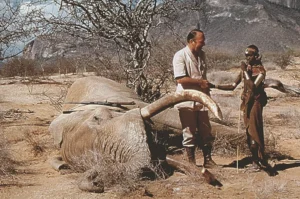
Robert Ruark with his last elephant, an impressive old bull with tusks of over 100 pounds a side. Ruark used a Jeffery double in .450/400 NE that had once belonged to the famous elephant hunter, W.D.M. Bell.
THE CALL OF AFRICA
Ruark was at the height of his fame, but this came at a price. By 1951, he was consuming too much alcohol, smoking excessively and generally needlessly punishing his body. The cure, he decided, was an African safari.
He ended up booking a two-month East African safari with Ker & Downey of Nairobi, one of the premier hunting outfitters in Africa then. Bob and Virginia Ruark set foot in Nairobi, Kenya, in June 1951 for their safari.
Their professional hunter would be a young and unknown hunter named Harry Selby, born near Frankfort, South Africa, on 22 July 1925. I’m pretty sure that neither Ruark nor Selby knew then that their lives would change dramatically in just a short span of time because of this safari.
The Kenya of 1951 was the last of what some have described as the “old” East Africa. Upon arrival, Bob and Virginia Ruark were taken to a tailor for custom-made boots and safari clothing. They were even invited to dinner by the American ambassador, so it was probably a relief when, a few days later, Harry Selby pointed the Land Rover’s nose south towards Tanganyika (now Tanzania), with the truck loaded with all the provisions for their safari, as well as the camp staff on the back.
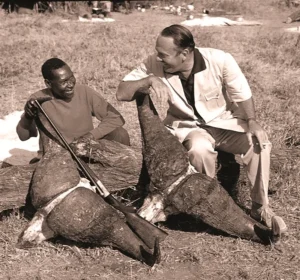
In addition to superb elephant, Bob Ruark also hunted numerous magnificent buffalo, such as these.
ARTILLERY
Weapon-wise, Ruark was well advised on his choice of rifles for the safari. As all members of the Big Five were on the menu, he rented a boxlock Westley Richards double rifle in .470 NE from Ker & Downey (renting an expensive double rifle from your safari company was commonplace in the Kenya of 1951).
In addition to the big double, Ruark also had a Winchester Model 70 in .220 Swift, a Remington 721 in .30-06 Springfield and another Model 70 in .375 H&H Magnum. As he was a keen birdshooter, there were also a couple of shotguns – a Churchill 12-bore for himself, and a borrowed Sauer 16-bore for Virginia.
What is interesting about Ruark’s choice of rifles is that they were all over-the-counter factory rifles. As he was a man of considerable means by 1951, he presumably could have had a custom gunmaker build him a battery of fine rifles to take on safari, yet he stuck to reasonably priced factory rifles. The combination of a .30-06 alongside a .375 H&H Magnum has also remained popular to this day.
Harry Selby is recorded by Ruark as using two large-calibre Rigby rifles, a double rifle, as well as a bolt-action in .416 Rigby. Also thrown into the mix was a 6.5 Mannlicher. Ruark’s vivid descriptions of both the .470 NE in his own hands and Harry Selby’s .416 Rigby quickly laid the foundations for the future popularity of both cartridges.
During the months-long safari, Ruark hunted two buffalo, two lion, a leopard and a selection of East African plains game. Upon returning home, he wrote the book Horn of the Hunter about the hunt in just over a month – no mean feat! It has been described as the best book ever written about an African safari, and it made an instant celebrity out of Harry Selby. At one point, Selby was booked five years in advance by hunters looking to experience the same type of hunt that Ruark did!
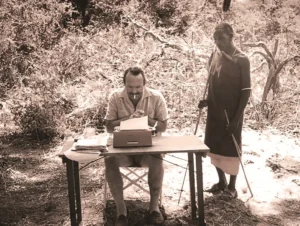
Ruark was a prodigious writer. Here he is in camp, typing away at his next column.
AFTER HORN OF THE HUNTER
On 3 October 1952, the Mau Mau rebellion in Kenya claimed its first victim when a woman was stabbed to death near Thika. The rebellion soon spread throughout large parts of Kenya, especially in areas with extensive European settlement, and this effectively put the country on a war footing. Consequently, many professional hunters were conscripted into the security forces, and hunting was subsequently curtailed.
Ruark soon heard about the Mau Mau rebellion and rushed to Kenya to report on it. He also made use of the trip to fit in a second hunt with Harry Selby in Kenya’s Northern Frontier District, then a large, arid and sparsely populated area on the Kenya/Somalia/Ethiopia border. The NFD, as the area was called, was home to large elephant and then-plentiful black rhino, two trophies Ruark missed out on during his first hunt.
Ruark leased the Westley Richards .470 NE again, and rather astonishingly, managed to hunt not only a fine rhino bull but also a 100-pound-a-side elephant bull – a true holy grail trophy if ever there was one.
At this time, Ruark was a very well-paid writer indeed. Long-time Field & Stream editor David Petzal wrote in a 2023 article for Gray’s Sporting Journal that Ruark was, at the time, paid the astronomical sum of $1 500-00 per instalment for his “Old Man and the Boy” column. That amounts to $17 000-00 in 2023 money, which is simply astounding! Ruark was, therefore, at the crest of his fame as a journalist, enjoying a wide readership and a very appreciative audience.
Ruark’s exposure to the horrors of the Mau Mau rebellion would lead to the novel Something of Value in 1955. The book dealt with the life of a fictional character called Peter McKenzie, rumoured to be based on a youthful Harry Selby.
Something of Value pulled no punches, however. In addition to plenty of fine guns and African hunting, it is also very graphic with extremely detailed descriptions of oathing ceremonies and other distasteful things.
Although Something of Value was criticised by many, it was a best-seller and made Bob Ruark a lot of money. It was even made into a movie starring Rock Hudson and Sidney Poitier, which netted Ruark thousands of dollars in royalties.
In addition to hunting in East Africa, Ruark also hunted extensively in Mozambique, notably with Wally Johnson Senior as his professional hunter. His writings about his Mozambican hunting were never as vivid as those about his East African hunting, though.
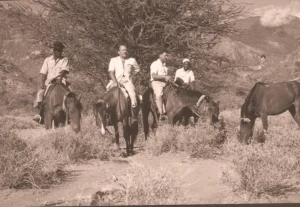
Selby and Ruark’s last hunt was a horse and camel safari into Kenya’s Northern Frontier District.
UHURU
In 1962, Ruark published what was to be his last novel, Uhuru. “Uhuru” means “freedom” in Swahili, and the novel deals with life in Kenya after the Mau Mau rebellion and with the British about to grant independence to the colony. Just like he did in Something of Value, Ruark didn’t pull any punches and didn’t hesitate to call a spade a bloody shovel!
In 1962, Ruark happened to be on safari in the NFD once more, again guided by Harry Selby. On the way to Kenya, Ruark stopped at the premises of Westley Richards just in time to find that they had been tasked with selling a few rifles from the estate of the late Walter Dalrymple Maitland Bell, the famous elephant hunter.
Ruark bought what was probably Bell’s last .275 Rigby, as well as a Jeffery boxlock double rifle in .450/400 (3″) NE. As Ruark was the godfather of Harry Selby’s son, he had both rifles inscribed with the words “MARK R. SELBY FROM YOUR UNCLE BOB” and gave them as gifts to Mark Selby. As far as I could ascertain, both are now owned by American collectors.
Ruark’s hunt with Harry Selby was a horse-and-camel safari, and they were on the lookout for another elephant. As it happened, they crossed the spoor of another 100-pounder near a place called Illaut in the NFD. Ruark used the W.D.M. Bell Jeffery .450/400 NE to kill the bull cleanly with two heart shots.
Returning to Nairobi after the safari had wrapped up, Ruark was informed that a senior Kenyan politician believed Ruark had defamed him by his writings in Uhuru and was in the process of instituting legal action against Ruark. Ruark flew to Johannesburg the same evening before papers could be served on him, however.
It would be the last hunt for Ruark with Harry Selby, who was on his way to a new life in what was then the Bechuanaland Protectorate (now Botswana), and the last time Ruark would see Kenya.
PROBLEMS
Just like his father and an uncle, Bob Ruark had been punishing his liver for many years and was a heavy alcoholic by this time. Alcohol was something he never shied away from in his writings, and his boozing was not something he was afraid to admit.
His doctors had advised him to quit smoking and drinking. In addition, he and Virginia had left New York for Palamós in Spain in 1960, where he bought a villa and a Rolls-Royce.
The drinking was getting to Bob and Virginia, however, and rather predictably, it started to take its toll on Ruark’s writing as well. A last novel, which was to be entitled Long View from a Tall Hill, was in the works, but nothing came of it.
In 1963, Virginia Ruark filed for divorce, but her alcohol abuse at that stage matched her husband’s. Ruark’s health was failing, and despite quitting drinking and smoking for a time, he fell off the wagon again.
In June 1965, Ruark travelled from Spain to London due to ill health, but on 1 July 1965, he passed away. The cause of death was cirrhosis of the liver. He was only 49 years of age.
LEGACY
After his death, Ruark was seemingly quietly forgotten by the world. He went from a much-in-demand and much-admired columnist, journalist and novelist to basically unknown. His books continued to sell on the second-hand market, but it was as if his legacy was slowly turning to ashes.
A collection of hunting and hunting-related stories entitled Use Enough Gun – Ruark on Hunting Big Game appeared in 1966. This was an effort by the executor of his estate to make money to pay off some of Ruark’s debts. It is, however, well worth the read and contains a few real gems from Ruark’s pen.
It was republished by Safari Press in later years and sold well, as did Horn of the Hunter when it was republished by Safari Press as well in 1989.
Then, in the 1990s, a few anthologies of his work began to appear. The first one, Robert Ruark’s Africa, was compiled and edited by the late Michael McIntosh and published by Countrysport Press in 1991. Another anthology, Robert Ruark – The Lost Classics, was edited by Jim Casada and published by Safari Press in 1996.
And just like that, Ruark was back at his best, writing with a virtually unmatched passion about Africa.
Although Ruark hunted extensively in the USA, India (where he was mauled by a wounded leopard) and Australia, it was Africa that brought out the best in him. One of his biographers, Terry Wieland (A View from a Tall Hill, Countrysport Press, 2000), places Robert Ruark in the spot as the foremost outdoor writer of the 20th century, even above Hemingway.
I’m inclined to agree, for what my opinion may be worth. Ruark is one of very few authors whose prose I can read and reread without tiring of it.
If you haven’t discovered Robert Ruark’s writings yet, I urge you to do so. Ruark’s demons may have gotten the better of him in the end, but his writings about Africa stand as tall as the day they left his typewriter.
As Dave Petzal rightly said, “Ruark was, quite simply, a genius. He was unable to write a boring sentence.” There is no denying that!
Photographs courtesy of Saeed Al Maktoum/www.accuratereloading.com