





16 September 2026
From the plains to the savannah – the .243 Winchester
BY JOHAN VAN WYK – It was one of those dry and windy winter’s days in the Eastern Cape’s open country. I had spent the morning fruitlessly searching for a springbuck ram, the last animal on my wish list for this hunt. A small cluster of rocks with a young thorn tree near the water’s edge provided the only bit of shade in the surrounding grasslands. I scratched out a little clearing with the tip of my right boot where I could sit down and rest my weary feet for a while.

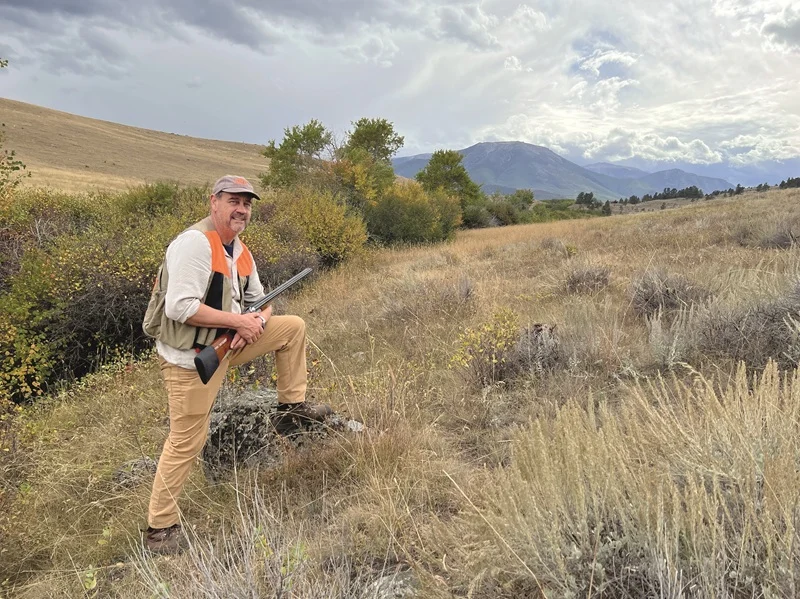
Here I am sitting next to the Maluti Mountains blesbuck ram mentioned in the text.
I was contemplating my surroundings, trying to banish thoughts of cool, frothy drinks from my mind as I sipped my lukewarm water, when a small and rapidly moving white dot caught my eye. The binoculars revealed a lone springbuck ram, typically feeding at almost full speed as he made his way in my direction. He was still far off, but I slowly raised the plastic-stocked Remington 700 to my shoulder, resting it over the rock against which I had been sitting. The rangefinder was also ready, showing the distance to be far. Too far. For the moment, I tried to relax and followed the lone ram through the scope as best as I could.
The ram would move at that typical springbuck running pace for short distances, stop and contemplate his surroundings before taking off again. The terrain was flat and open, but I was well camouflaged under the thorn tree and hidden by the rocks. I also knew that springbuck have phenomenal eyesight, so I kept as still as possible. When the rangefinder eventually showed that the ram had passed the 200-metre mark, I knew that the moment of truth wasn’t far off.
I watched the ram through the scope as he slowly got closer. At what looked to be around the 150-metre mark, he stopped, turned to my left and presented a broadside shot. I could see the grass waving in the breeze, so I allowed a crosshair thickness or two for the wind. With the crosshair just behind the ram’s shoulder and in the middle of his body, I slowly squeezed the Remington’s trigger.
The little Remington’s bark sounded almost muted in the open country, and there was no sound of the bullet hitting. The ram bucked briefly after the shot and took off in the direction he was facing, but he didn’t get far. I saw him collapsing after a short run, marked the spot and slowly gathered my things. According to my notebook, it was 168 of my long paces to where I found the ram in the grass. The bullet, a 90-grain Swift Scirocco, had exited after passing through both lungs.
That springbuck ram wasn’t the first animal I had hunted with the .243 Winchester, nor was it the last, but it was certainly the type of scenario that this cartridge’s designer had envisioned all those years ago.
ENTER THE .243 WINCHESTER
The first two 6mm rifle cartridges were the 6×57 Mauser from Germany and the 6mm Lee Navy from the USA, both introduced in 1895, and both long dead. While the 6×57 Mauser was intended for sporting purposes from the outset but failed to catch on, the 6mm Lee Navy was produced for the US Navy. Winchester manufactured approximately 15 000 rifles using the 1895 Lee straight-pull bolt-action, and although both Winchester and Remington briefly offered sporting rifles in 6mm Lee Navy, it is a dead horse today.
The .308 Winchester (alias the 7.62 NATO, 7.62x51mm or T-65 in military terms) was introduced by Winchester in 1952. It is, in effect, a shortened .30-06 and one of the most popular sporting cartridges of all time.
We have the late Warren Page to thank for the existence of the .243 Winchester as we know it today. Page, a well-known gun writer for Field & Stream in the USA and a contemporary of Jack O’Connor, was an avid wildcatter and necked down the .308 Winchester to .244″, calling the cartridge the .240 Page Super Pooper. Winchester took one look at Page’s creation, and in 1955, adopted it as the .243 Winchester.
Simultaneously, Fred Huntington, the man behind RCBS and the later Huntington Die Specialties, experimented with the .257 Roberts necked down to .244″. He called his creation the .243 Rockchucker, and the folks at Remington adopted this creation as the .244 Remington, also in 1955.
Whereas Winchester intended their adopted cartridge as a combination cartridge for varmints as well as smaller game such as whitetail deer and pronghorn antelope (or speed goats, as an American friend calls them), Remington envisaged their cartridge more as a varmint round for use with lighter 6mm bullets. The result was that the .243 Winchester was given a barrel with a twist rate of 1:10″ to stabilise bullets in the 90–100-grain weight class. Remington, on the other hand, went with a twist rate of 1:12″, making the .244 more suitable for use with lighter 6mm bullets. The .243 Winchester went from strength to strength in a hurry, whereas the .244 Remington languished and had to be reintroduced years later as the 6mm Remington, with a twist rate more suitable for use with heavier bullets.
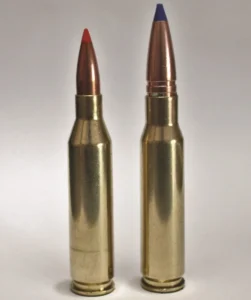
A .243 Winchester cartridge (left) next to its parent cartridge, the .308 Winchester. PHOTO: THINUS STEYN
THE .243 WINCHESTER IN THE FIELD AND ON THE RANGE
At first glance, the .243 Winchester with its tiny bullet looks almost puny compared to a 7mm Magnum, .30-06 or any of the .300 Magnums. This is a clear indication that it was never intended to fill the boots of any of these cartridges, but rather a niche of its own with various other applications. The .243 is actually quite versatile and does good work with bullets from 75 grains to as heavy as 105 grains in rifles with the standard 1:10″ twist rate. In rifles with barrels with different twist rates, the bullet weight can go down to as light as 65 grains or as heavy as 115 grains. This spectrum covers a lot of bases.
Some hunters, present company included, have used the .243 successfully on larger antelope such as kudu and black wildebeest. One very famous professional hunter even favoured the .243 as a leopard rifle! His reasoning was that, since the .243 delivered very low recoil, his clients were not afraid of shooting it, and the bullets therefore landed on target. Well, low recoil and good shot placement certainly always go hand in hand, but I’m 100% sure that I wouldn’t want to take a crack at a leopard with a .243!
With good, premium-quality bullets and proper shot placement, the .243 will slay large animals very effectively. I have done so myself, but ever since one sour experience with a black wildebeest, I have relegated the .243 to the smaller antelopes and the shooting range in favour of heavier artillery. The fact that the .243 can and has killed animals as big as eland in the hands of some certainly doesn’t anoint it as the ultimate eland cartridge.
When loaded with frangible, lightweight, varmint-type bullets, the .243 Winchester and other similar cartridges are extremely effective on problem animals such as baboon, lynx and jackal. Indeed, the .243 is a favourite choice among those who regularly hunt such creatures.
Loaded with heavier bullets, say from 90 grains and up, the .243 Winchester is an excellent choice for springbuck, blesbuck, mountain reedbuck and other similar critters, especially in more open country. Just one caveat, though: the .243’s lightweight bullets can be wind sensitive if the wind starts to push on the open plains. I remember one hunting trip for springbuck in the eastern Free State where a friend used his .243 in very gusty conditions. He filled his quota, but getting the .243’s bullets on target took some effort.
Many also use the .243 Winchester in the bushveld. My dad was fond of the now-discontinued round-nose 105-grain Speer Hot-Cor bullet as well as the older-style round-nose 100-grain Nosler Partitions at a moderate muzzle velocity for impala and the like in the bush. This combination worked, but it is in more open country that the .243 really starts to shine.
On the shooting range, the .243 can be a pleasure to work with. With the aforementioned Remington 700 .243 Winchester, I found early on that the rifle had an affinity for the 85-grain Sierra GameKing hollow-point boat-tail bullet. When loaded to 3 150 fps in Winchester cases with S-365 propellant and CCI200 primers, the rifle shot exceptionally well. This Sierra bullet is marketed as a hunting bullet, but I’m afraid to say that my experience in this regard was not very rosy…
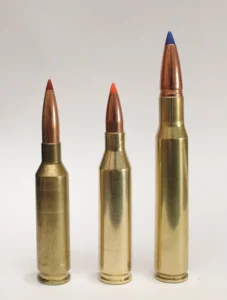
A 6mm Creedmoor cartridge (left) next to a .243 Winchester cartridge (middle), with a .30-06 cartridge (right) for comparison. PHOTO: THINUS STEYN
On a cold, blustery morning one year in July, I found myself lying on a rocky ledge overlooking a valley in the Free State’s Maluti Mountains. Besides me, professional hunter Christo Roos was watching a herd of blesbuck grazing below us through his Zeiss binoculars. There was a very nice ram at the far end of the herd, and the Leica rangefinder showed the distance to be just under 300 metres. I had a good, solid rest, so with the crosshairs a touch low for the downward angle and some Free State windage thrown in for the mountain breeze, I squeezed the trigger.
We clearly heard the bullet striking the animal in the quiet mountain air and the ram collapsed in his tracks. The sound of the shot echoed around the mountains and the herd milled about, not quite sure where to go next.
“Shoot another one!” was the order from Christo. A big ewe stood broadside, and with a similar aim than for the ram, she also dropped in her tracks.
Both animals had been shot squarely through the shoulders, but the meat damage caused by the Sierra bullets, even at just shy of 300 metres, was something to behold. The shoulder meat was severely bloodshot and bruised, and I immediately set about finding a more fit-for-purpose hunting bullet for the .243.
I eventually settled on the 90-grain Swift Scirocco. The Scirocco is an aerodynamic, bonded-core boat-tail bullet with a polymer tip, and with a grain less S-365 propellant than what I loaded for the 85-grain Sierra, they left the barrel at 3 110 fps and shot beautifully. I hunted a lot of game with the 90-grain Scirocco, and it worked to perfection. It is a bullet that I would recommend without hesitation to anyone looking for a hunting bullet in .244″, but the availability of Swift bullets can be a challenge in South Africa.
Over time, I grew slightly weary of the Remington .243’s lightweight barrel. I eventually sold it in favour of a Winchester Model 70 Coyote Light with a Bell & Carlson synthetic stock and a medium-contour, stainless steel barrel. Strangely enough, the Winchester did not like the 85-grain Sierras one bit but took to the 90-grain Swifts very well. A bit of experimentation with the Winchester showed that the Hornady 87-grain V-Max bullet in Winchester cases, CCI200 primers and S-385 propellant were the preferred choice, and this combination became my go-to load for gongs and paper.
The Winchester’s stainless steel barrel took about 80 shots and plenty of judicious scrubbing to tame, but once the initial phase was over, the rifle behaved as advertised. It’s a nice combination, and the short control-feed action offers additional peace of mind.

Paul Pretorius with a springbuck ram hunted with his trusty Sako Deluxe in .243 Winchester.
A POPULAR AND LONG-LASTING CHOICE
Over the years, other 6mm cartridges have also seen the light of day. The 6mm Creedmoor is starting to get more popular in some circles, and if you want the ultimate in 6mm-related fire and brimstone, Roy Weatherby’s .240 Weatherby Magnum is still available. If you want to go to the trouble of shooting a rifle chambered for a wildcat cartridge, contenders such as the 6mm Dasher and a few others are available as well.
The .243 Winchester is one of the most popular cartridges in the world today. Its recoil is manageable, making it a good choice for youngsters and those who don’t like too much recoil or muzzle blast. In addition, ammunition for the .243 Winchester is widely available throughout South Africa, making it a good choice for the hunter who doesn’t reload. Reloading components are widely available as well.
When used within its limitations, the .243 Winchester is a fine cartridge, and I predict that it will still be with us after the demise of many of the newer commercial or wildcat 6mm cartridges.