
14 September 2026
A Boertjie’s walk and stalk Montana turkey hunt
BY DANIE GROBLER – Outwitting a gobbler takes some effort.
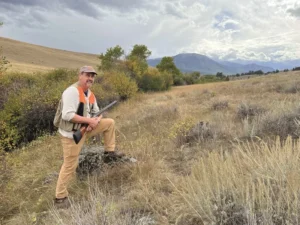
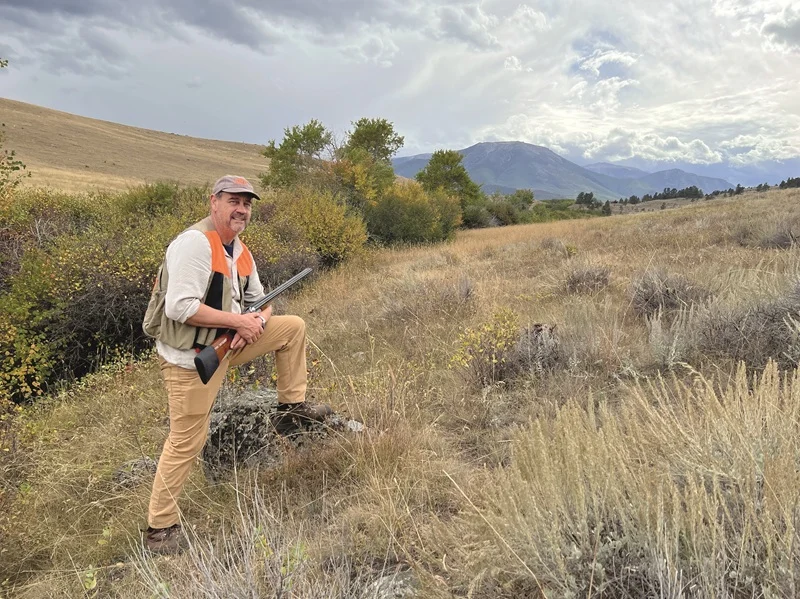
Going for upland birds in sage country. Part of the Beartooth Mountains is visible in the background.
Many moons ago, back when ESPN still meant “actual television” and not an app, I used to waste many hours watching North American hunting programmes. Most of them felt like they came from another planet.
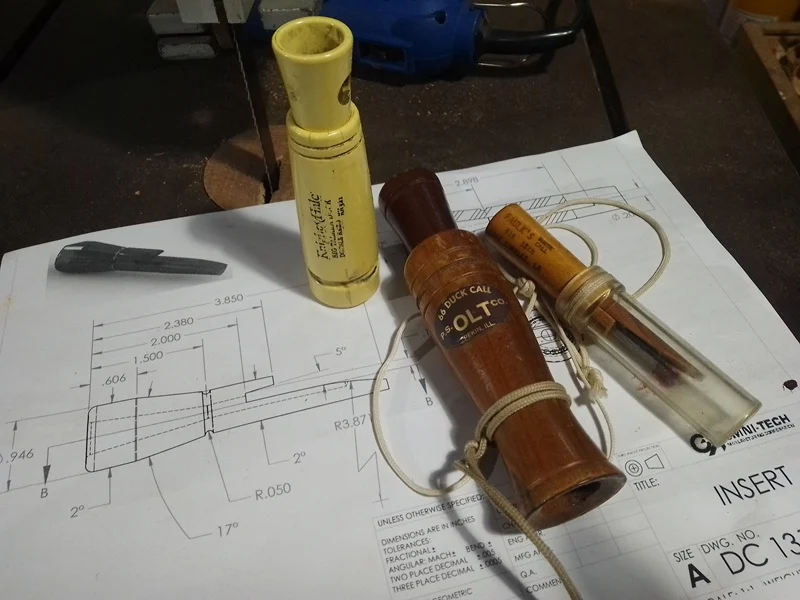
What always baffled me were the animals Americans hunted and the peculiar ways they went about it. Turkey hunting never failed to make me stop and stare. Maybe it was the manic gobbling and unhinged cackling the toms make during the breeding season, or maybe it was the spectacle of grown men dressed like badly assembled shrubs, crouched in pine forests while whispering sweet nothings (in “turkey language”) into bits of plastic and wood.
To most of us bushveld hunters, the whole thing looked unwell. Sitting on the ground, calling birds with Primos “box caller” gizmos? Surely not. Try that back home and see how far you get! Picture yourself calling in a guineafowl or an ostrich. Or, if you really want to test your medical aid, a kudu bull. The idea alone is enough to earn you a quiet intervention from your hunting mates. And yet, for all the mockery, it kept pulling me back.
A bit of late-night internet searching revealed that the American wild turkey (Meleagris gallopavo) is far more interesting than its barnyard reputation suggests. It is a true North American original and part of the galliform clan – birds that clearly prefer scratching around on the ground to flapping about in the sky. They are solidly built, stubbornly terrestrial creatures with powerful legs, short wings and the flying ability of something that only does it under protest.
When startled, they explode into the air, and when the day is done, they sensibly roost in trees, well out of reach of anything with four legs and canine teeth.
The Spanish first ran into wild turkeys in Mexico and the southern United States in the early 1500s and promptly decided Europe needed some. Somewhere between the docks and the dinner plates, Europeans convinced themselves these birds came from the Ottoman Empire, now called “Turkey”, and the name stuck despite being gloriously wrong.
In 1758, Carl Linnaeus finally gave the bird its official title, Meleagris gallopavo, which loosely translates to something like “guineafowl pretending to be a peacock, but is really just a chicken”.
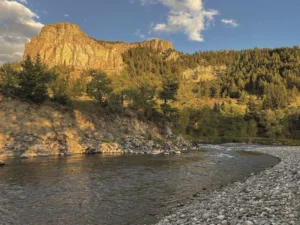
The view from our Airbnb below Castle Rock on the bank of the Stillwater River during the last week of summer.
TWO SURVIVING COUSINS
As it turns out, there are only two living species in the genus Meleagris: the widespread wild turkey and the far more flamboyant ocellated turkey of the Yucatán Peninsula. Genetic work suggests the two parted ways a couple of million years ago, and fossils hint at extinct cousins that once strutted about Pleistocene North America.
Modern DNA studies have also settled the final argument around the fire, where every domestic turkey on the planet traces its ancestry back to wild birds from southern Mexico.
Which means that somewhere, deep in a pine forest, a suspicious, foul-mouthed bird with a head like a sunburnt raisin is the reason entire families argue over dry white meat once a year. And that, I suppose, is when I stopped laughing quite so hard at the men in ghillie suits.
Regular readers of SA Jagter/Hunter magazine may recall that, for the past few years, I have found myself in the somewhat enviable position of managing a mineral exploration project in south-central Montana, USA.
Being foreigners, however, we operate with only a vague understanding of the full maze of American hunting regulations – a system so complex it could qualify as a mineral resource in its own right
So, you can imagine my surprise when I casually heard one afternoon during a relaxed coffee break that turkey season was, in fact, open.
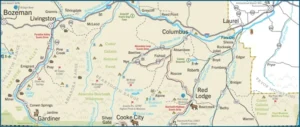
Our hunting focused on the area between the small towns of Roscoe, Absarokee, Fishtail and Nye in the Carbon and Stillwater counties. The ancient Bozeman Trail passed through this area, with several historic points indicated on Highway 78 from Red Lodge to Columbus.
MORDERN TURKEY COUNTRY
A quick internet search told me that an “out-of-state” turkey tag would set me back about $130. I was still processing that information when my American colleague Justin Modroo casually mentioned that he’d be happy to take me turkey hunting – and that I could borrow his 12-gauge side-by-side Charles Daly Superior Grade gun.
At that point, common sense stopped contributing to the conversation.
Downloading turkey regulations from the Montana Fish, Wildlife & Parks website was easy enough, but understanding them was another matter entirely.
In the US, everything hunting-related is regulated. There are seasons for rifle, bow, crossbow, black powder, handgun, and combinations I’m convinced were invented purely to confuse outsiders. Each species has its own booklet, and ignorance is not considered a valid excuse. Which is why foreigners like me need a local.
Fortunately, Justin from the small town of Red Lodge stepped in. With his guidance, I dashed into the local ACE Hardware store just before closing time. During the online registration process, the cheerful salesperson casually remarked, “These turkeys only look stupid. Hunting them isn’t always that easy.”
I also bought a box of No. 3 shot shells. No gun licence. No questions. Nothing. As a hopelessly over-regulated South African gun owner, I nearly needed a moment to lie down.
A few minutes later, I walked out with my first $130 out-of-state turkey tag. My tag covered the fall season (1 September to 1 January) and allowed either sex in Region 5 (Stillwater County).
On our last Friday of the summer, Justin and I slipped away from work and tried a nearby piece of state land along the West Fork of the Stillwater River. It was close to our project office near Nye and required minimal driving, always a good sign.
We stalked through black cottonwood, quaking aspen and lodgepole pine, surrounded by whitetail and black bear or grizzly sign that suggested everything else was thriving nicely. Except turkeys.
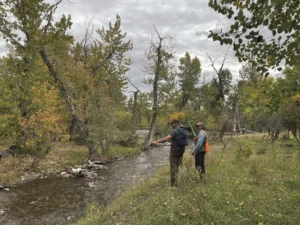
Albie and Justin staring at trout along the West Fork of the Rosebud River while hunting turkey. Both are prolific, highly experienced fly fishermen.
By late afternoon, having found absolutely nothing, we called it a day.
Saturday morning, Albie, a friend and colleague, joined the hunt. We left our Airbnb at Castle Rock early to meet up with Justin and his dad, Allen, at the office near Nye.
Driving into town, I glanced up and saw several large birds roosting high in a cottonwood. Turkeys. Right there.
Less than a hundred metres, or rather yards, from the town centre. We had spent the entire previous afternoon searching the bush while the birds probably sat above our heads, laughing quietly.
Heading toward Fishtail, we spotted more turkeys on a ranch. Justin stopped to ask permission, which is normal here. Unfortunately, this was a horse farm, and hunting was out of the question.
Further along, we stopped at the Lannen Ranch, part of a block management area. The paperwork was simple: fill out a pink tag, keep it on you and return it afterwards.
We hunted along the West Fork of the Rosebud River. Allen wandered off to try upland birds in the feedlots. We bumped some whitetail deer, but the turkeys remained mythical.
Filling up with gas at the Rockin J, our spirits were low. We decided to try upland birds near the Beartooth foothills, only for me to realise I didn’t have the right tag.
Justin laughed and pointed out that tags were sold right there at the gas station. I bought a three-day upland licence for $50.
The terrain was steep, brushy, and at an elevation that made both Albie and me question our life choices. Again, the birds refused to cooperate.
On the way back, while driving, I was helping Allen to buy a second-hand, premium-grade Italian Rizzini over-and-under shotgun over the phone at the Scheels outdoor shop in Billings. I had spotted the beautiful gun there the previous week.
The next moment, Justin, who drove the car ahead of us, turned sharply off the road.
Albie had spotted turkeys in the tall grass along Highway 78.
Justin quickly turned into the ranch homestead and asked the landowner for permission to hunt, which was promptly granted. Suddenly, things got serious. We were going hunting!
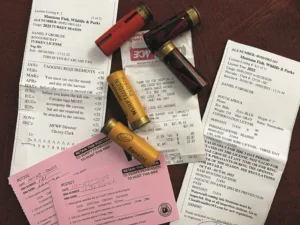
My turkey and upland bird tags, and the receipt for the box of ammunition bought for the occasion.
ON THE HUNT
We slipped into the riverine forest of the East Fork of the Rosebud River. The birds blended perfectly with the leaf litter and shadows. We moved slowly, bushbuck slow.
Eventually, we spotted movement at about 60 yards – six or seven birds, but no obvious tom. The lead hen suddenly froze. I feared the moment was gone. Some thick brush ahead obscured any shot I had. Justin was positioned left of us.
I motioned for him to take a .22 shot if possible. He fired and the bird ran into an opening. I followed up with the shotgun. Bird down.
With another valid tag and time running out, Justin motioned me to chase the rest. The vegetation thickened near the river’s edge. Birds scattered.
I finally spotted a large bird in tall grass and took a head shot, the only clear option.
Holding that heavy turkey in dense undergrowth, the absurdity and reality of it all hit me at once: I had hunted a turkey. In Montana. Most importantly, with my American friends!
Not every Boertjie gets a chance like that!
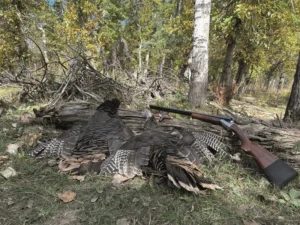
The spoils of our turkey hunt – enough meat for Thanksgiving and Christmas dinner.