








15 September 2026
SA’s free-roaming cheetahs: fewer than thought, more important than ever
BY LIZANNE NEL – “Conservation begins with knowing what we have.” This is a simple statement, yet one that lies at the heart of every successful wildlife management programme. For South Africa’s free-roaming cheetahs, obtaining that knowledge has taken four years, nearly 100 000 km² of fieldwork, millions of camera-trap photographs and the cooperation of hundreds of private landowners.
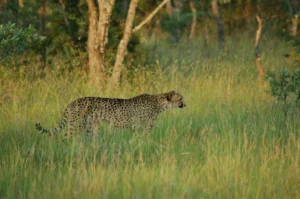
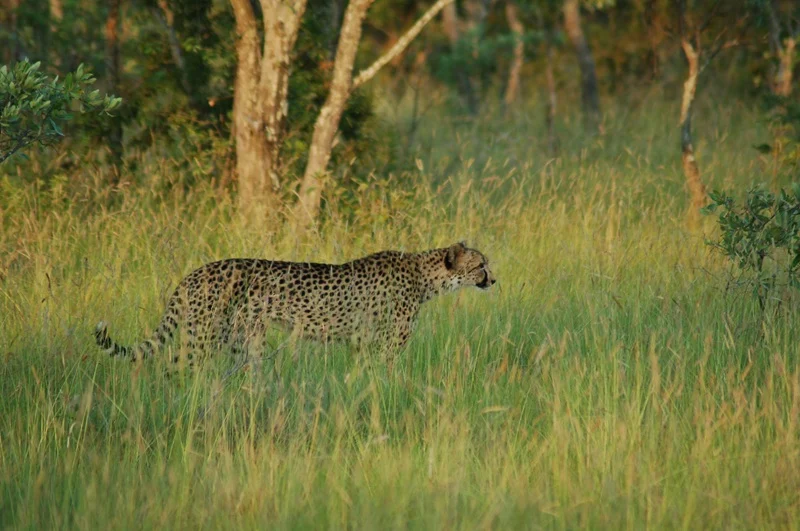
Unlike lions or African wild dogs, many of South Africa’s free-roaming cheetahs survive beyond the boundaries of national parks. PHOTO: NIC DE BRUINE
The recently completed Free-Roaming Cheetah Census (2022–2025) has fundamentally changed our understanding of one of South Africa’s most iconic predators. For years, conservation planning relied on estimates suggesting that around 300 free-roaming cheetahs survived outside formally protected areas. The new census paints a more sobering picture, confirming a minimum of 119 individual cheetahs which were identified, including just 83 mature adults.
Importantly, this is not evidence of a sudden population crash. Rather, the study replaces broad estimates with the first scientifically robust baseline against which future population trends can be measured, as well as a minimum population number.
CONSERVATION BEYOND PROTECTED AREAS
Unlike lions or African wild dogs, many of South Africa’s free-roaming cheetahs survive beyond the boundaries of national parks. They occupy a mosaic of game ranches, livestock farms and communal land across the Northern Cape, North-West and Limpopo provinces. These working landscapes have become some of the country’s most important conservation areas.
To better understand this population, researchers from Ashia Cheetah Conservation, the Cheetah Outreach Trust and the University of Groningen undertook the largest survey of its kind ever conducted in South Africa. Over four years, they deployed 389 camera traps, analysed more than 5,2 million photographs, collected genetic samples, fitted satellite collars and interviewed 299 landowners across almost 99 800 km².
The project would not have been possible without the support of private landowners. Many members of the South African Hunters and Game Conservation Association (SA Hunters) participated by granting access to their properties, hosting camera traps, reporting sightings and sharing valuable local knowledge. Their contribution demonstrates the important role that hunters and game ranchers continue to play as partners in conservation science.
BETTER SCIENCE, BETTER CONSERVATION
Previous estimates of the free-roaming cheetah population were based largely on extrapolations from smaller studies. By surveying an enormous landscape and identifying individual cheetahs through their unique spot patterns, researchers were able to produce the first reliable estimate of the national free-roaming population. This has established the minimum number of individual free-roaming cheetahs in South Africa.
This distinction is important. Good conservation depends on accurate information. Overestimating populations can create a false sense of security, while reliable data enable conservationists and policymakers to focus resources where they are needed most.
HUMAN ACTIVITIES REMAIN THE GREATEST THREAT
Although cheetahs have adapted to living in agricultural landscapes, coexistence with people remains challenging.
The census found that 86% of known cheetah mortalities were caused by human activities, including illegal persecution, snaring and vehicle collisions. Researchers estimate that approximately one in five known adult cheetahs died during the 3½-year study period, with the true figure likely being even higher because not every mortality could be confirmed.
These findings reinforce the importance of responsible wildlife management, effective law enforcement and constructive relationships between landowners and conservation organisations.
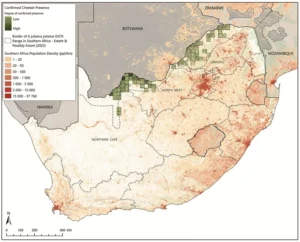
Map of confirmed cheetah presence overlaid with human population density across South Africa. The overlap underscores the increasing constraints on suitable habitat and the challenges of long-term survival. (Map: National Cheetah Survey).
WHAT DO FREE-ROAMING CHEETAHS REALLY EAT?
One of the most fascinating aspects of the census examined one of the longest-standing debates surrounding predators on farmland: Do cheetahs regularly kill livestock?
Rather than relying on anecdotal reports, researchers used modern DNA technology to analyse the diet of free-roaming cheetahs. They collected 164 scat samples, of which 106 were genetically confirmed as cheetah. Prey DNA could be identified in 54 samples, providing the clearest insight yet into what these predators were actually eating.
The results were surprising. Every identifiable prey item consisted of wild game species. Researchers found no DNA from cattle, sheep, goats or chickens in any of the confirmed cheetah samples, despite many animals occurring on livestock farms.
More than half of the identified prey consisted of small- to medium-sized indigenous game, while the remainder reflected the most abundant wild prey available in the surrounding landscape.
The study does not suggest that cheetahs never kill livestock. Individual incidents undoubtedly occur and can have significant consequences for farmers. However, the findings indicate that livestock predation by cheetahs may be considerably less common than is often believed.
The report also notes that livestock losses can easily be attributed to the wrong predator. Leopards, black-backed jackals, caracals and feral dogs all prey on livestock, making careful investigation essential before management decisions are taken.
This is an important lesson for both wildlife managers and livestock producers. Sound conservation depends on objective evidence rather than assumptions, and tools such as camera traps, spoor identification and DNA analysis are helping replace perception with science.
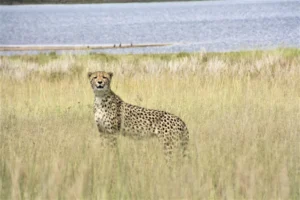
Rather than relying on anecdotal reports, researchers used modern DNA technology to analyse the diet of free-roaming cheetahs.
HUNTERS AS CONSERVATION PARTNERS
The census also highlights the importance of collaboration. Private landowners, wildlife ranchers and many SA Hunters members contributed directly to the project by sharing observations, allowing access to their land and supporting fieldwork.
Their participation reflects a principle that has long underpinned South Africa’s conservation success: wildlife survives because people choose to conserve it.
Responsible hunting and wildlife ranching provide incentives to maintain healthy habitats, conserve indigenous wildlife and invest in long-term stewardship. These working landscapes are increasingly recognised as vital components of South Africa’s conservation network.
LOOKING AHEAD
The report also draws attention to increasing habitat fragmentation. Expanding infrastructure, fencing and agricultural development restrict the movement of cheetahs and reduce opportunities for genetic exchange between populations.
Maintaining connected landscapes, conserving natural habitat and supporting healthy populations of wild prey will therefore remain central to the long-term survival of free-roaming cheetahs.
WHAT HUNTERS AND GAME RANCHERS CAN DO
Every landowner can contribute to cheetah conservation by doing the following:
- Conserve natural habitat and maintain landscape connectivity.
- Manage healthy populations of indigenous wild prey.
- Use camera traps and systematic wildlife monitoring.
- Capture all cheetah sightings on the SA Hunters App.
- Investigate livestock losses objectively before undertaking predator control.
- Report predation incidents to the conservation manager of SA Hunters, Lizanne Nel, on 076 797 2530 or to Deon Cilliers of the Cheetah Outreach Trust on 082 853 1068.
- Remove wire snares and report illegal activities.
- Support scientific research and long-term wildlife monitoring.
- Promote responsible, science-based wildlife management.
- Participate in predation management forums.
A SHARED RESPOSIBILITY
The Free-Roaming Cheetah Census provides the clearest picture yet of one of South Africa’s most elusive predators. While the population is smaller than previously believed, it is now far better understood.
Perhaps the greatest lesson from the study is that the future of South Africa’s free-roaming cheetahs lies not only within protected areas, but across the country’s privately owned farms, game ranches and communal landscapes.
The willingness of hundreds of landowners – including many SA Hunters members – to work alongside researchers demonstrates that conservation is most successful when science and responsible land stewardship go hand in hand.
For members of SA Hunters, this should be a source of pride. Hunters and game ranchers are not merely beneficiaries of wildlife – they are among its most important custodians. By maintaining habitat, supporting research and embracing evidence-based wildlife management, they are helping ensure that future generations will continue to witness one of Africa’s most magnificent predators roaming freely across South Africa’s landscapes.