























29 September 2026
Black magic – making sense of a specialised subject
BY PIERRE VAN DER WALT – For most of us, night optics represent black magic. This is simply because we have not taken the trouble to familiarise ourselves with these devices. They are not particularly complicated. Night optics are increasingly applied in the fields of anti-poaching and problem animal control, and we can flow with the times or fall behind. In this article, I will endeavour to lift the lid enough to take the apprehensive edge off at the risk of oversimplification.

The HikMicro Alpex 4k night-vision riflescope offers day and night application, rangefinding out to 1 000 metres from the bubble on the objective lens and ballistic information with a self-adjusting aiming point.
TYPES
The most important thing to understand is the difference between night-vision devices and thermal devices.
NIGHT-VISION DEVICES (IMAGE AMPLIFICATION OR INTENSIFICATION)
Night-vision optics were originally known as “starlight optics” because they rely on ambient light. The ambient light may consist of infrared light provided by an infrared “torch”, or natural light from sources such as the moon or stars. The device then electronically amplifies the light falling on and reflected from the object viewed to enhance and modify the reflected light into the visibility spectrum of the human eye, which can see light with a wavelength between 400 and 700 nanometres (nm). The human eye sees only a very small portion of the entire spectrum of ambient light.
This light energy picked up by the objective lens of the optical device is referred to as photons. A photon is a name Einstein gave a discreet unit of radiant energy. The photons (light energy) pass through the objective lens, which focuses it on the so-called image intensifier (photocathode positioned behind the objective lens). The photocathode converts the photons (light energy) to electrons (electrical energy). The racing electrons are then disturbed to cause collisions between them. The turbulence knocks additional electrons off a microchannel system, and an electron cascading effect is achieved. The higher the number of electrons cascaded/created, the better the image becomes.

Black Hot is basically the reverse of White Hot in the thermal colour palette.
Due to the wear and tear of the knocking-off in the microchannel, night-vision devices have a finite lifespan.
From the above, it should be obvious that night vision (image intensification) is impossible in total darkness and the absence of ambient light. To overcome this, infrared (IR) torches or so-called “IR illuminators” were created. They provide “light” in the infrared spectrum required for night vision to work, or additional light in low-light conditions.
IR illuminators are generally offered in two nanometre strengths: 850 nm or 940 nm. Illuminators emit light in the 700–1 000 nm wavelength spectrum. The higher the wavelength, the less visible the light is to the human eye. The shortcoming of IR illuminators is that they are comparable to spotlights. The light provided reflects from interfering obstacles such as vegetation and it then becomes difficult to see targets beyond the interference.
THERMAL DEVICES (RADIATED HEAT IMAGING)
Thermal devices have sensors that detect the infrared energy invisible to the human eye radiated by objects. The radiated heat (energy) is a function of the object’s temperature. The device then electronically converts the detected photon temperature pattern into a so-called thermogram (heat picture). The thermogram is then digitised to be visible to the human eye on a screen.
This means that thermal vision is possible in total darkness, such as inside a closed vault, since it detects the heat picture of an object. However, any obstruction that screens the target object from the device sensors can prevent detection. For this reason, thermal imaging is not possible through obstructions such as windows. Theoretically, thermal devices can last forever.
Now that we understand the difference between night vision and thermal vision, we can proceed to some understanding of the numbers we are confronted with.
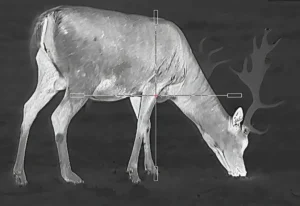
The White Hot palette is the most popular thermal option for general use as it provides great definition and clear images.
NIGHT-VISION DEVICE TERMINOLOGY
The terminology initially seems daunting, but it actually is not.
CMOS – This stands for “complementary metal-oxide semiconductor” and is just the digital device sensor technology description. Sensors are offered in different resolution capabilities, and the “image” collected is then displayed on a screen.
Sensor resolution – Electronic optics image quality is measured in pixels. You have a horizontal (listed first) and a vertical (listed second) pixel density. The higher the pixel values, the better the image, but there is a bit of a catch on the terminology side.
Allow me to explain. A million pixels constitute a megapixel (MP), but some or other person threw a spanner in the works. The night-vision realm has three common image quality (resolution) levels: 1 020 × 1 080, 2 560 × 1 960 and 3 840 × 2 160.
Simple? Yes and no.
1 020 × 1 080: It is actually known as a 1 080 P, which means the vertical pixel count is used. If we multiply the two values, we get to 1 101 600 or 1.1 MP. Why not call it that?
2 560 × 1 960: Sensibly listed as 5 MP because it has 5 017 600 pixels.
3 840 × 2 160: Normally listed as 4K! Heaven knows why because it actually has 8 294 400 pixels. Why they don’t just call it an 8.3 MP device defeats logic.
Screens – The screens on which the image is viewed by the user are normally either OLED (organic light emitting diode) or LCOS (liquid crystal on silicon) screens. This is much of a muchness, but OLED screens use less power, offer better contrast and are faster than LCOS screens. OLED screens are fast becoming the standard for night-hunting devices.
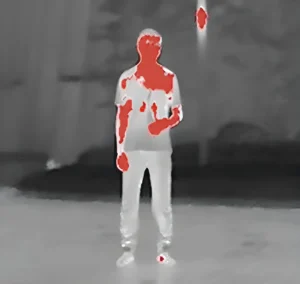
The Red Hot colour palette highlights the hottest part of the object viewed in red.
THERMAL DEVICE TERMINOLOGY
Thermal sensor resolution – Thermal devices commonly fall in one of three resolution categories, even if the exact horizontal vertical counts may differ somewhat:
Low: 160 × 120 (19 600) pixels.
Medium: 320 × 240 (76 800) pixels.
High: 640 × 480 (307 200) pixels.
Thermal riflescopes should deliver medium resolution, at the very least. Such devices can pick up heat signals to almost 2 kilometres! Man-sized objects can easily be identified to almost half a kilometre! High-resolution device detection ranges can exceed 2,5 kilometres.
Noise equivalent temperature difference – NETD tells us how sensitive the device is to temperature differences. This sensitivity is expressed in so-called milli-Kelvin with the symbol μM (or mK). The lower the μM number, the more sensitive the device is and the clearer the on-screen image, given the sensor resolution. On hunting devices, the μM value needs to be below 2 μM. The common NETD spectrum on hunting devices is in the region of 17–12 μM.
Display size – The display size refers to the dimensions of the device’s screen. This can be expressed as horizontal × vertical pixels or just the width in inches, i.e. 1 024 × 768 or 0.39″. The larger the display, the easier for ageing eyes to use.
Focal length – Focal length determines the field of view visible through the device. The longer the focal length, the narrower the field of view. For general scanning or surveillance, a wide field of view is best, but for actual shooting, a narrow field of view and on-target detail are essential. To offer the best of both, quality devices offer a picture-in-picture feature that enables the hunter to aim precisely yet track the fleeing animal after the shot on the wide screen.
Palette – Most thermal hunting optics offer images in several colour schemes (palettes) that enable the user to switch to a colour scheme optimal to the heat situation on the ground.
The most common palettes on current thermal devices are:
White Hot. A grey-scale image in which heat is shown as lighter shades of grey and cooler objects appear darker.
Black Hot. Another grey-scale image, but the reverse of White Hot. The warmer the object, the darker it appears.
Red Hot. The background can be grey-scale or other subdued colours, but the warmest parts of the object are highlighted in red.
Fusion. Represents the image and background in the light colour spectrum visible to the human eye, with yellow being the hottest and blue the coldest.
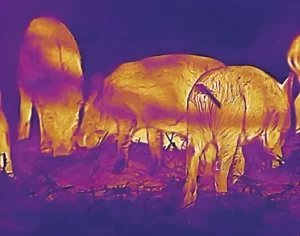
Fusion is a colour composition image providing the image in the 400-700 nm wavelength spectrum visible to the human eye.
The above information should enable the buyer to interpret the most critical technical specifications in brochures and have a meaningful conversation with the salesperson or fellow hunter. Form follows function, and the user must decide on the geometry of the device that he wants. For that, it is essential that the prospective user has a very clear grasp of his intended application so that he can choose from the following:
Hand-held monocular or binocular. These are suitable for searching or surveillance but lack reticles for shooting.
Tactical device. These devices are block-like but quite short and well suited to installation as aiming devices on assault rifle platforms.
Clip-on device. This constitutes a budget solution where the device is clipped onto a normal riflescope, but the integration between daylight optic and nocturnal device is somewhat complex and imperfect.
Integrated riflescope. A riflescope that can be used during the day and night. They are elegant and effective, and some models even offer ranging features. They also are the most expensive.
USER COMMITMENT
Nocturnal devices, be they night vision or thermal, are slightly more complex than traditional daylight optical devices because they are digital and work with a menu and button selectors.
Reading the manual is essential because you do not want to press a button and end up with your device set to Cantonese or Mandarin with no way to figure out how to revert to English!
UNDERSTANDING LIGHT AND NOCTURNAL DEVICES
If you have read up to here, you have a definite interest in understanding nocturnal optics and this article is not intended to make the reader an expert. It is aimed at providing a basic grasp, and for that reason, the reader needs to understand a few “nice-to-know” aspects of light and vision.
Light visible to humans can simplistically be described as light with wavelengths of the various colours of the rainbow – each colour having its own wavelength. Red, on the one end of the visible-to-human light spectrum, has the lowest energy (longest wavelengths) and violet, on the other end, has the most (shortest wavelengths).
Outside visible light, the electromagnetic spectrum continues, with infrared on the low end of the scale, and ultraviolet on the other – both beyond the perceptive abilities of the human eye. In other words – invisible.
The infrared part of the electromagnetic spectrum is generally divided into three categories:
Near-infrared. This lies closest to visible red with wavelengths between 700 nm and 1 300 nm.
Mid-infrared. With wavelengths between 1 300 nm and 3 000 nm.
Thermal infrared. This kind of infrared has wavelengths falling between 3 000 nm and 30 000 nm.
Unlike near- and mid-infrared, thermal infrared is actually emitted from an object. In other words, all matter radiates thermal infrared light.
Why is this and what is the significance thereof? Thermal infrared is emitted because of atom activity. All matter consists of atoms. An atom is made up of an electrically positive nucleus consisting of protons and neutrons. Around this nucleus orbits a cloud of electrically negative electrons at different orbit levels, depending on their inherent energy levels. When energy (such as heat) is applied to an atom, the electrons become excited by the energy they absorb and increase their orbit diameter. In other words, they start orbiting further from the nucleus.
This higher energy level is not the natural state of that excited electron, and it has the natural tendency to want to revert to its original (ground) state. So, as the source of energy (imagine a heater) that excited (heated) the electron fades or terminates, the electron ends up having more energy (imagine heat) than its immediate surroundings and it will shed that energy (cool down) in order to return to its ground state. When the electron releases the pent-up energy, it does so in the form of a release of a particle of light energy in the thermal-infrared spectrum.
That particle of light energy is called a photon – thanks to Albert Einstein.
An example. When steel is heated up, it turns red. The colour is the result of excited atoms emitting red photons in an attempt to return to their natural ground state. The heat of the object determines the actual wavelength (colour) of the photons released. The increasingly hotter an object becomes, the shorter the wavelength of the photons it releases until it can release photons within the visible electromagnetic spectrum.
Although the electrons in the atoms making up normal living organisms emit photons, they do not possess enough energy to emit them within the visible electromagnetic spectrum.
In simple terms, nocturnal vision devices pick up the photons. Night-vision devices convert the available photons to electrons, which are then cascaded (multiplied) to create a better image. Thermal devices, on the other hand, collect the wavelengths of the photon emissions of excited electrons and convert them to a digital image the human eye can see on a screen. In theory, it is that simple, even if the science is not.
(This article was published in the July 2024 edition of SA JAGTER/HUNTER)