9 June 2026
Always Be Prepared for the Unexpected!
By DOCTARI
Have a healthy respect for the unpredictability of the formidable big boys.
It was an afternoon in November 2016, and we were in the Southern African Wildlife College’s training area, located within Kempiana Private Game Reserve, a section of the Timbavati which is open to the Greater Kruger National Park.
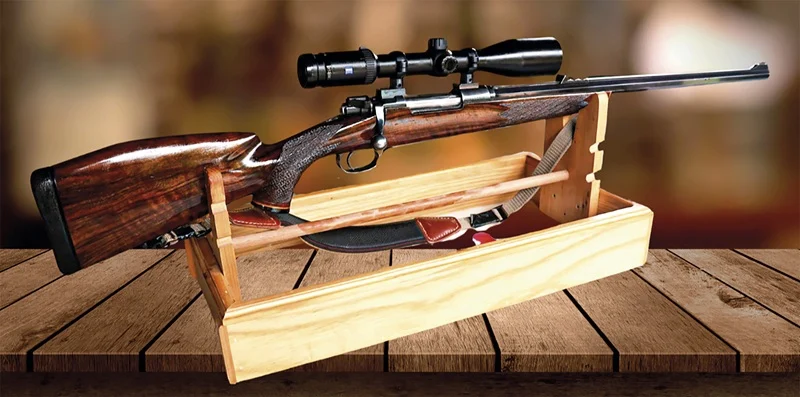
At the time I headed up the SAWC’s Sustainable Utilisation and Field Guiding department, and a group of our students were in the final stages of their 18-month professional hunting training course. In preparation for their final assessments the students were given the opportunity to conduct “practice” dangerous game hunts. On such occasions one student would be tasked to be the “tracker”, the second the “client” and the third the “PH”. To make such situations more realistic, the “client” carried a “rifle” – basically a piece of water pipe fitted into an old Brno stock.
Within the pipe was a laser pointer, so powerful that even in bright sunlight it could project a green dot more than a hundred metres far. Basic open sights were fitted to the contraption’s barrel and sighted in perfectly for dangerous game hunting distances. To take a “shot” all that was needed was for the “client” to aim correctly and when ready to shoot, a small button above the stock’s fore-end was simply pressed. The position of the resulting laser beam’s green dot on the target animal would then be photographed as proof of a successful “shot”.
The Southern African Wildlife College’s 4 000ha training area is regularly visited by the Big Five and all the Kruger’s plains game species. For training purposes students are allowed to walk in this area as long as they are accompanied by a suitably armed and qualified trainer. One such trainer is needed to protect every 4 students. On this particular occasion, the Greater Kruger National Park was in the grips of a severe drought. In such conditions, little ground cover remains which makes looking for tracks of the larger-hooved species easy. We did not have to go far before those of a lone buffalo bull were found – the ideal animal for such a “hunt”.
FOLLOWING THE TRACKS
I accompanied the three-student “hunting team” as the “tracker” took up the easy-to-follow bull’s tracks. So as not to disturb the whole process, my two departmental trainers and the remainder of the PH students followed at a discreet distance. After only a short tracking period, the buffalo bull was spotted up ahead as he walked slowly on a well-worn elephant path. It appeared as if he was walking towards a distant waterhole. Even from a distance it was easy to see he was in a pathetically poor body condition. With his job now complete, the tracker handed over to the PH who, with his client in tow, commenced the stalk.
With my .505 Gibbs over my shoulder, I ambled along behind the trio, observing their stalking methods. I could find no fault and soon we were within a reasonably comfortable 50m shooting distance from the bull. Despite his pitifully thin condition the bull supported an impressive set of wide-spreading, blunt-tipped horns and I listened keenly as the PH aged and trophy-assessed the bull for the benefit of the client. By this stage the bull was aware of the hunting party’s presence and had turned to stare at them, as only a buffalo can.
By doing so he presented a classic frontal chest shot. Up went the shooting sticks and with well-practiced movements the client was quickly in position to take the shot. I stood directly behind him, camera at the ready. As I would have expected, the PH described the correct shot placement position and enquired if the client was comfortable with the shot. The client confirmed he was and moments after the command, “OK you can shoot”, a green dot miraculously appeared on the bull’s chest, positioned perfectly. I was ready for this moment and caught it on camera. (Photo 1)
NOWHERE TO GO!
At that precise moment, the situation suddenly changed. With a shake of his impressive blunt-tipped horns the emaciated bull suddenly started coming towards us in a most aggressive manner. His body language very obviously portrayed a demeanour which clearly shouted, ‘Don’t point that thing at me – I’m coming to sort you all out!’
“Get behind me,” I shouted to the students as I dropped my camera and quickly stood ready with the .505 Gibbs. Already chambered in my Dumoulin was a cartridge containing a 600gr North Fork Cup-nosed Solid. I flicked off the flag-type safety catch and shouldered the rifle. While doing so I noticed an unsteadiness to the bull’s hind legs – he was rapidly coming towards us like a sprinting drunken sailor, while shaking his head from side to side in a most aggressive manner. His intentions were clear, he wanted to turn all four of us into strawberry jam!
With the students tucked in behind me we tried to back up, while collectively shouting “Hey, hey, hey!!” at the top of our voices. Our shouting had little effect on the bull and on he came. One of the many elephant-pushed-over knob thorn trees halted our backing up efforts. With us stuck against the thorn tree there was nowhere to go.
I had realised at the start of the bull’s advance that there would only be time for a single shot with my Dumoulin .505 Gibbs. I was also well aware of the consequences my trainers and I had discussed many times regarding the shooting, even if in self-defence, of an animal within the Greater Kruger National Park. The tongue-in-cheek consequences are simply this – if the animal does not kill you, the paperwork will.
IMPRESSIVE PERFORMANCE
What a predicament to suddenly be in. Initially, my hope was that our shouting would stop or turn the bull, but it soon became clear he had no intention of doing so. I was the only one armed, and the four of us were stuck in a fallen thorn tree! It was my responsibility to protect us all – so, I just waited until sure of a killing shot. When the bull was five paces from us, I sent a 600-grainer through his brain. The result of the shot was impressive – the bull simply dropped with his eyes wide open. He never moved again, not even the slightest twitch or tremor, nothing. Not even a blink. That big bullet had switched his lights off absolutely and instantly. It was the quickest death I’d ever seen with any animal.
Instinctively I reloaded but remained standing where I was. Before me lay the bull, totally motionless, so after a minute or so I took a couple of paces forwards and touched his one cornea with the muzzle of my rifle. There was no reaction whatsoever, the bull was stone dead.
As the adrenalin subsided and my heart rate returned to normal, I noticed that blood started to seep from the bull’s nostrils – strange I thought, for a frontal brain shot. (Photo 2)
My fellow trainers and the remainder of the PH students were soon on the scene. Together we examined the bull closely and the reason for his extremely aggressive demeanour and unsteady gate soon became obvious. The old bull had been mauled by a lion. There were four evenly spaced, deep puncture wounds – from a lion’s canines I suspected, two on either side of his prominent spine in the lumbar region and as we watched maggots started wiggling out of the holes, followed by watery green pus. This I’m sure was the reason for his unsteady running action, and why he was so thin. His whole body was also heavily tick infested – another sign that he was severely stressed and immune-compromised.
The local section ranger was duly summoned and when he arrived the situation was explained to him. Expecting to find myself in hot water I was pleasantly surprised when he said: “Heck man, I’ve been looking for this bull, he’s the one who yesterday charged and damaged a tourist vehicle. So, you did me a favour, many thanks, just write a report on the incident for my records. You can also have the carcass for educational purposes. Do a post-mortem to try and find out why your shot killed him so quickly.”
POST-MORTEM
This the students and I did. Although my shot looked off-centre, (the bull was still shaking his head when I fired) the 600gr cup-nosed bullet passed through the bull’s brain and exited the back of his skull. It then penetrated down the right side of his neck, smashed through the second thoracic vertebrae and entered the chest cavity. The bullet then passed through the left lung before lodging in the rumen. This is where it was recovered. (Photo 3)
The blood seeping from the bull’s nostrils was obviously from the bullet passing through his left lung. Interestingly, there was very little blood at the entry wound. While I did not realise it at the time, the reason for the bull’s instantaneous death was obvious – my shot had both scrambled his brain and severed his spinal cord in the shoulder region.
When the bull’s skull was finally cleaned up, I was surprised to discover that the bullet entry wound, and the exit one at the base of the scull are both exactly double calibre in size. Terminal ballistics has long been an interest of mine, but I’m still struggling to figure out how it is possible for a bullet, even one that has riveted due to its cup-nosed construction, to create holes through extremely hard bone twice as large as itself. I can only surmise a pressure wave ahead of the bullet “blows” such large holes open. (Photos 4 and 5)
By measuring the crown heights of the bull’s two lower-jaw, first molar teeth, we were able to determine that the bull was 11 years 6 months old at the time of the incident.
What an eye-opening experience the incident turned out to be for the three PH students. All of a sudden each had a very healthy respect for the unpredictability of these formidable black bovines! Most importantly though, they all went on to pass their final assessments with ease.