










7 September 2026
Check it out: An affordable, versatile scope for hunting and range work
BY THINUS STEYN – Recently, I had the opportunity to put the Lynx LX3 2,5-15×50 scope with the SA Hunters reticle through its paces, first on the shooting range and then on a hunt in the veld of the Southern Free State.
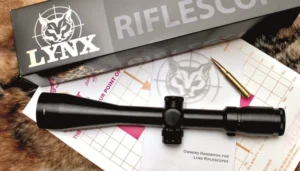
The Lynx LX3 2,5-15×50 is a versatile scope with excellent glass, a useful reticle for longer-range hunting and an illuminated centre cross for low-light hunting.
Lynx Optics is no stranger to South African hunters, and its rifle scopes, scope mounting systems and binoculars are popular with local hunters and sportsmen. The company has been active in South Africa since 1984. Lynx scopes are manufactured in Japan, with a full backup service in South Africa.
UNBOXING AND FIRST IMPRESSIONS
Living out in the country, we have no door-to-door delivery, so I collected the package containing the Lynx scope at the friendly farmer’s co-op in the Free State village of Philippolis.
This was not my first experience with Lynx scopes. I used to own a 3-9×40 that served me well, first on a .300 Winchester Magnum and then on my wife’s 7×57. That scope eventually went to my brother, who mounted it on a Ruger No. 1 in .300 Winchester Magnum and used it for years without any problems.
The LX3 2,5-15×50 came in a sturdy box with an owner’s handbook and a two-page instruction manual for using the SA Hunters reticle. The reticle instruction manual is in Afrikaans and English, while the owner’s handbook is in English only and quite comprehensive.
The manual explains how to focus the reticle, mount the scope properly and sight it in. It also explains MOA, parallax, and general scope operations and maintenance in detail. Also included is a neoprene-type scope cover.
The Lynx LX3 is sturdy, well-made and rather large, with an attractive matt black finish.
Specifications
- Magnification: 2.58x – 14.91x
- Eye relief: 99 mm
- Objective diameter: 50 mm
- Tube diameter: 30 mm
- Total windage adjustment range: 60 MOA
- Total elevation adjustment range: 60 MOA
- Length: 381 mm
- Weight: 780 g
- Anti-reflective lens coating: Lenses are fully coated
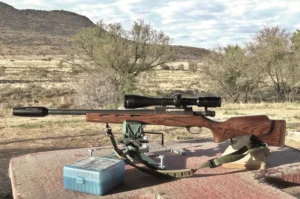
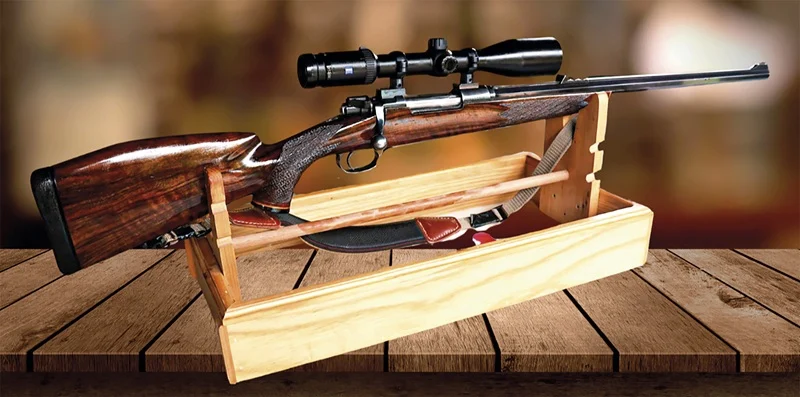
The Lynx LX3 2,5-15×50 mounted on a Howa 6.5 Creedmoor rifle. This is a versatile scope, suited to open-country hunting and range work.
DESCRIPTION AND OPERATION
Starting at the rear of the scope, the reticle is focused by rotating the eye bell. It is the fast-focus type, which is handy when different people use the same rifle. The adjustment is stiff enough to stop the eye bell from moving accidentally.
The magnification ring is marked from 2.5 to 15, and rotating it in a clockwise direction increases the magnification. The operation is stiff enough to prevent unintentional adjustment but not to the extent that it becomes difficult.
On the left side of the scope is a turret for adjusting the parallax. This turret also houses the CR2032 battery and the control ring for the crosshair illumination. The parallax is adjustable from 35 m to infinity. There are 10 brightness settings for the illumination, with an off position between each of the brightness settings.
The elevation and windage turrets are in the normal positions and are capped. Each click will move the point of impact by ¼ MOA. The clicks are crisp and tangible.
The adjustment knobs for windage and elevation are clearly marked, with 12 MOA in each revolution. There are indexing marks on the turret below the adjustment knob. This is useful for returning the adjustment to the original position after dialling more than a full revolution, should you want to use the scope for long-range target shooting.
The adjustment knobs are of the pop-up type and can be returned to the zero setting by pulling up on the knob, turning it to line up with the zero mark, and then pushing it down.
At 381 mm, this is a long scope, so mounting it on a long-actioned rifle while achieving correct eye relief is a breeze. However, the length, combined with the 50 mm objective lens, makes it difficult to mount on a rifle equipped with open sights without first removing the rear sight. As most modern hunting rifles do not have open sights, this is unlikely to be of much importance.
Optically, the scope is very good. The lenses are clear with very little distortion around the edges, even at the maximum magnification. I made a point of looking towards the rising sun on a few occasions and experienced no scope “whiteout”.

Two shots fired at 300 m using my .30-06 with 167-grain Peregrine bullets at 2 700 fps. These shots were fired with the magnification set at 12x using the 300 m range bar, as described in the article.
MOUNTING AND INITIAL ZEROING
I mounted the Lynx on two different rifles: first on a bull-barrelled Howa 6.5 Creedmoor, and later on a Howa .30-06 with a light, fluted barrel. On the Creedmoor, I used horizontally split Warne rings in conjunction with a Lynx 20 MOA rail, and on the .30-06, I employed 30 mm Leupold rings on Leupold bases.
Originally, I intended to also mount the scope on my Zastava .375 H&H to test it on a rifle with heavier recoil. However, as I would have had to remove the rear sight on the Zastava, I decided against this.
With an eye relief of 99 mm, at the lowest magnification, it is unlikely that one will suffer a “Weatherby kiss” from this scope, even on a heavy-recoiling rifle. Also, my previous experience with the older Lynx 3-9×40 on a light, unsuppressed .300 Winchester Magnum rifle leads me to believe that .375 H&H levels of recoil won’t affect the scope’s zero.
USING THE SA HUNTERS RETICLE
The SA Hunters reticle is well thought out and practical for hunting. While it does not offer as many aiming points as a true MOA reticle, it is easier to use under hunting conditions because it is fairly simple and not as busy as most long-range reticles.
The scope has aiming points that compensate for bullet drop as well as wind drift, and is calibrated in metres for distance and km/h for wind. There are two range bars, with vertical marks providing hold-offs for wind speeds of 10 km/h and 20 km/h, as well as three smaller markers below the central cross and one small marker above it.
Interestingly, the instruction manual shows two small markers below the centre cross while the test scope has three.
The illustrations in the instruction manual clearly illustrate the reticle and its use, and explain different techniques for zeroing to fit the reticle to the ballistics of your chosen load.
As the reticle of the LX3 2,5-15×50 is in the second focal plane, decreasing the magnification increases the distance between the range markers, allowing you to tailor the reticle to the ballistics of your load.
To illustrate, I will explain zeroing the scope on my .30-06 for hunting at ranges out to 300 m, using my current load for this rifle: a 167-grain Peregrine VLR-4 bullet at 2 700 fps.
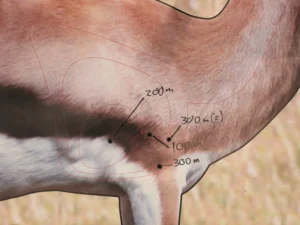
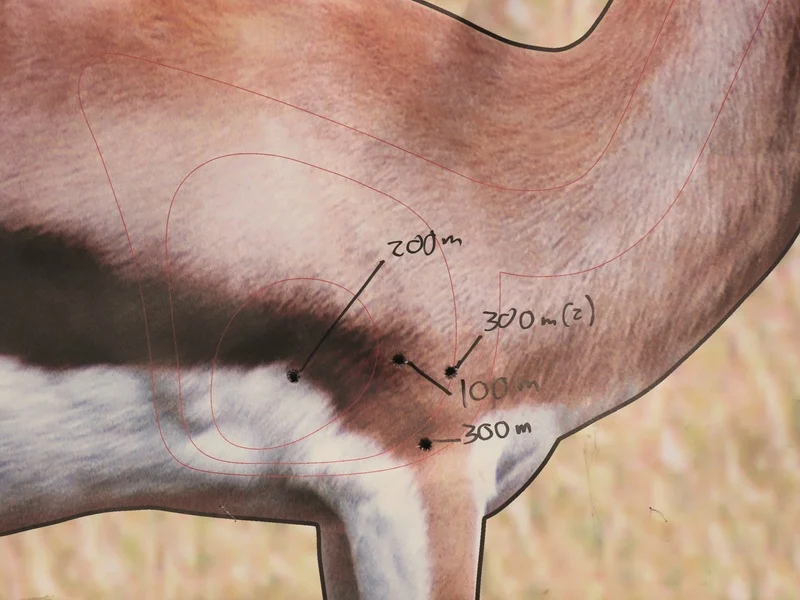
Shots fired at 100, 200 and 300 m using the SA Hunters reticle after determining the correct magnification to use with the reticle for this particular load, as described in the article. My point of aim was at the impact point of the 100 m shot.
Except for a .416 Remington Magnum, I prefer to zero all my hunting rifles at 200 m because this is a distance at which I take many of my shots. I thus zeroed the Lynx scope so that the central cross was on target at 200 m.
I then moved back to 300 m, shooting at a 70 cm x 70 cm steel plate. Aiming at a mark at the top of the plate, with the magnification set at 15x and using the centre cross, I fired a shot. Thanks to the excellent optics of the Lynx, I could see the mark left by the bullet on the white-painted plate.
With the rifle on a solid rest, I aimed at the centre cross at my original aiming point and adjusted the magnification until the first long-range bar was on the mark left by my shot. This happened at 12x.
I then fired a couple of shots at a 300 m target – with the magnification set at 12x and using the first long-range bar for aiming – to confirm my 300 m zero. Both shots were close to my aiming mark.
Next, I proceeded to shoot at a life-sized springbok target off shooting sticks at 100, 200 and 300 m. I used the centre cross for aiming at 200 m, the small marker above the centre cross at 100 m, and the first long-range bar below the centre cross at 300 m.
At 300 m, my shot was a little lower than I would have liked. However, at this stage, the wind had picked up considerably and accurate shooting off the sticks was becoming difficult, so I packed up and went home.
Early the next morning, I was back at the range and fired another shot at the springbok target at 300 m. This time, the impact was at the correct height.
I also fired one shot each at targets at 250 and 400 m, using the first small marker below the centre cross for the former, and the second long-range bar at the latter range. The 250 m marker was dead on and the shot at 400 m impacted ±70 mm low.
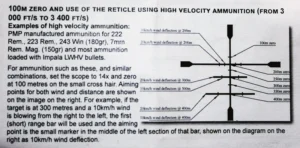
The SA Hunters reticle as illustrated in the instruction manual.
FIELD WORK – HUNTING WITH THE LYNX
As I had to hunt several animals for a predator project and for rations, I decided to take the Howa .30-06/Lynx LX3 combination out hunting. After all, the best way to test a scope and reticle designed for hunting is to hunt with it!
I hunted on foot, using shooting sticks to steady my aim. However, to get to the hunting areas, I had to drive on rather terrible, rocky roads. The rifle and scope went on my hunting bakkie’s dashboard, where my working rifles spend much of their time.
A hunting scope needs to be able to take a lot of bumps without losing zero, and the Lynx soaked up this punishment for three days without any problems.
While hunting, I carried the scope with the magnification set at 6x in the event of closer shots. My reasoning was that a hunter normally has more time to turn up the magnification when a longer shot is presented than to dial down the magnification when a sudden close-range shot is on the cards.
On the first morning, I shot two subadult red hartebeest out of a herd. With the scope set at 6x, the animals went down within a minute of each other at 200-220 m.
On the second morning, I dropped a springbok ram with a shoulder shot at a measured 298 m, using the first long-range bar and setting the scope at 12x. The springbok was shot before sunrise, and despite the less-than-ideal lighting, I could easily pick out the ram with the help of the scope.
My last hunt with the Lynx LX3 2.5-15×50 was for a young red hartebeest bull. I managed to get within 100 m of the herd but could not get a clear shot at the targeted bull.
As I watched the herd moving up a hill, I dialled up the magnification to 12x. Two young bulls started sparring at a range of approximately 300 m. As they moved apart, one was perfectly broadside. I put the 300 m bar on his shoulder and squeezed the trigger. He went down less than 50 m from where he stood when I shot.
CONCLUSION
The Lynx LX3 2,5-15×50 is a good choice for the hunter who frequents the open plains, and it offers a very sensible magnification range for hunting.
The crisp optics make hunting in low light easy, and although I have never used the illuminated centre cross while hunting, it will make shooting at dark-coloured animals like blue wildebeest in deep shade feasible.
While I would not mount the LX3 2,5-15×50 on a dedicated short-range bushveld rifle, I would certainly not feel handicapped using this scope set at 2.5x and with the reticle illuminated for close-range bushveld hunting.
With a bit of practice, the SA Hunters reticle is easy to use and helpful when precise shot placement is needed at longer ranges and in windy conditions.
This is also a good scope for general range work like testing handloads due to its excellent glass and the ability to set the parallax precisely when using it at higher magnification, enabling you to spot your shots on the target. I am, in fact, very tempted to buy one for my 6mm Creedmoor rifle.
For the hunter who needs an affordable, versatile, quality scope suitable for hunting and range work, I can recommend the Lynx LX3 2,5-15×50 without reservation.
Ask your dealer to contact Lynx Optics on 011 792 6644 or via www.lynx.co.za to find out more about their products.