









3 September 2026
In the DNA –the Rigby Shikari Boxlock double rifle
BY JOHAN VAN WYK – For many, the double rifle is the ultimate weapon for dangerous game. It offers two almost simultaneous shots – much faster than a bolt-action can fire two shots – and the balance and pointability generally make for a very well-handling firearm. All of these are positive assets if something big and dangerous with ill intent is bearing down on you.
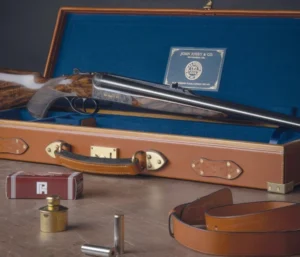
A Rigby Shikari in its oak-and-leather case, along with accessories. PHOTO: JOHN RIGBY & CO
The double rifle will also forever be associated with a handful of British makers who, through the finest craftsmanship and attention to detail, produced the best sporting firearms in the world at the time. Firms like Holland & Holland, Westley Richards, Purdey, Rigby and others will always be associated with unsurpassed gunmaking and best-quality firearms.
Rigby was historically perhaps best known for focusing on rifles, especially those for African hunting. It introduced steel-jacketed bullets in loaded ammunition for its proprietary cartridges, as well as legendary cartridges such as the .416 Rigby and .450 Nitro-Express, the .450 Rigby Rimless. These offerings remain a commercial success for Rigby, but as befits a pedigreed London gunmaker, best-quality, hand-made guns and rifles for those who demand and can afford the best are also available.
Another design Rigby is best known for is the famous vertical-bolt, bar-action sidelock design, known to the gunmaking world as the “rising-bite” action. Patented by Thomas Bissell and John Rigby, and introduced in 1879, the rising-bite action with its characteristic dipped-edge lock plates and traditional scroll engraving and carved fences became synonymous with Rigby. Around 1 000 rising-bites, both rifles and shotguns, were manufactured between 1879 and approximately 1912, and they are much sought after by collectors today. When Rigby decided to reintroduce a new best-quality double rifle, it resurrected the rising-bite, and new examples are available on a bespoke basis from the company today.
The rising-bite was an expensive bit of kit, though, and financially well out of reach for most hunters. To appeal to a wider market, Rigby did what many London gunmakers did in earlier years: look to Birmingham.
ENTER THE SCREW-GRIP
Starting in 1897, Rigby began to sell boxlock-actioned rifles made for them by Webley & Scott in Birmingham. At the time, Webley & Scott was one of the largest gunmaking concerns in the United Kingdom and enjoyed an excellent reputation for quality firearms at a reasonable price. It also made a great many shotguns and rifles for other makers who, in turn, sold these firearms under their own name. Rigby was therefore in good company when it started its collaboration with Webley & Scott.
In the 1901 Rigby catalogue, a new best-quality, rising-bite double rifle in .450 NE is listed first cordite-loaded big-game round intended for dangerous game. The introduction of the .450 NE signalled the death knell for the large-bore, black-powder-loaded cartridges of the day, as the new cartridge delivered the same amount of muzzle energy but in a lighter and handier package with less recoil.
After a few years of turmoil, Rigby was acquired by the German L&O Group and headquartered in London again. With Marc Newton as managing director, Rigby introduced a range of high-end, factory-made bolt-action rifles in various calibres. The Highland Stalker is available in chamberings such as .275 Rigby and .30-06 Springfield, while the Big Game is, as its name suggests, intended for dangerous game in chamberings such as .375 H&H, .416 Rigby for sale at 65 guineas, or £68,25.
For the time, this was a heap of dough and definitely too pricey for most, but a Second Quality boxlock-actioned, non-ejector rifle in .450 NE was considerably less expensive at 50 guineas (5 guineas extra for ejectors). The Rigby literature of the day describes the Second Quality (or Class C) rifle as follows: “This is a thoroughly reliable and well finished weapon, and will stand any amount of hard wear.”
The Class C Rigby double rifle in .450 NE featured in this article is just such a weapon. It was originally ordered by a client from India and delivered in 1900. After serving admirably there for decades, it was imported into Australia in the 1970s, where it was used extensively on water buffalo and banteng in the Northern Territory. Its current owner, Andrew Hepner, has also used the Rigby for this exact same purpose with great success.
Despite being almost 130 years old and having seen constant use, the old Rigby’s barrels are still shiny with plenty of rifling left and tight on the face. Screw-grip Webley actions are rightly regarded as one of the best double-rifle actions ever produced, and there is more than a little justification for this broad statement. They were made with a long water table (the area of the action that supports the barrels underneath the chambers), and the 1882-patented T.W. Webley and T. Brain patent screw-grip third bite is as strong as anything. Throw in superb workmanship and good regulating, and it is clear why Rigby staked its reputation on the screw-grip Webley as a more affordable alternative to the rising-bite sidelock.
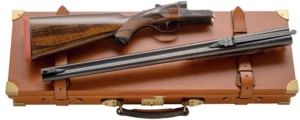
One of the advantages of double rifles is that they can be broken down and carried in smaller cases for travelling purposes. The Shikari is no exception. PHOTO: JOHN RIGBY & CO
REBIRTH OF THE RISING-BITE
Production of the much-admired Rigby rising-bite sidelock action resumed in 2015. A vintage rifle in .450 NE was carefully reverse-engineered, and the end result was a stunning London-made, best-quality double rifle produced from modern steel to the highest standards. It is available in 10 calibres from .275 Rigby to .600 NE, but with a price tag starting at £149 000 (excluding VAT) and going up to £175 000 for the larger calibres, the rising-bite is as exclusive a piece of equipment as ever.
The availability of new rising-bite Rigbys has also had a positive influence on the value of vintage guns and rifles. Rising-bite Rigby guns and rifles have never been cheap, but the resurgence of the rising-bite has seen a handy increase in the value of older guns and rifles in good condition as well.
Since there was a demand for a less expensive double bearing the Rigby name, Marc Newton and his team did what John Rigby had done all those years ago: turn to the boxlock.
THE GENESIS OF THE SHIKARI
The inspiration behind the latest Rigby double rifle was the Webley & Scott-made Class C boxlock-actioned double rifles that Rigby sold prior to World War II. The last screw-grip action left the Webley & Scott factory in 1947, so, just like with the resurrection of the rising-bite, the starting point was a vintage rifle that was studied meticulously and served as the basis for the new Shikari double rifle, as the latest Rigby creation is called.
Traditionally, the weak point of the Anson & Deeley boxlock action was that a lot of steel had to be removed from the action’s inside to house the cocking levers, mainsprings and tumblers. In addition, two pins went right through the action on which the action’s moving parts were mounted. All this weakened the action to some extent. When designing the Shikari, Rigby did a rethink of the traditional boxlock design and reinvented the wheel.
Jérôme Lanoue, a Belgian-trained French gunmaker, joined the Rigby team in 2020 from Verney-Carron, the well-known French gun manufacturer. Since he had extensive experience in working with double rifles at Verney-Carron, Jérôme set about designing the Shikari in a different way. Firstly, the mainsprings were moved to the rear of the tumbler, which meant there was no need to fit a bottom plate to access the inside of the action, as was the case with the traditional Anson & Deeley design. The tumblers were fitted to the action from the back, while the cocking levers were fitted from the front. All this meant that the action body contained considerably more solid steel than a traditional boxlock design and was thus also stronger.
Therefore, the Shikari’s action design owes a lot to the trigger-plate designs made famous by Scottish gunmakers like Dickson and MacNaughton.
The Shikari retains the doll’s head rib extension found on the original Webley & Scott rifles, but it no longer acts with a latch or bar of sorts inside the action. According to Rigby, the use of modern steels negates the need for a third grip on the doll’s head, which is no longer needed, yet is nevertheless retained. With the solid action bar, there is less flexing of the action when one barrel is fired, another strengthening enhancement.
As for options, well, the Shikari is marketed as a fully bespoke rifle. Standard calibres on offer include the .450/400 NE, .450 NE, .470 NE and .500 NE. The barrel length is as per the customer’s choice, as is the grade of walnut the rifle is to be stocked with. Border engraving (Rigby describes it as “adventurer grade”) is standard, but a customer can order his Shikari with whatever engraving his taste and budget may dictate. Ejectors are also a standard feature, as is a hinged front trigger to protect the trigger finger against recoil when the rear trigger is pulled.
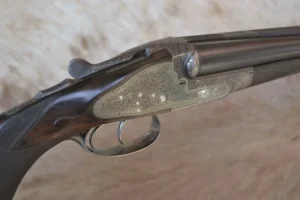
A vintage Rigby rising-bite sidelock double rifle in .303 British. Note the dipped-edge lock plates, a typical Rigby feature.
As befits a British double rifle, the Shikari comes standard with a quarter rib with one standing and two folding sights. The front sight is a sturdy brass bead with a flip-up enamel bead for shooting in poor light conditions. The barrel regulation is done at 50 metres, and if possible, the client’s choice of ammunition will be used. As a bonus, with its modern steel barrels, the Shikari can also digest modern premium steel-jacketed and monometal bullets.
Many double-rifle manufacturers modify their rifles for the fitment of a red-dot sight, such as the ones made by Aimpoint and others. This usually entails a few slots and a hole milled discreetly into the quarter rib, which, if done well, is a relatively unobtrusive modification. To my surprise, the Shikari does not come standard with this feature, although it is one of the many bespoke options available to the customer. A friend who has a Shikari in .450 NE on order told me he chose this option because he intends to fit a dot sight on his rifle. He also said approximately 30% of Rigby’s customers go this route from the start, so perhaps it will be a standard feature on the Shikari in future.
I was recently given the opportunity to have a good look at a new Rigby Shikari in .500 NE. It was the entry-level model with explorer-grade engraving, colour case-hardening and a decent, if not necessarily exhibition-grade, Turkish walnut stock. This model sells for £49 500,00 (excluding VAT), well south of the price of a new sidelock rising-bite but still a very expensive rifle. Despite the price tag and the wait for delivery, I’m reliably informed that Rigby has thus far received orders for more than a hundred Shikari rifles in various calibres, so the venture is certainly a commercial success.
I would have loved to fire the Shikari, but as it was already intended for a particular customer and because of time constraints, this was unfortunately not possible. My overall impression of the rifle was favourable, however. The wood had a good, straight grain for strength and was nicely finished in what Rigby calls a London Best oil finish. The blacking on the 26″ barrels and furniture was well done, and the rifle fitted me very well. At just over 11 lbs, it was slightly heavier and bulkier than my own Heym in .450 NE, but given the larger calibre, this was no surprise.
If I had to nitpick, my two criticisms of the Shikari were the chequering and the doll’s head rib extension. Although the chequering was well executed, it was, in my humble opinion, just a short throw below what would be expected of a rifle in this price class. It certainly wasn’t bad. As a matter of fact, it was rather good, but there were a few overruns, and another coat of oil rubbed gently into the cuts would have enhanced the overall impression.
As for the doll’s head, it was a touch too big for my taste when the barrels were lowered. It was fitted very well, though, and with the rifle closed, there wasn’t space for even a speck of dust to get in between the doll’s head and the recess in the top of the action. I did say I was nitpicking, so I must add that if it had been my own rifle, I would certainly be able to live with both the chequering and the doll’s head rib extension. As the reader, you are therefore asked to draw your own conclusions about this matter, and feel free to disregard my two criticisms completely!
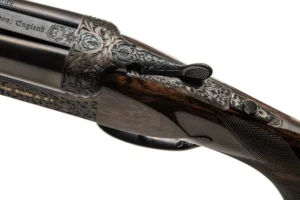
This Shikari features deep-relief engraving and colour case-hardening on the action. PHOTO: JOHN RIGBY & CO
As always, the question will be asked: Just how good is the Shikari? Well, this is a difficult one to answer. For my money, it’s a pretty smart design that is well made by one of the world’s oldest gunmakers. There is one particular Shikari in .500 NE that has thus far digested more than 2 000 full-power loads without a hiccup. If this is any indication of the Shikari’s inherent quality and reliability, it should give excellent service for a great many years, provided it is well looked after.
The old Webley boxlock double rifles sold by Rigby were some of the finest doubles made in their time. Many are still providing outstanding service after a century or more of use, and if this DNA is present in the Rigby Shikari, it certainly has a promising future.
The Rigby agent in South Africa is Safari Outdoor (www.safarioutdoor.co.za). Contact them for more information on Rigby products.