










4 September 2026
Recoil and comfortable shooting mass
By PIERRE VAN DER WALT – From what I have observed over the years, most hunters don’t perceive the recoil impulse from a properly fitting rifle-and-cartridge combination as a punishing blow when the recoil velocity falls below approximately 17–19 fps. Instead, they experience it as a manageable push, regardless of the level of recoil energy involved.
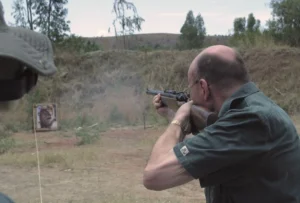
Because recoil functions in milliseconds, we do not always appreciate its effect on the human body. Look at the shooter’s left upper arm skin distortion and imagine the forces exerted on the nerves that run through the shoulder under the butt contact point.
That doesn’t mean that even tolerable recoil is enjoyed by most of us. I have heard this on an almost daily basis from fellow shooters for most of my life and have given the matter much thought over the years. To make sense of this article, however, we first need to take a few steps back.
PHYSICAL RESPONSE TO RECOIL
The human body is neither an inert nor a stable launching platform. It cannot absorb a barrage of punitive recoil impacts and retain its ability to deliver pinpoint accuracy. The human body and nerves running through the shoulder area react proportionally to the force it is subjected to.
Recoil energy is a factor, but not the primary issue. Most regular shooters can handle recoil energy up to around 90–100 ft-lbs quite well, irrespective of their size or build. Higher recoil energy levels are problematic. However, even lower recoil energy levels cause problems when the velocity with which the energy is delivered exceeds about 18–19 fps. It becomes difficult for most hunters to sustain accuracy for any extended period of shooting. We quickly become recoil-shy at such levels. It is therefore important to keep the recoil velocity at a tolerable level.
It is also not just a matter of Newton’s Third Law of Motion, namely that for every action, there is an equal and opposite reaction. Other physical responses of the human body cannot be ignored when considering recoil management. Muzzle blast and noise also disorientate the shooter and must be considered. Muzzle climb is the motionary consequence of recoil, but the human body’s biomechanical recovery from it is another matter altogether.
High muzzle climb slows the hunter down as it requires additional time from the hunter to rock back into balance, get the muzzle down, get the sights back on target and execute another controlled shot. Additional platform mass is a factor that can reduce muzzle climb and speed time up between shot recovery. To a point, that is – after that, additional platform mass becomes a handicap.
The nerves running through the shoulder are increasingly affected as high doses of recoil pound them. The problems do not relate to physical construction only, but to conditioning, mindset, co-ordination, concentration, stress levels, positioning, stability and several other factors.
The reactions of the human mind and body to recoil and blast are the most crucial variables affecting accurate delivery of the power launched from the human platform on a sustainable basis. Managing it is crucial to sustain precision.
What I am driving at is the simple truth that in a crisis, a man who can handle a .375 H&H Magnum well has an infinitely better chance at survival than one who cannot handle his .700 Nitro-Express.
Sadly, many egos have their owners opt for excessive power rather than ability as an attempt at compensation for platform (hunter) inadequacy. The egotistic want others to believe that they are so macho that they can handle the recoil of any cartridge, so the ownership of a great recoiler is supposed to impress others. But there is also another side to the coin. Even though you may be the least egotistic hunter on earth and use a big recoiler out of true conviction, your body and mind will react to that recoil.
Call it Van der Walt’s First Law of Recoil or whatever you like – a practical combination of Newton’s Third Law of Motion and the sheer physical impact of muzzle blast, kick and the other factors mentioned above. Add to that the exhaustion of 10–14 hours on foot in Africa’s heat. They all affect you at the moment of truth – so does the adrenaline.
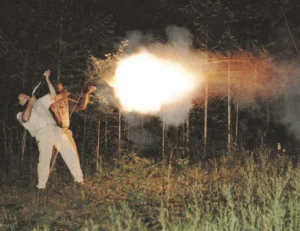
Recoil needs to be managed to reduce biomechanical impact and improve the firing tempo, which is adversely affected by muzzle climb.
RECOIL FITNESS
You cannot escape these factors I mentioned, but you can prepare yourself for their effect. By shooting regularly and correctly, the mind and body are conditioned to accept and absorb their physical effects. The desired shooting position to become recoil-fit is standing, either offhand or from shooting sticks.
For example, most hunters have no problem firing many shots with a 12-bore shotgun, yet they baulk at shooting the .375 H&H Magnum. The recoil is fairly similar. It is the shooting position adopted that makes the difference. The shotgun is fired standing up and with free upper body movement.
At some point, the mind loses much of its nervous reaction to noise, blast and recoil. It accepts it by and large. Even though the mind can never ignore it totally, the adrenaline is largely contained, the nerves are conditioned and the body is prepped. Suddenly, shooting a recoiler becomes no more of an issue than shooting other, smaller cartridges. But it is a process – you must become recoil-fit and that fitness, once achieved, must be maintained.
CSM – GUIDING BASE FORMULA
The Britons had it right with the technology at hand to them at the time – they used mass to curb recoil intensity and built rifles for cartridges such as the .577″ NE at around 15–16 lbs (6,8–7,3 kg). We can cheat a bit with technology such as muzzle brakes, suppressors and recoil reducers so that we do not have to carry so much weight (using other means than mere mass), but we cannot deny that there is a sensible platform mass level for different rifle-and-cartridge combinations. Still, we do not have to reinvent the wheel.
Bear in mind that nowhere did I say a comfortable platform mass makes for comfortable carrying! The British big-game hunters of old employed strong assistants to carry their rifles for them, but those days are long gone.
Devices and accessories excluded, the platform mass determines the recoil velocity and recoil energy of a given cartridge load and does so in terms of Newton’s law. The human body has parameters of ability, and no man’s body or mind will ever acclimatise to the firing of a 5 lb (2,3 kg) .50 Browning offhand.
I therefore developed a “formula” that calculates the total platform mass that will keep the recoil velocity below 19 fps (5,8 m/s) for all but the most punishing cartridges, and then remarkably close thereto. I call it the comfortable shooting mass (CSM) of a rifle, and it is also structured to not add excess mass. Here it is:
CSM = Ke ÷ Cr
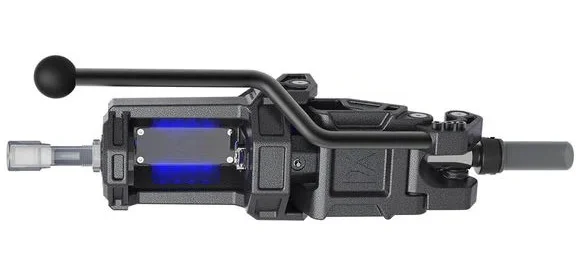
The CSM formula uses the rifle’s kinetic energy (Ke in ft-lbs) divided by a constant (Cr) to calculate the minimum total platform mass that will ensure that recoil velocity remains below 19 fps (5,8 m/s) most of the time. For imperial calculations, the Cr is 440. For metric calculations, Cr divided into the joules generated by the cartridge is 1 315. The recoil comparison table compares CSM recoil with that of an 8 lb rifle.
When I refer to total platform mass, I refer to the rifle, sling, accessories (and their effect), mounts, rings, scope and cartridges inside the magazine.
One must therefore deduct the impact and effect of recoil reducers and all accessories to achieve the correct rifle-only mass, i.e. the CSM for the .460 Weatherby is listed in the table as 16,7 lbs, and one’s first thought is “Wow, that’s heavy!” If you deduct the following from that figure to get to the net rifle weight, the picture looks different:
- Effect of recoil reducer: 2.00 lbs/0,907 kg
- Mass of recoil reducer: 0,83 lb/0,376 kg
- Riflescope: 0,84 lb/0,380 kg
- Rings and mounts: 0,44 lb/0,199 kg
- Sling: 0,44 lb/0,199 kg
- Cartridges in magazine: 0,54 lb/0,245 kg
- Total deductions off CSM: 5,09 lbs/2,306 kg
By deducting 5,09 lbs from the recommended 16,7 lbs, it leaves a minimum rifle-only required mass of 11,61 lbs, which is eminently realistic and not bad for a .460 Weatherby.
If there is a need to reduce the felt recoil even more, I suggest that, rather than making the rifle heavier than determined by the CSM formula, one should consider a stock design and dimensions that counter the recoil effect on the human body. Below are some of the possibilities:
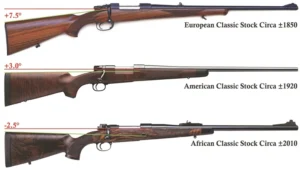
The lower the heel below the barrel axis, the lower the centre of the stock’s butt and the more severe the felt recoil due to the comb impact on the shooter’s cheek.
HEEL HEIGHT CENTRE OF BUTT AXIAL ANGLE
The barrel axis defines the direction of the initial recoil force, which drives the rifle butt into the shooter’s shoulder. The stagnation point of recoil (the primary contact centre point between the butt and the shoulder) is located below the barrel axis. The angle formed between the barrel axis (force direction) and the butt’s contact centre (resistance position) causes the rifle to follow the path of least resistance, lifting the muzzle.
The more pronounced this angle, the greater the muzzle climb, all other factors being equal. This upward rotation drives the spine of the comb into the shooter’s cheek, intensifying the harshness of the recoil experience.
To mitigate this, the centre of the rifle butt must be as close to the barrel axis as is feasible. Put differently, the smaller the angle between the barrel axis and the centre of the butt, the less muzzle climb there is.
LENGTH OF PULL (LOP)
The length of pull is the distance from the centre of the trigger to the end of the buttstock. This measurement is critical as it affects shooting mechanics and how recoil is perceived and managed. The ideal length of pull for a shooter is typically determined by measuring the distance from the inside of the bent elbow to the joint behind the trigger finger pad. Adjustments may be necessary depending on the climate and clothing requirements.
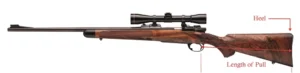
Commercial rifle stocks are dimensioned to fit the average American male. Their length of pull can either be too short or too long for any individual. The incorrect length of pull increases the felt recoil and is the primary cause of being introduced to the “half-moon club” because of scope smack.
CAST OF THE BUTT
The cast of a rifle butt refers to the lateral offset of the buttstock, specifically how the vertical axis of the butt is shifted left or right relative to the bore axis. This subtle yet significant adjustment greatly influences how naturally the rifle aligns with the shooter’s body.
The cast may be “off” (to the right), “on” (to the left) or neutral. A cast tailored to the shooter provides the same benefits as any other fitting adjustment, plus a reduction in felt recoil.
COMB GEOMETRY
The height, radius and angle of the comb play a key role in how recoil is perceived. If the comb is too low or too high, sight alignment becomes strained, altering recoil vectors and increasing perceived recoil.
A comb radius that is too small creates a sharp edge that can bite into the shooter’s cheek during muzzle climb, while a more generous radius softens this impact and improves shooter comfort.
When the comb nose sits higher than the butt heel, it causes the spine of the comb to drive into the shooter’s face under recoil, intensifying the felt impact. The steeper the comb’s backward angle, the greater the perceived recoil due to the rotational impact on the shooter’s cheek.
To minimise this, an axial comb spine with a generous radius, positioned at an appropriate height to promote natural sight alignment, is key to reducing the facial impact and increasing shooting comfort.
RIFLE BUTT SURFACE AREA
A rifle, paired with a given cartridge load, produces a specific amount of recoil force. This force is transferred to the shooter’s shoulder and is spread across the contact area between the rifle butt and the shoulder.
The larger this area, the lower the force per unit measured in square inches or square centimetres, and the gentler the perceived recoil, regardless of the actual force or impulse.
CONCLUSION
There is no monopoly on method, and therefore, there are diverse ways to manage actual and felt recoil. The CSM is just one way of going about it.