












10 September 2026
The .300 Magnum face-off
By PIERRE VAN DER WALT – Pitting the big .300s against each other.

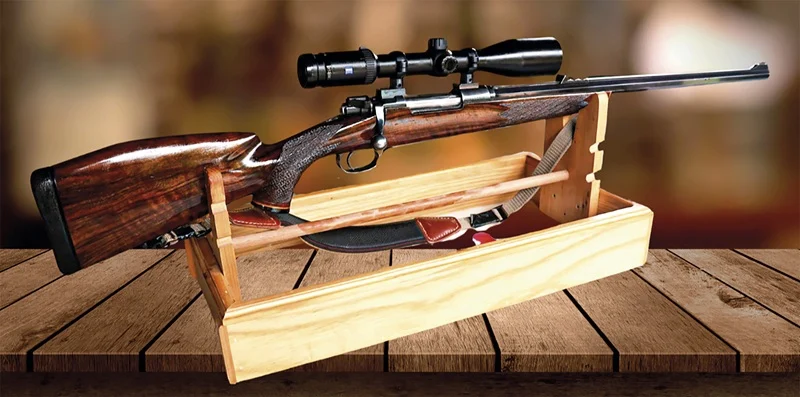
My Model 70 Winchester in .300 Winchester Magnum is a favourite rifle that has accompanied me on many hunts.
The term “magnum” carries varied meanings across regions. In the United States, any cartridge featuring a belted case is often labelled a “magnum” irrespective of its actual capacity or ballistic performance. Take the .350 Remington Magnum, for example. The British, who originally coined the term, reserve it for cartridges with substantial case capacity, such as the .505 Magnum Gibbs, regardless of case design. Continental Europeans, by contrast, tend to avoid the term altogether. Derived from Latin, “magnum” can be translated as “great”, “large” or “powerful”.
When tasked by your editor to produce a comparative analysis of the .300 Magnums, I faced the challenge of narrowing down a vast field – there are several dozen to choose from. To streamline the selection, I applied three criteria: ballistic performance (specifically, achieving 3 000 fps or more with a 180-grain bullet from a 24″ barrel), local popularity, and the inevitable constraints of article length. If your preferred .300 Magnum is not included, rest assured that it was excluded solely due to space limitations – nothing more.
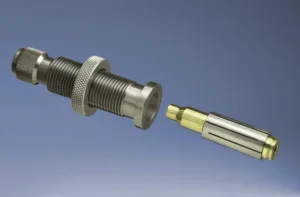
A universal belted case swaging die that resizes the bulged area of belted cases. Besides this extra step being a hassle, it is quite an expensive tool. It is available from Sudami X-Ring in Midrand. (Photo: Courtesy of African Dangerous Game Cartridges)
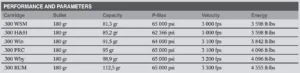
VELOCITY COMPARISON
I often come across articles where it is clear that the author has cherry-picked data to support a particular viewpoint. To avoid falling into that trap, I averaged the five highest published velocities for each cartridge as listed in reloading data from propellant and bullet manufacturers. All figures were derived from 24″ barrels to maintain consistency.
RECOIL COMPARISON
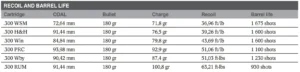
For the Recoil and Barrel Life table, I employed internal ballistic software to generate loading data at P-Max (maximum specified pressure). This produced optimal charge weights for the most suitable propellants for each cartridge. I then averaged the loads of the five best-performing propellants and calculated the recoil using Robinette’s recoil model for 4,0 kg rifles. This method accounts for the jet effect, offering a more accurate representation than simple free recoil.
The propellant charge required by the .300 Weatherby Magnum may well surprise many readers as will the challenge to equal the performance of the .300 Winchester Magnum with the PRC despite its much larger case.
BARREL LIFE
This is a fluid and often contentious subject, as any barrel can be prematurely damaged through overheating. The standard method for estimating barrel longevity (outlined in my soon-to-be-published book African Large Game Cartridges) is based on the relationship between the barrel cross-sectional area and the propellant charge, including its energy content.
While rapid fire and thermal stress can significantly distort the outcome, my approach was to perform the calculation without accounting for barrel heating.
Another consideration is the threshold of deterioration that qualifies as barrel exhaustion, a highly subjective matter. To maintain consistency, I applied a fixed calculation method, varying only the energy content of the propellants favoured by each cartridge. This ensures that the deterioration rate is presented as uniformly as possible. For the relevant figures, refer to the Recoil and Barrel Life table.
TRAJECTORY (DROP)
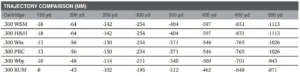
For the comparison shown in the Trajectory Comparison table, I used the Hornady 180-grain SST bullet, zeroed at 100 yards. This is a streamlined projectile with a relatively high ballistic coefficient, representative of those typically employed in magnum cartridges for extended-range shooting. The sight height above the bore axis was kept constant and a 100-yard zero was used.
APPLICATION BANDS
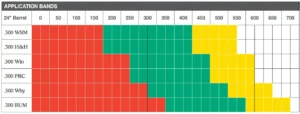
The different application bands of the cartridges are detailed in the Application Bands table. The red band indicates an impact velocity in excess of 2 600 fps, the green band represents the 2 600-2 200 fps impact velocity recommended for traditional jacketed soft-point bullets and the amber band indicates an impact velocity of 2 200-2 000 fps.
Since almost no animals are shot at ranges exceeding 450 yards (preferably well under 300 yards), I have limited the application score to 450 yards. The cartridges were scored by simply counting the green band blocks to the extent of practical application versatility out to 450 yards.
Capability beyond 450 yards is unnecessary, questionable and of little value as further explained under the next topic. You may or may not agree with this approach; if you do not, simply change the scores and re-rank the cartridges to your liking. Just be honest about what percentage of animals you have actually killed beyond 300 yards.
TWIST-RELATED VERSATILITY
By versatility, I refer to the range of bullet weights (and lengths) that a cartridge can gyroscopically stabilise, as well as the range of applications it can accommodate in factory configuration. Versatility can be altered by modifying the rifle set-up, such as changing the stock, barrel contour or twist rate. In essence, any of these cartridges can be tailored to suit a specific purpose, but for the purposes of this comparison, we assess each in its standard factory form.
Of the group, the .300 PRC stands out as the most versatile, thanks to its 1:8.5″ (216 mm) twist rate. This allows it to stabilise heavier bullets than its counterparts, which typically feature a 1:10″ (254 mm) twist.
I’m inclined to give the advantage to the PRC, albeit reluctantly. The reason is simple: very few shots at game are genuinely taken at very long range, and I have reservations about the risk-related implications of such distances. Up to 450 yards, the PRC offers no meaningful bullet-related advantage over its peers.
RIFLE SIZE
For the walk-and-stalk hunter, rifle size is a critical consideration. For others, it may be less consequential. In this context, objectivity is key. The more compact the firearm, the better.
We are dealing with three magazine lengths (short, standard and stretched) but only two action lengths (short and standard). The short-action WSM scores the highest in this regard, while the remaining standard-action-length cartridges share equal points.
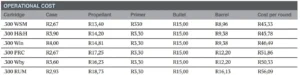
OPERATIONAL COST
It is an accepted reality that belted cases, particularly those operating at high pressures, tend to have shorter service lives than rimless designs. Belted cases seldom exceed 10 reloads before base bulging or case head separation becomes problematic – a condition that can be remedied with a specialised and costly resizing tool.
For the purposes of cost calculation, I assumed a lifespan of 10 reloads for belted cases and 15 for rimless cartridges, although actual figures may vary. Regular annealing was assumed across the board. Barrel costs were standardised at R15 000,00, with that figure divided by the calculated barrel life to determine per-shot depreciation.
As not all case manufacturers produce brass for every cartridge reviewed in this article, I was obliged to select from various brands. Accordingly, the case cost was calculated by dividing the purchase price per case by its estimated reload lifespan.
This brand variation made it less scientific than I would have liked, but that is the reality for every user of the cartridges. Based on the approach that rimless cases can be reloaded 50% more than belted cases, the benefit of rimless over belted cases is obvious from the Operational Cost table.
Unfortunately, cost is not the only consideration. Cases for the Holland & Holland, Weatherby and Remington Ultra Magnum are hard to come by in South Africa, and this needs to be factored in. I could not figure out a method to include this in a scientifically justifiable way, so it was not considered.
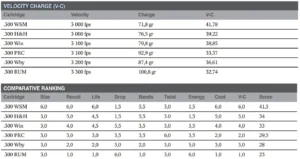
Another relevant factor under this heading is efficiency: how effectively a cartridge converts its propellant charge into velocity. While results can vary depending on the specific propellant used, I applied an averaged top-propellant approach to offer a broader perspective as outlined in the Velocity Charge table.
The calculation is straightforward: divide the propellant charge into the achieved velocity to determine the feet-per-second yield per grain of powder consumed.
COMPARATIVE RANKING
This comparison assigns an impartial, equal weighting to each evaluated aspect. Naturally, one could apply different weightings depending on personal priorities, but I chose not to.
For the sake of simplicity, I merely totalled the scores. In cases where two or more cartridges achieved identical values, I totalled their positional scores and divided these by the number of tied entries. The final results were then arranged from highest to lowest in the Comparative Ranking table.
CONCLUSION
It is important to note that this ranking was based on performance with a 180-grain bullet. Had the comparison been made with a bullet in the 230-grain class, the .300 PRC would likely have scored more favourably.
In fact, I initially expected the PRC to rank near the top. However, it surpasses the threshold where diminishing returns begin to outweigh practical advantages.
Had space allowed it, I could have included handloading considerations such as body taper, shoulder angle, neck length and turbulence point. These factors would have favoured the PRC and disadvantaged the H&H. However, this comparison was intended as a general feature overview, not a handloading analysis. Weighting the article with such specialised criteria would have undermined its broader relevance.
Had all handloading considerations been excluded, the .300 H&H would have ranked higher. Technically, I have little admiration for the case design of the .300 H&H, but aesthetically, there is no sexier or more elegant cartridge. It is, after all, the .300 Magnum that has occupied pride of place in my gun safe throughout my life.
The Weatherby Magnum came as a surprise. Had I not awarded the PRC the benefit of its superior twist rate, the Weatherby would have outscored it. With a tighter twist barrel, it would certainly do so.
The clear winner is the .300 WSM, and deservedly so. It’s an outstanding design and a consistently strong performer. In my view, it has not received the recognition it merits since the advent of the much publicised but somewhat misplaced enthusiasm surrounding the PRC trend.