


9 June 2026
Nocturnal Oryx Consternation
By DANIE GROBLER
Never underestimate an oryx!
All serious hunters love hunting dangerous game, but for obvious reasons, this is a pastime that doesn’t always lie within everyone’s reach. So, to afford ourselves at least some gratification, we turn to hunting what we perceive to be our own version of big game. For example, apart from the evident dangers of hunting a huge elephant bull, getting close to a large giraffe bull can provide a remarkably similar experience because of its enormous size. Likewise, stalking a big, lone eland bull in the thick stuff can certainly be as difficult as hunting old dagga boys.
Oryx hunting, however, falls in a completely different category. Antelope are usually not seen as a threat to hunters and, therefore, we are not always that careful during the follow-up. This can lead to situations just as perilous as with any of the Big Five. Add to that a few measures of stupidity, and you have a dangerous situation that can rival any horror story about big-game hunting around the braaivleis fire, as I’m about to explain.
Among the African antelope species, it is mostly only oryx and bushbuck that are known to become dangerous adversaries when wounded. Numerous incidents were recorded in the past of an oryx or a bushbuck that stood its ground against hunters. Many a Kalahari farmer will tell you that an aggressive, cornered oryx can accurately hit a stone thrown at it with its horns time after time. Interestingly, in his book on African mammals, Jonathan Kingdon notes that the southern oryx (gemsbok) displays low-level, aggressive behaviour in a more sustained and continuous manner than in any of the other oryx populations. This involves threat displays, horn gestures, butting, circling and parallel walking, as well as outright fighting.
Ron Thomson was once asked what advice he would give a novice big-game hunter who is attacked by an irate animal he has been hunting all day long. “Stand your ground,” he responded. This obviously implies that in a life-or-death situation, you kill the animal that attacks you, or be killed by it. There is no point in running away. “You just HAVE to ‘stand your ground’ and face it – and do the very best that you can.” (Ron Thomson, Stand Your Ground, 2011).
So, there are situations when it is imperative that a hunter take a leaf from the book of these dangerous-game hunters of yesteryear and just stand their ground. This reminds me of a few stories my father used to tell.
Kalahari capers
During the 1920s to early 1960s, my grandfather owned a Kalahari farm between Tosca and Bray on the Botswana border. Being a creative storyteller, my father used to share many dangerous hunting encounters they experienced during those days along the Molopo River. They hunted exclusively to provide meat for the family and make biltong, which they sold to a smous (nomad trader or peddler).
Being young and inexperienced, several of their hunts involved nerve-wracking follow-up situations with wounded oryx. At least one of these encounters occurred when an oryx stuck its behind in a swarthaak bush (black-thorn bush, Senegalia mellifera) while aggressively trying to defend itself. My father and his brother, Jan, had been tracking a wounded oryx for some time before they spotted it among dense swarthaak. The bull was understandably upset by then and charged them at full speed, dropping his head as he got closer. Fortunately, armed with my grandfather’s 9×57 Mauser, my dad stopped the bull in its tracks at about 10 yards.
Due to ammo scarcity at the time, they mostly hunted with an old .303 British Lee-Metford or my grandfather’s .22 LR Mauser rifle. This obviously created ample opportunity for hazardous follow-ups. One such occasion nearly ended in disaster. Easily detectable in the soft red Kalahari sand, they were again on the spoor of a wounded oryx when stumbling upon the den of young lion cubs. Being extremely careful, they scrutinised the surrounding brush in the vicinity of the cubs, trying to spot the lioness. Failing to do so, they decided that she was clearly not nearby. They only had the .22 Mauser with them. Being young, adventurous Kalahari boys, they totally forgot about the wounded oryx and decided there and then to try and catch one of the cubs.
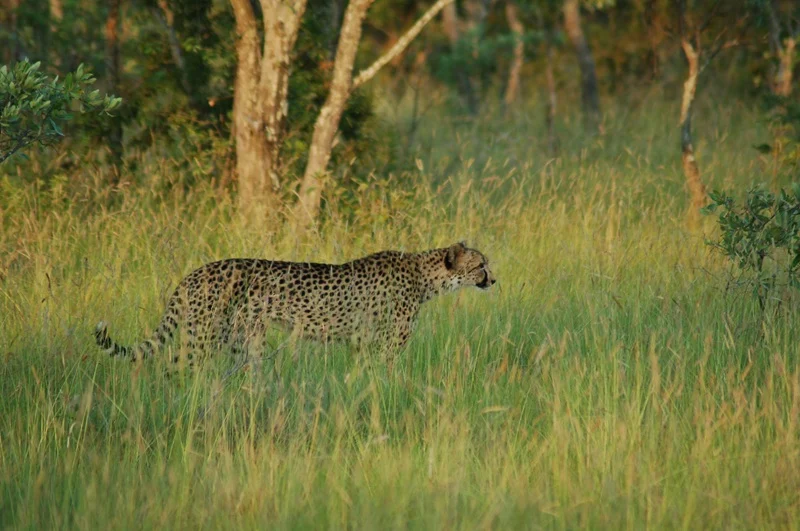
At the time, they were already raising two young cheetahs at the homestead and in their minds, a lion cub would fit in well. As Uncle Jan grabbed the little fellow, it protested loudly. While struggling to keep the cub under control, the enraged lioness suddenly charged at them out of nowhere. Surprised, my father instinctively dropped down on his knee and shot the lioness in the left eye (through the brain) at about 20 yards.
Uncle Jan, being unarmed, had dropped the aggrieved cub by now and rapidly sought shelter by moving away from the “crime scene”. The lioness dropped dead in her tracks.
Regarding the killing shot into the lioness’ eye, I suspect that a few readers may find this hard to believe. I would thus like to politely submit some additional supporting evidence. Firstly, I have personally heard my father share this story on numerous occasions. Secondly, many of my hunting buddies can also attest to this. Thirdly, my father used to be a pretty good shot in his heyday. I observed him shooting a .22 casing standing on a tree stump at 30 yards many times. Lastly, with that same .22 Mauser, he could shoot a hole through a 2c coin thrown into the air… This is all true! Furthermore, just for pure Sunday afternoon fun, those tough Kalahari boys chased blue wildebeest on horseback, ran them down, jumped off the horse, grabbed a young wildebeest by its horns and pushed its head onto the soft Kalahari soil. A great deal of this happened across the border in the then Bechuanaland Protectorate, which later became the Republic of Botswana.
Back to the oryx
Back to my story. Oryx hunting in the mopane bushveld ranks very high on my list of biltong-hunting preferences. The added benefits of having tasty venison and the opportunity to hunt large game put it solidly in that position. During our early days of bushveld hunting, it so happened that my hunting mates and I became increasingly familiar with the great taste of oryx venison. Wikus and Albie, my fellow geologist friends, and I started focusing our annual hunts on oryx to provide our spoiled families with tasty venison and biltong. Most of these hunts took place on the farm Braam (Janda Safaris in those days) in the Breslau district north of Alldays and on the farm Ostend north of Tshipise, both in Limpopo Province.
During one of these hunts, I had to do a follow-up in dense jesse all by myself. As I got closer, the oryx gave a frightening bellow, causing me to question my approach without any backup. Fortunately, this turned out to be a death bellow, not a roar of aggression.
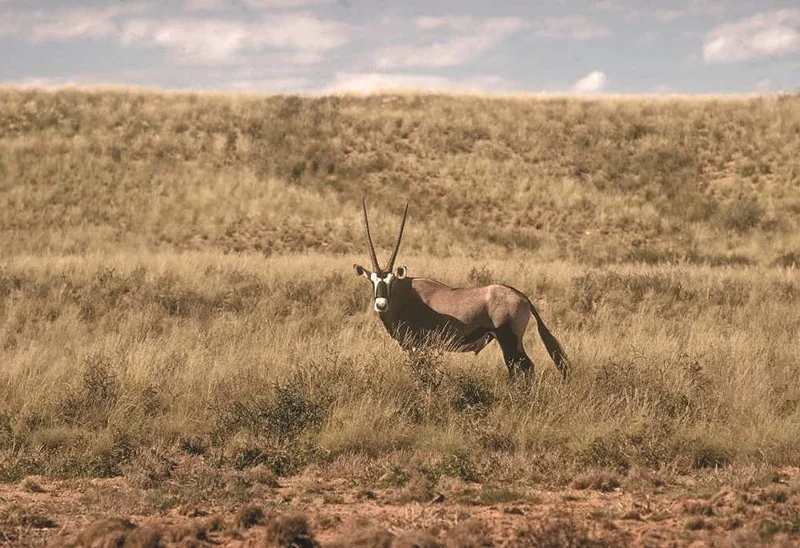
For some reason, the hunts conducted by Wikus, Albie and me usually ended up being the most gripping affairs. Spotting those black and white facial markings among dense mopane bush can dramatically increase your heart rate! Oryx are extremely alert and normally keep in herds. The many eyes make the approach difficult for the hunter, especially in thick mopane shrubland. We have also found that these animals tend to frequent specific areas with their preferred food sources, and which they consider safe havens. These areas normally contain telling evidence of oryx activity, such as old as well as fresh droppings, spoor and obvious signs where they lie down to rest.
Their hideouts are usually in densely vegetated parts. These favoured spots typically have lots of small rocks or gravel, or are found in elevated, secluded areas hidden between large rocky outcrops on granite hills/koppies. Most of these hiding places are well chosen and difficult to approach in silence.
A wounded beast
I was hunting with Albie and Wikus in the Breslau district during 2008. Late afternoon on the second day, we were loading a big kudu bull on the hunting truck when the farm manager, Nico, received a call over the two-way radio. One of the trackers informed him that Albie had wounded a large oryx bull on the other side of the 2 500 ha property. The sun was setting, so we hastily loaded the kudu and dropped it off at the slaughtering facility. Then, Nico sped like a rally driver along the dirt tracks across the farm, and we reached them just as the sun disappeared below the horizon.
Appearing from the bush with his tracker, Albie told us he had shot the bull with his .451-calibre Parker-Hale Volunteer black-powder rifle. The wounded oryx had just crossed the road a few minutes before we got there. After the initial shot, it went down but got up again before Albie could reload the muzzle-loader. They followed what appeared to be a heavily wounded oryx through some dense mopane as he got in another shot, which possibly missed. Albie added that the first shot was placed a bit low behind the shoulder, hence the limited amount of blood found on the spoor. The fact is that it was heavily wounded, obviously very sore, but still mobile.
Standing in the road where the oryx’s tracks crossed, we had to make up our minds very quickly. We expected the animal to be already some distance away across the low-lying hill in front of us. In the fast-fading light, Nico suggested it would be best if he returned to the lodge to collect his dogs and some flashlights. While there, he would also pick up Wikus with his .375 H&H rifle to provide extra firepower. Albie and I remained behind with the two trackers. We tried to follow the spoor for some distance, but soon lost it in the poor light conditions. We also didn’t want to bump into an irate oryx at short range in the fading light.
Returning to the road, we discussed the dangers of tracking a wounded oryx at night. The trackers pointed out that, from their experience, we should also not expect much help from Nico’s two dogs. They were also adamant that the oryx would be far away by the time Nico returned and that it would be best and safest to search for it the next day. I could see that Albie, noticeably disappointed, agreed with them.
Just then, Nico returned with Wikus and the two dogs in attendance. By now, it was a beautiful, dark, windless winter evening. The dogs jumped off the truck and, surprisingly, soon picked up the wounded animal’s spoor. They immediately disappeared in the thick mopane shrubland towards the foot of the low hill ahead. The next moment, we heard a loud yelp from the Staffordshire terrier and the Jack Russell barked ferociously. This all happened very quickly while we were still standing at the truck, discussing what to do.
Scrambling, we got the flashlights going and loaded our rifles. We followed Nico, running in the direction of the commotion ahead. Nico was in front, followed by Albie and Wikus, with me bringing up the rear. The trackers cleverly remained behind. Only Nico had a good flashlight; the other one was pretty much useless and the rest of us thus followed more or less blindly. We could still hear the Jack Russell barking fiercely as he tried to defend himself against the enraged oryx. The Staffie, however, remained silent.
We soon got closer to the furore and slowed down in the dark mopane thicket. The shadows were playing spooky mind games with us. The undergrowth was denser here at the foot of the hill. The next moment, I heard one shot after the other going off. This was utterly confusing, for at that stage, I did not know that Nico was carrying his 9mm pistol. We broke into a fast walk as we entered a 6 ft deep erosion ditch, following the flashlight beam jumping across the mopane treetops just opposite the ditch.
The last stand
The 9mm kept firing shots in rapid succession as Albie broke the crest of the ditch on the opposite side. At this stage, none of us knew what to expect, nor were we fully prepared for it. The scene before us was surreal, with the torchlight dimmed by the red bushveld dust kicked into the air during the dog/oryx skirmish. Albie saw Nico standing to the right, pistol ablaze. Nico was firing defiantly what remained in the clip at point-blank range at the heavily wounded, angry oryx making his last stand.
In an instant, the oryx turned towards Albie, broadside to the pistol as Nico emptied the last rounds from the 9mm. A second later, the oryx charged, closing the distance to Albie. It lowered its head with the deadly, razor-sharp horns at the same time as the muzzle lowered and the hammer drop clicked. A flash from the .451 Volunteer’s muzzle and a loud, massive “boom” released all mayhem on the charging oryx.
For the next few seconds, which felt like ages, the entire scene was engulfed in black-powder smoke. It was impossible to see anything in the torchlight. The oryx could have been anywhere. Suddenly, it was eerily still in that dark mopane bush. Then, in a subdued voice, I heard Nico asking Albie and Wikus if they were ok. Their low, concerned voices barely reached me a few yards back.
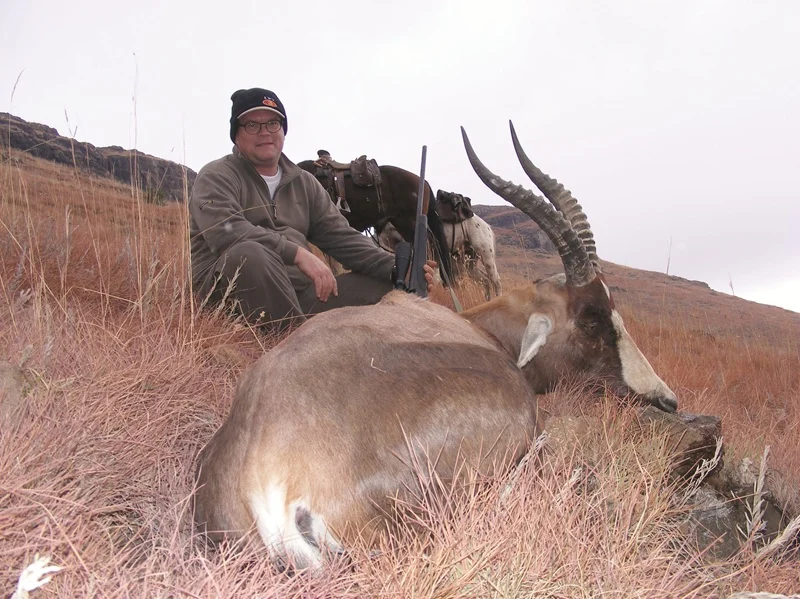
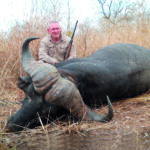
I moved towards them as the smoke started to clear. It took me a few seconds to comprehend what I saw… The oryx was lying directly next to Wikus’s right leg and right at Albie’s feet. Nico was standing a few yards to their right. I looked at my watch: it was 19:20. Nico told Wikus to give the oryx an insurance shot with the .375 to make sure it would not get up again. We were all stunned by what had just happened. Albie and Wikus were speechless. Albie shot the animal at point-blank range when it came into view. The raw emotion of the experience was still clearly etched on his face in the first picture I took of him behind his day-night trophy a while later.
Returning to the “crime scene” the next morning, the trackers explained that the oryx was lying in a shallow erosion ditch when the dogs found it. The Staffie was brutally hit on its flank by a horn as it got too close, which explains why the dog remained quiet at the time. The next thing that happened was that the oryx saw the light from the torch when Nico came into view. It then charged at the light and Nico started shooting with the pistol, hitting it several times without any visible effect.
Passing Nico, who stood slightly behind and in the shadow of a mopane tree, the oryx focused on Albie and raced towards him. Fortunately, Albie’s 560-grain paper-patch cast bullet hit it squarely in the chest, dropping the animal right at their feet. He had to jump out of the way when it fell. To complicate the situation, the smoke from the .451-calibre black-powder gun filled the air, blanking out any visibility. Wikus only realised what had happened once the smoke cleared.
Had it not been for Albie’s shot, any one of us could have ended up like a kebab on an oryx horn. Albie explained that it all seemed to happen in slow motion as the oryx went past Nico and focused its charge on him. Fortunately for all involved, “he stood his ground” courageously.
In retrospect, it was also most fortunate that we did not encounter any lion cubs that may have distracted us during the nocturnal follow-up. Sadly, Nico’s poor Staffie didn’t survive the ordeal and died a few days later. Afterwards, we all agreed: you don’t need to hunt buffalo to experience a full-blown charge. A much more affordable oryx hunt can offer the same excitement!
The moral of the story is that oryx hunting still requires suitable large-calibre rifles and proper shot placement as this antelope can put you in a dangerous situation very quickly, just like any of the Big Five. Within this logic falls the full quotation of Robert Ruark’s depiction of his fear of Cape buffalo from his book Use Enough Gun: “I don’t know what there is about buffalo that frightens me so. But that buff is so big and mean and ugly and hard to stop, and vindictive and cruel and surly and ornery. He looks like he hates you personally. He looks like you owe him money. He looks like he is hunting you.”
Unlike in Ruark’s well-known adage above, an oryx does not just stand still, looking at you like you owe him money; an oryx comes at you like he wants to kill you. Accordingly, make sure of your initial shot placement. Most importantly, if you wound an oryx in the late afternoon, rather do the follow-up the next morning. Contrary to what your hunting buddies believe, becoming an oryx horn kebab in the last vestiges of our wild Africa may not be such a great hunting experience after all.