










3 November 2026
Wild pigs: Origins, distribution and the threat to South Africa’s wildlife
Discover the origins and distribution of wild pigs, and how invasive European wild boars and feral pigs threaten South Africa’s indigenous species and biodiversity.

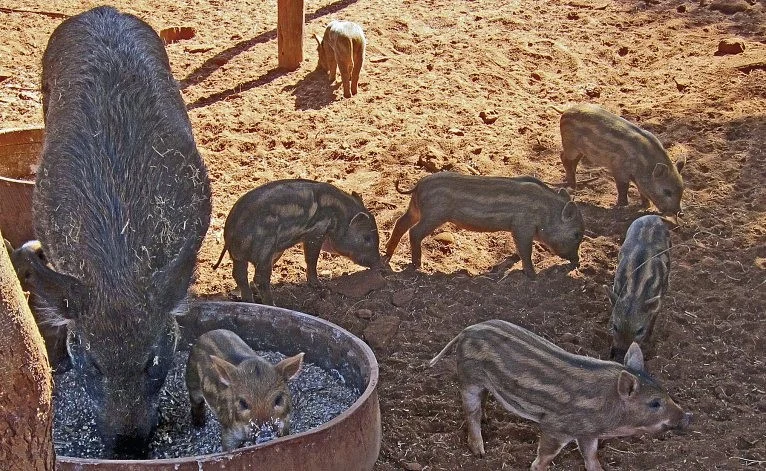
These young pigs are all hybrids between European wild boars and domestic pigs.
Wild pigs have the largest global distribution of all mammals. Indigenous to Africa, Asia and Europe, they have spread to other parts of the world through human activity. Fossil evidence shows that the earliest undisputed wild pigs lived approximately 20 million years ago.
Over time, different evolutionary lineages spread across Africa and Eurasia. Genetic analysis shows how readily these animals interbreed, a process that continues today.
The introduction of non-indigenous wild pigs and their crossbreeding with local species have created serious conservation concerns, particularly in South Africa, where indigenous bushpigs and other wild pig species face the threat of genetic contamination.
THE SPREAD OF WILD PIGS
Humans have played an important role in the geographical distribution of wild pigs.
- Approximately 11 400 years ago, seafarers transported wild pigs from the Middle East to Cyprus and other Mediterranean islands.
- Explorers introduced wild pigs to Iceland and Greenland during the ninth century.
- During the 15th century, wild pigs were taken to the Americas, New Zealand and Australia.
- Many introduced pigs had different genetic origins and were deliberately or accidentally released into the wild, where they interbred with local species.
AFRICAN WILD PIG SPECIES
Africa is home to several different wild pig species, including forest hogs, warthogs, bushpigs and river pigs.
FOREST HOGS
Giant forest hog (Hylochoerus meinertzhageni)
The giant forest hog is the largest of the wild pigs. It occurs in the mountains west of the Western Rift Valley in Rwanda, Uganda, northern Tanzania, the Kenyan Highlands and Ethiopia, as well as the Imatong Mountains of southern Sudan.
An adult male can reach:
- Head-and-body length of 2.1 m.
- Tail length of 45 cm.
- Shoulder height of 1.1 m.
- Weight of 275 kg.
The male’s tusks curve widely outwards and can reach 35.9 cm in length. The current Rowland Ward record for lower tusks is 15.50 inches (39.4 cm).
Central African forest hog (Hylochoerus rimator)
First described in 1906, this species is slightly larger than the bushpig. The male’s tusks curve less widely outwards than those of the giant forest hog.
It occurs across west-central Africa, from the Cameroon-Nigeria border to the Ituri Forest, north into the Central African Republic and in southern Sudan west of the Nile River. It does not occur south of the Congo River.
Western forest hog (Hylochoerus ivoriensis)
First described in 1930, this species is smaller than the Central African forest hog and has a short muzzle and palate. It occurs in the forests of West Africa, from Liberia to Ghana.

Warthogs in the Kruger National Park.
WARTHOGS
Warthogs have disproportionately large heads, eyes positioned high and far back on the head, and slender legs. Their skull structure differs from that of bushpigs.
Males have four facial warts, compared with two in females. There are two living species:
- Desert warthog (Phacochoerus aethiopicus): Has a shorter, broader skull than the common warthog, an egg-shaped head and hook-shaped facial warts. The subspecies Phacochoerus aethiopicus aethiopicus historically occurred only in parts of the Eastern Cape Karoo, but may already be extinct. Phacochoerus aethiopicus delameri occurs in northern Africa, from Somalia north-westwards to Djibouti, north-eastwards into Kenya and east along the Ethiopian border.
- Common warthog (Phacochoerus africanus): Has a longer, narrower skull, two upper incisors that may disappear with age, cone-shaped facial warts, leaf-shaped ears and an hourglass-shaped head. It occurs in the less arid parts of north-eastern Africa and is not found in Kenya and Ethiopia. The current Rowland Ward record for upper tusks is 24 inches (61 cm).
BUSHPIGS AND RIVER PIGS
Like European wild boars, bushpigs and river pigs have long bodies and short legs. Males have two warts on the underside of the face, and the part of the skull behind the eyes is elongated.
Bushpig (Potamochoerus larvatus)
Bushpigs have long, sparse, bristly hair and a crest. The colouring of the head contrasts with that of the body, but there is no facial mask. The current Rowland Ward record for lower tusks is 9 inches (22.9 cm).
Three subspecies are described:
- Potamochoerus larvatus larvatus occurs in Katanga, Tanzania and southwards through Namibia to the Southern Cape. This southern population is geographically separated from those in KwaZulu-Natal and the Eastern Cape.
- Potamochoerus larvatus hassama occurs in the forested Ethiopian Highlands, southern Sudan, the Democratic Republic of the Congo, Rwanda, Burundi, Kenya, Uganda and northern Tanzania.
- Potamochoerus larvatus somaliensis occurs in forests along the Tana, Juba and Shebelle rivers in East Africa.
Red river hog (Potamochoerus porcus)
The red river hog has a bright reddish-orange coat with a white stripe along the back, starting behind the head. It has a black facial mask, a white muzzle, white rings around the eyes and long whiskers on the cheeks.
Its ears are exceptionally long, with tufts at the tips. The hair on the muzzle and most of the face is bristly, while that on the body and forehead is short, soft and dense.
It occurs in rainforests from Senegal through west-central Africa to the Democratic Republic of the Congo. The current Rowland Ward record for lower tusks is 11 inches (27.9 cm).

A Barbary wild boar from the Al Maha estate in North Africa.
BARBARY WILD BOAR
The Barbary wild boar (Sus scrofa algira) is a smaller subspecies of the European wild boar. It occurs in the Atlas Mountains of Morocco, Algeria and Tunisia.
The current Rowland Ward record for lower tusks is 9.875 inches (25.1 cm).
WILD PIGS AND HUMAN USE
Wild pigs have been hunted for meat for centuries.
The term “safari hunting” originated in the 17th century when people from Evora and Alentejo in Portugal gathered to hunt wild pigs. Long safari hunts became popular among British military officers in East Africa during the 19th century.
“Safari” is a Swahili word derived from the Arabic word safara, meaning “to travel”.
The domestic pig was developed approximately 9 000 years ago from the wild boar (Sus scrofa) in the Near East. Wild pigs from Asia reached Europe approximately 7 500 years ago, where they spread rapidly and were kept as domestic pigs.
Other developments included:
- Different domestic pig breeds were developed through crossbreeding with European wild boars.
- European wild boars were introduced to the United States in the late 1800s and early 1900s and established in private hunting reserves.
- Many escaped, and most wild pigs in the United States are crosses between domestic pigs and European wild boars.
- Domestic pigs have long been a source of food in rural parts of Africa, where they were not confined and interbred with indigenous wild pigs.
- Crossbreeding between domestic pigs and bushpigs has been documented since 1970 and also occurs in the forests of the Southern Cape.
THE IMPACT ON BIODIVERSITY
European wild boars are among the world’s top 100 invasive mammal species and are considered the invasive species causing the second-highest level of ecological damage.
Crossbreeding threatens the survival of numerous wild pig species around the world. In certain areas, the chances of survival for indigenous wild pigs are estimated to be almost as low as those of domestic cats that have become feral.
Introduced European wild boars in the United States have caused considerable problems, despite strict regulations governing their introduction.
Their impact includes:
- Destroying agricultural fields by rooting through the soil while searching for food.
- Damaging natural ecosystems.
- Spreading numerous diseases.
- Interbreeding with domestic pigs.
- Competing with wildlife for food.
- Hunting other animals and changing natural predator-prey dynamics.
- Attacking livestock and people.
- Damaging the habitats of indigenous wildlife.
They are highly fertile and adaptable, allowing them to occupy and dominate natural ecosystems. They also spread diseases to livestock and people, including swine fever and foot-and-mouth disease. They have the potential to spread new pathogens that could lead to epizootic outbreaks.
THE THREAT TO SOUTH AFRICA’S INGIGENOUS WILD PIGS
In South Africa, wild pigs in the forests of KwaZulu-Natal and the Southern Cape are particularly threatened by crossbred populations.
Feral domestic pigs have a serious impact on the genetic integrity of indigenous wild pigs through interbreeding.
They also:
- Hunt reptiles, small mammals, insects and amphibians.
- Eat the chicks and eggs of ground-dwelling birds.
- Compete with indigenous species for habitat.
- Destroy habitat through their rooting activities.
- Spread parasites and epizootic diseases such as swine fever.
In the United States, wild pigs have been responsible for the decline of at least 300 plant species, with the survival of more than 250 species threatened.
In the Western Cape, numerous bushpigs have already been genetically contaminated through interbreeding with feral domestic pigs. These pigs have become an uncontrolled source of swine fever.

European wild boars on a breeding farm in South Africa. These pigs pose a major threat to our indigenous pig species.
EUROPEAN WILD BOARS AS HUNTING ANIMALS IN SOUTH AFRICA
Some South African game farmers breed European wild boars as hunting animals without considering the extensive damage they can cause.
This practice could create a more serious threat to game and livestock farmers than indigenous predators.
It also creates a significant risk of genetic contamination, with the potential to introduce serious diseases and unwanted parasites into a wildlife producer’s game population.
The consequences could ultimately damage both the wildlife and hunting industries.
(Source: ‘Die oorsprong, geografiese verspreiding, impak en jag van wildevarke’ by J. Du P. Bothma, July 2024 edition SA JAGTER/HUNTER.)