










10 November 2026
Custom rifles – creations of timeless beauty
Discover what goes into building a bespoke hunting rifle, from selecting the action and barrel to choosing the perfect stock, finish and finer details. – BY DANIE JOUBERT

I am often asked: “Why a custom rifle?”
Many people deem it unnecessary or even impractical to have a custom rifle built. “Factory rifles are accurate and reliable and I can get them in just about any calibre,” some argue.
These are valid arguments; factory rifles are indeed fine and you simply might not “need” a custom-made, one-of-a-kind rifle that costs thousands more than a production gun. But if you have to ask why anyone would “want” one, perhaps you just don’t understand what a custom rifle entails.
WHAT IS A CUSTOM RIFLE?
Before I attempt answering the question why a custom rifle instead of a production gun, it is necessary to first define just what a custom rifle is and, by inference, is not. Most dictionaries define “custom-made” as something that is being made to an individual’s specifications. Following that definition, I can add that a custom rifle is one that’s made to an individual’s specifications in terms of fit, finish and function. The only restrictions are basically determined by time and money.
Let me explain. Just as the top-of-the-line Rolex wristwatch cannot show the time more accurately than your cell phone does, so will a custom-made rifle not make you shoot any better. While most of us appreciate quality and well-made products, not all of us can recognise craftsmanship. Thus, the entire point of a custom-made rifle is to order something unique that reflects your taste and ideals (from a gunsmith whose tastes and talents you admire).

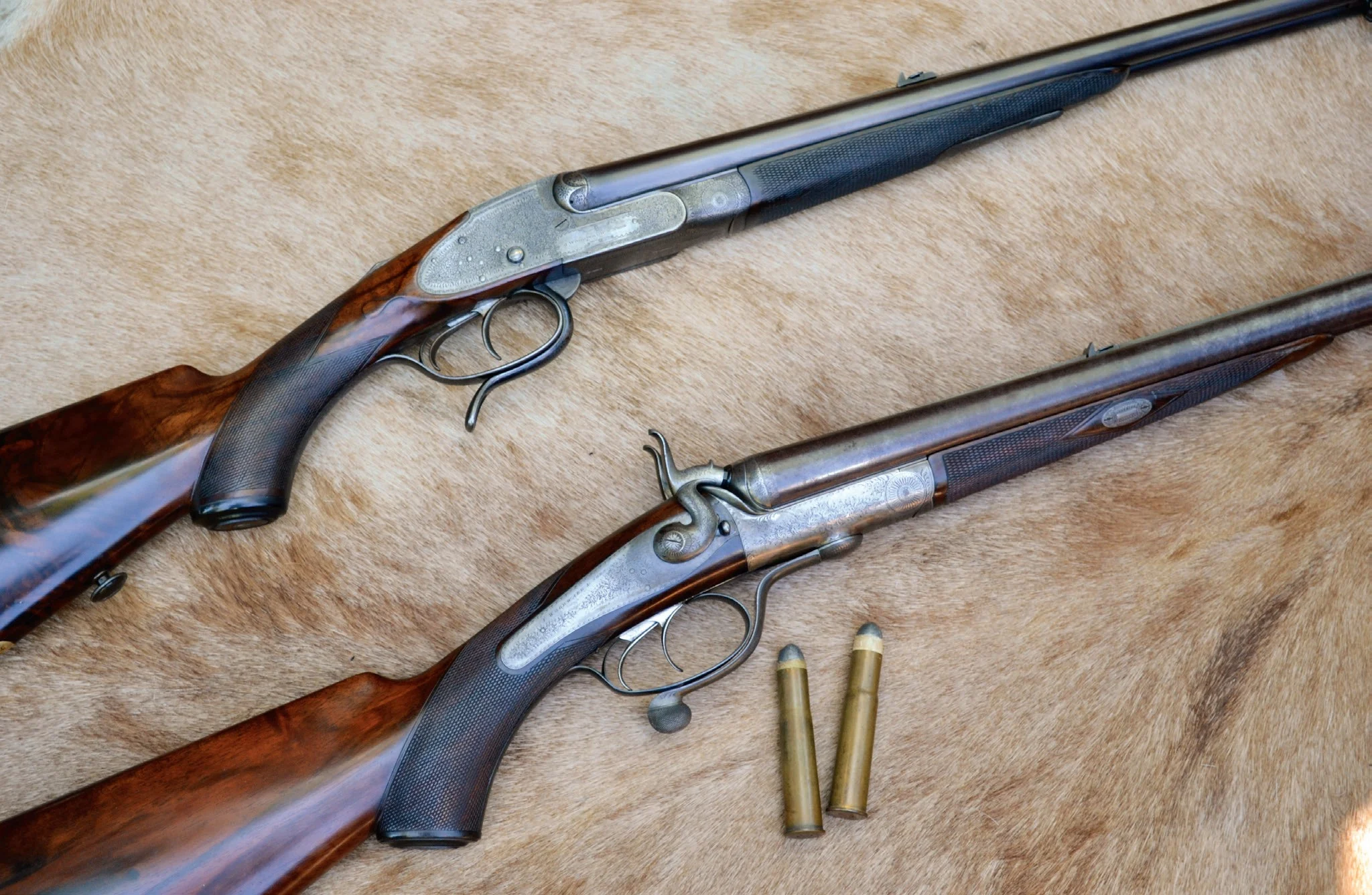
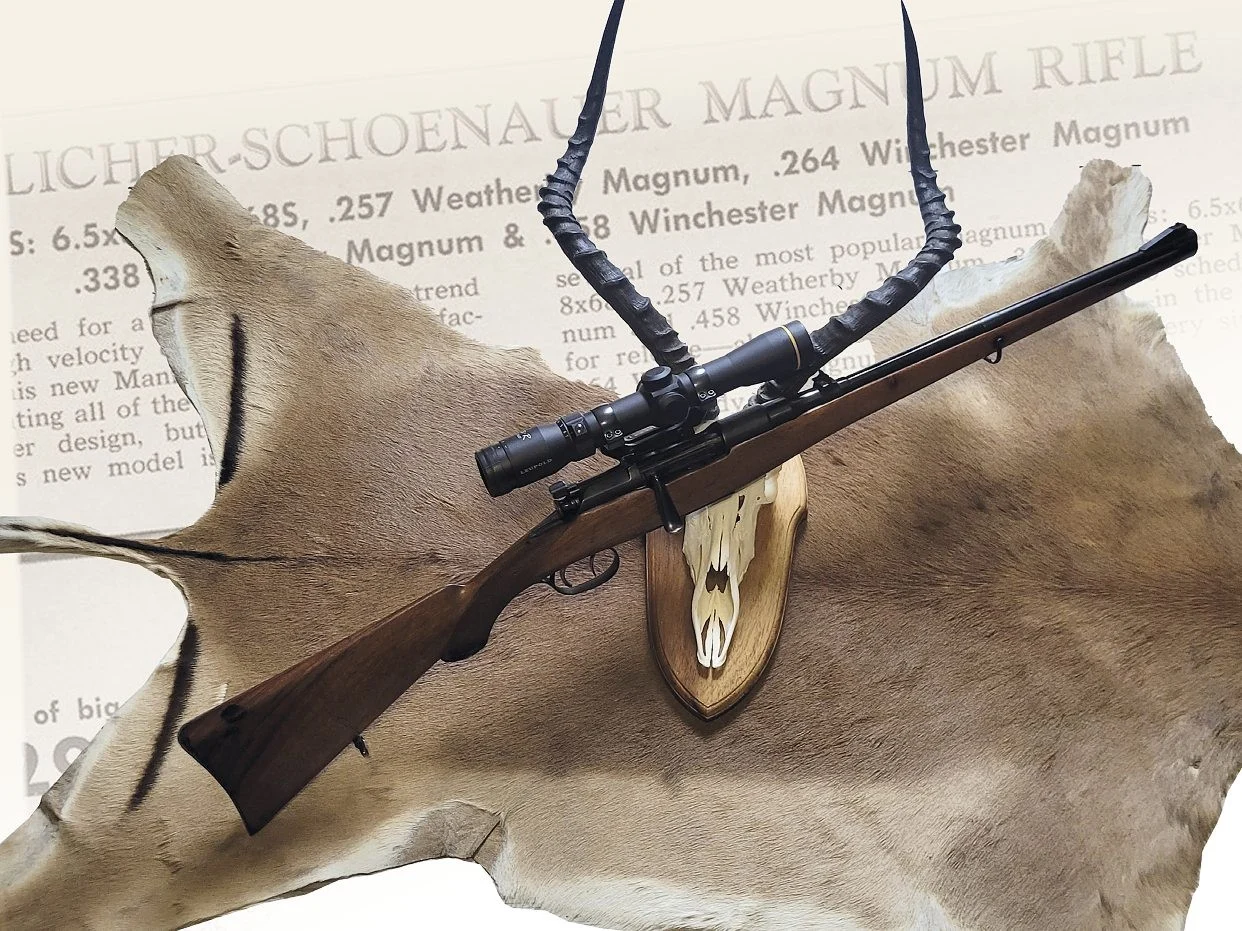
Two custom rifles on Mauser actions – both by Danie Joubert.
So, although factory rifles are just fine, many of us dream about owning a custom rifle and especially a bolt-action rifle. Perhaps this is due to our heritage as “a nation of riflemen”. There is a sense of satisfaction in owning something unique, something that’s being made specifically for you. Particularly when that something is a superior product, both in functionality and aesthetical appeal. For many hunters and sportsmen, the Holy Grail of firearms is a top-of-the-range custom-built hunting rifle.
Many types of actions are used for custom rifles and although the main photo accompanying this article illustrates a Ruger Number 1 action, most of what I am going to discuss will actually refer to bolt-action hunting rifles.
When building a bespoke rifle, the gunsmith will rework or customize the action, fit a custom-contoured barrel, cut the chamber and ensure that the action feeds cartridges from the magazine 100% reliably.
A custom stock with all the trimmings, usually from a walnut blank that the customer selected himself, will finish off the rifle. The customer will decide on the checkering pattern he wants and how many lines per inch. When it comes to the metalwork the customer will again decide what route the gunsmith will follow: matte finish or high-gloss, hot-bath blue or slow rust blueing, open sights or scope only. The options are endless.
A true custom rifle is typically ordered from an individual rifle maker or a small custom shop. It is built by one or more fine craftsmen to the exact specifications, measurements and wishes of the customer.
Not all rifles are truly custom-built. Some gunsmiths merely take an existing action, fit a stock to it and call it a custom rifle. To me that is actually not a custom rifle. However, there is a place in the trade for all of us, no matter how much or how little we actually customize a rifle.

A few examples of very desirable actions that can be used on a bespoke rifle. TOP: Mauser M98 single square bridge. L-R: Brno ZKK, Granite Mountain and Weatherby MK5.
WHERE TO START
Anyway, most rifle projects start with the receiver. The action is the heart of the rifle and merits a great deal of attention. Customers planning custom bolt-rifles often choose Brno/CZ, Weatherby Mark V, Winchester Model 70 or commercial Mauser 98-type actions, there are many possibilities. The four actions mentioned offer many combinations of cartridge handling (controlled or push feed), lock-up (twin or multiple locking lugs), bolt-throw (90 degrees down to 54 degrees), extractor-type, ejector-type (receiver or bolt mounted), bolt removal, safety, and action length.
Internal magazines may be blind or incorporate a hinged floorplate. If the action chosen does not incorporate a satisfactory trigger, an appropriate aftermarket trigger assembly can be fitted. If your dream rifle falls in the big-bore category, a purpose-built magazine should be seriously considered.
THE BARREL
Whether you or the gunsmith supplies the barrel, long lists of decisions and considerations need to be worked through before any work starts. Both the barrel blank and the work to be done to it require special attention.
I’ll assume that you’ve already selected the cartridge of your choice. Having decided on the cartridge is, however, not the only thing you need to do. You also need to specify the twist rate of the lands and the throat length, which in turn is determined by the range of bullet weights you intend using in the rifle.
Barrel contour and length is important. If your shooting style involves removing the rifle from your shoulder between shots, this might not be terribly important, but if you keep the rifle in your shoulder, then less weight and better balance become very important.
Chambering the barrel is the gunsmith’s essential task in metal work. Even if he performs every possible modification to your action, that work will only be done once, but if you are an active shooter he might have to install more barrels on that action over the years. The type of iron sights, or the lack of them, is another option that must be considered.

This is to show the progress from a block of steel to a finished one-piece magazine box.
If it is a dangerous game rifle to which you want to fit a rifle scope it is recommended that iron sights be fitted too. Not only do the thicker barrels of these rifles look better with iron sights but in a case of an emergency (telescope failure at a crucial time) the rifle will still be functional if it is fitted with open sights. Although it serves no function other than as a base for the rear sight, quarter ribs just make large-calibre rifles look so much better.
The same applies to quick detachable scope mounts (QD-mounts). The custom rifle builder is not limited to scope mounts that are available at the local sporting goods store, he can make custom mounts. Unfortunately custom-built QD-mounts add a great deal to the cost of the rifle, but in the long term are well worth the investment.
Remember that, just as the stock is carved from a blank, all the trimmings of the metalwork also start life as steel billets that are painstakingly “carved” (often by hand) or machined to the customer’s liking and taste.
THE STOCK
A custom rifle stock should be aesthetically pleasing to the shooter. (It also doesn’t hurt if others find it pleasing to the eye.) The type and grade of wood is important, but again, if the rifle falls in the big-bore category the layout and grain flow of the stock is of utmost importance.

Recoil pad options.
The customer will also need to choose the material and style of fore-end tip and grip cap along with the type of butt plate/recoil pad. On this subject, I once saw a stock of which the fore-end tip, grip cap and butt plate were made of buffalo horn. The stock-maker in this case really did a splendid job.
Checkering pattern and coverage is done to order with a certain number of lines per inch specified. The customer must also decide whether he wants checkering with pointed or flat-top diamonds.
ALSO READ: The Case for the .30-06 Springfield: Why it remains a hunting favourite
Length of pull, drop at comb and heel, pitch, cast off, Monte Carlo hump and cheek-piece (if desired), type and style of grip (full-pistol grip, semi-pistol grip, straight hand, thumbhole, etc.) can all be specified. The shape (round, squared-off, pear) of the forearm cross-section, as well as its length, taper and tip style are also selected by the prospective owner.
So is the type of pistol grip cap (if applicable), butt plate or recoil pad. Look at the differences between the stocks of a Winchester Model 70 Featherweight, Remington Model 700 BDL and Weatherby Mark V Deluxe to get an idea of the possibilities. Since the stock is specifically designed for the individual customer, it is a key defining characteristic of a custom rifle.
Although engraving is an essential part of the bespoke rifle we will not discuss it here as space to do so is limited. The customer should, however, keep in mind that engraving does nothing for the functionality of the rifle but, if done properly, will add to the aesthetic appeal of the rifle and enhances its value.

Not for the faint-hearted, at the top is a shortened version of a DWM Mauser receiver, specially made for the .250 Savage cartridge.
The foregoing is an overview of the kind of thought that should go into a custom-built hunting rifle. Anyone who does not enjoy the kind of detailed planning necessary for building a true custom-built rifle would be well advised buying a semi-custom rifle from companies such as Kimber or Dakota.
Before ordering a bespoke rifle, the customer must carefully select a rifle builder willing and able to produce the rifle he wants. Then, the buyer and the builder need to work out all of the details, including the action tuning required, specific checkering and engraving patterns, price and delivery time, etc. For the prospective owner, planning and ordering a custom rifle can be a time-consuming and expensive undertaking, but ultimately very rewarding.
(This article was published in KOLSKOOT 2018)