












4 November 2026
SA Hunters promotes river conservation from catchment to coast
SA Hunters strengthens freshwater conservation through its Kruger National Park partnership and Water for Life project, involving communities and youth in river monitoring.

Lizanne Nel, Conservation Manager of the SA Hunters Game Conservation Association handing over monitoring nets to Dr Dumisani Khosa, freshwater ecologist from Kruger National Park. PHOTO: FACEBOOK/SA HUNTERS CONCERVATION
Rivers connect communities, industries, people and ecosystems along their entire length. What happens upstream can have a direct impact on freshwater biodiversity downstream, making river conservation a shared responsibility.
SA Hunters is putting this principle into practice through partnerships with conservation specialists and its Water for Life project, which encourages young people and communities to take an active role in monitoring the health of their local rivers.
SA Hunters recently strengthened its contribution to freshwater conservation by donating specialised monitoring nets to the Kruger National Park. The nets were officially handed over by Lizanne Nel, the organisation’s Conservation Manager, to Dr Dumisani Khosa, a freshwater ecologist at the park who is passionate about the health of aquatic ecosystems.
The nets are important tools for monitoring freshwater aquatic biota – the small organisms living in rivers and streams that serve as indicators of the ecological integrity of these systems.
Their presence, diversity and abundance can help scientists establish the condition of a river and identify potential changes in its ecological health.
The donation highlights an important principle underpinning freshwater conservation: rivers do not operate in isolation, and neither can their protection.
Activities in one part of a river system can have consequences much further downstream.
TAKING RIVER MONITORING TO LOCAL COMMUNITIES
The same specialised monitoring nets donated to the Kruger National Park are also being used in SA Hunters’ Water for Life conservation project in the Eastern Cape, where people are using it to monitor the ecological integrity of rivers in their regions.
The project aims to develop greater awareness of freshwater conservation while giving participants practical tools to assess the condition of local water systems.
By involving young people in monitoring activities, SA Hunters hopes to encourage a better understanding of how rivers function, what threatens their health and why protecting them requires collective action.
Water for Life is based on the principle that conservation starts with understanding the natural environment. By learning to assess the health of a river, participants can become more aware of the pressures affecting it and the role they can play in protecting it.

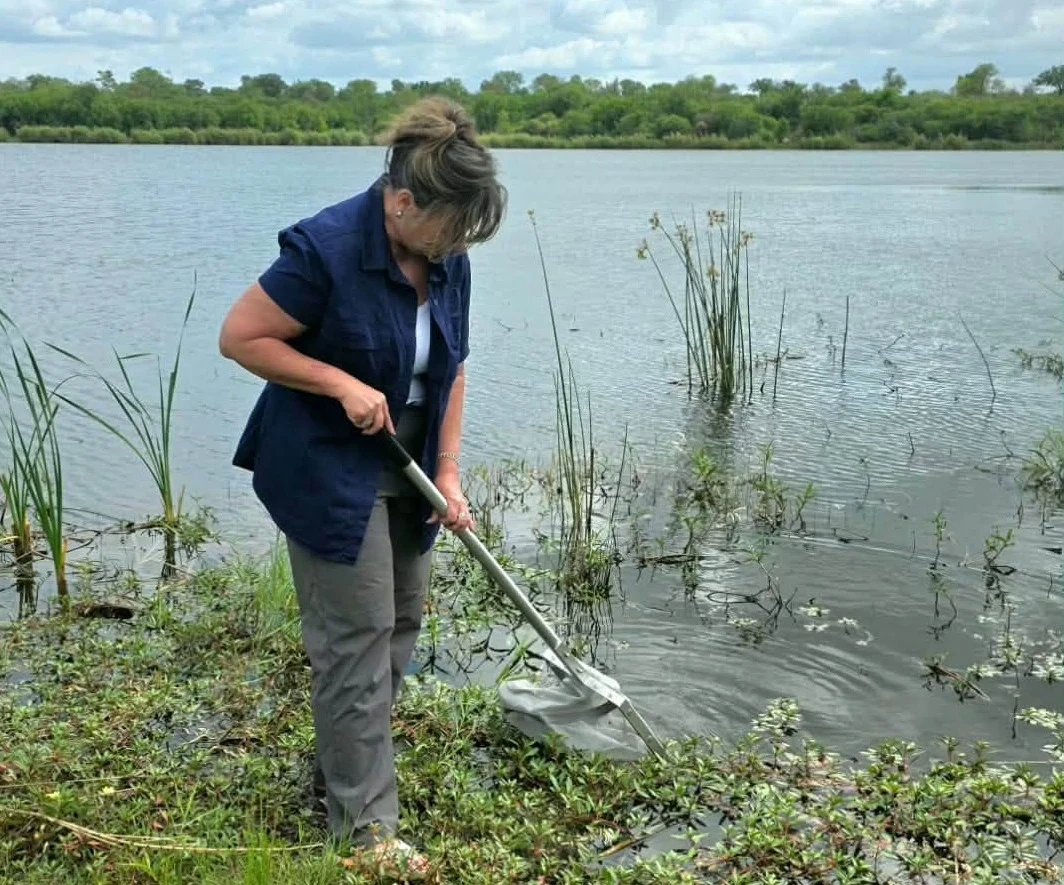
Lizanne Nel using the monitoring net. PHOTO: FACEBOOK/SA HUNTERS CONCERVATION
HOW DOES SA HUNTERS’ WATER FOR LIFE WORK?
The initiative uses the miniSASS (Stream Assessment Scoring System) methodology, a citizen science approach that enables people to assess the ecological health of a river without needing highly specialised scientific skills or equipment.
The method involves collecting small aquatic animals, known as macroinvertebrates, from a river. These include different groups of aquatic insects and other small creatures that live in freshwater environments.
Participants identify the organisms using an identification key and record which groups are present. Different groups have different tolerances to pollution and changes in water quality. Their presence or absence therefore provides an indication of the river’s ecological condition.
The results are used to calculate a score that places the river into one of five general health categories, ranging from natural to very poor.
By repeating surveys, participants can build up information about the condition of a river over time. The findings can help identify potential pollution problems, raise awareness and encourage further investigation and conservation action.
The information collected also contributes to a broader national dataset, allowing findings from individual communities to form part of a wider picture of freshwater ecosystem health in South Africa.
WHY MONITORING OUR RIVERS MATTERS
South Africa’s freshwater resources face growing pressure from pollution, overexploitation, invasive species and environmental changes.
The condition of municipal water infrastructure is another concern. According to figures cited in South Africa’s 2019 Water and Sanitation Masterplan, 56% of the country’s 1 150 municipal wastewater treatment works and 44% of its 962 water treatment works were in a weak or critical condition. A further 11% were classified as dysfunctional.
Poorly maintained wastewater treatment facilities can contribute significantly to pollution in river systems. Inadequate services, poor town planning and the growth of informal settlements also create challenges for water quality.
Although government has an important role in regulating activities that affect water resources, its capacity to monitor and protect these systems is limited.
This makes public participation and partnerships with conservation organisations and scientific institutions particularly important.
Monitoring provides a practical way of identifying problems and improving understanding of what is happening in a river system. It also helps communities recognise that the quality of their water is influenced by activities beyond their immediate surroundings.

Monitoring provides a practical way of identifying problems and improving understanding of what is happening in a river system.
WHO CAN PARTICIPATE?
Water for Life is open to everyone, including SA Hunters members, community groups, families and young people.
SA Hunters members can join activities organised by their local branch or contact the organisation’s Conservation Manager about establishing a project in their own community.
Children can also participate, provided they have permission from their parents or guardians.
WHAT PARTICIPANTS CAN EXPECT
Participants receive an introduction to the project and training in how to conduct a miniSASS survey.
The monitoring process involves collecting a sample of aquatic organisms from a selected river section, identifying the different groups and recording the findings.
Equipment includes monitoring nets, gumboots or waders, a magnifying glass, tweezers, a plastic container or white tray, a pencil, a timer and an identification key. Organic soap and sunscreen are also recommended. Life jackets are necessary for participants who cannot swim and when working in rivers with strong currents.
Once the organisms have been identified and the results recorded, participants can determine the general ecological health category of the river.
The findings can then be shared with the wider community to encourage awareness and, where necessary, further action to address threats to the river.
A GROWING CONSERVATION EFFORT
SA Hunters’ Water for Life initiative has already brought together different organisations and communities around freshwater monitoring.
The Garden Route branch worked with the Boy Scouts of George to conduct a miniSASS survey of the Malgas River.
The branch also collaborated with AfriForum Youth’s George branch to assess the ecological status and health of the upper reaches of the Witels River.
The Overberg branch has also started a Water for Life project in Stellenbosch, where students used the miniSASS method to assess the condition of a local river.
Together with the current activities in the Eastern Cape and the partnership with the Kruger National Park, these initiatives illustrate how freshwater conservation can extend beyond individual projects and organisations.
From national parks to local communities, the message is clear: rivers are a shared resource, and protecting them requires cooperation across the entire catchment.
Healthy rivers mean a healthier future for people, wildlife and the ecosystems that depend on freshwater.
For more information visit sahunters.co.za/conservation or contact +27 (0)12 808 9300.
(Source: sahunters.co.za)