






3 November 2026
The gemsbuck – Africa’s glorious gladiator
Discover why the gemsbuck is regarded as Africa’s gladiator, with insights into its behaviour, habitat, hunting challenges, suitable calibres and remarkable toughness. – BY GREGOR WOODS

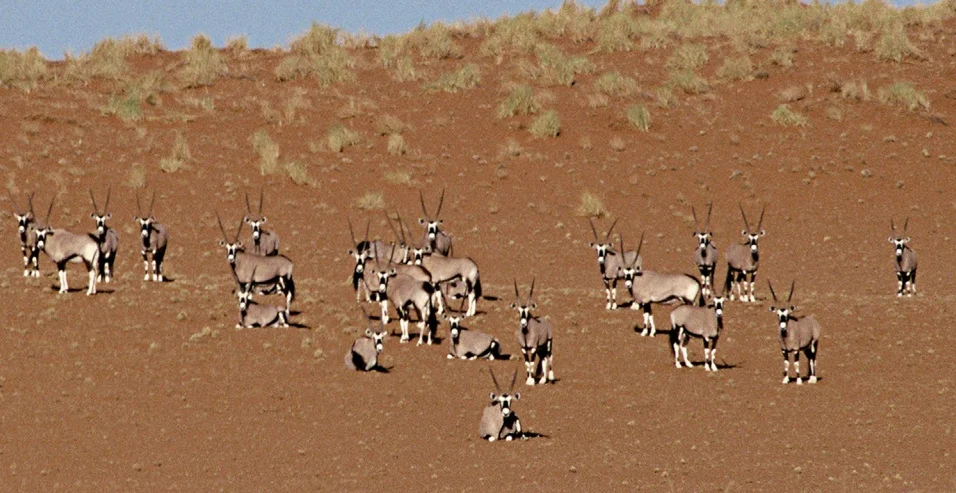
A typical herd in the sand dunes of the Namib Desert.
My first encounter with gemsbuck occurred when I was but a small boy; it left an indelible impression. I was born in South West Africa (Namibia), where my father was Windhoek’s chief telecommunications technician.
His job regularly involved road trips into the rural areas to oversee the installation and maintenance of telephone lines.
This was in the 1940s when livestock farmers regarded gemsbuck as fence-breaking pests and allowed my father to take one whenever he pleased, so he usually took a rifle along. As I was not yet of school-going age, he occasionally took me with him on day trips.
Driving through thick bushveld near Okahandja, we rounded a bend and came upon a herd of gemsbuck crossing the road. My dad grabbed his Lee-Enfield .303 and climbed out in time to bring down a tail-ender. The shot had hit the spine, paralysing the back legs, but the animal was still very much alive, lying with head and neck raised.
In those immediate post-war years, ammunition was costly – one shilling and sixpence per round. Therefore, my dad took a 4 lb hammer from the boot, intending to finish the beast with a blow to the skull.
The gemsbuck remained motionless, watching until my dad was just within reach. Then, in a flash, it dipped its head and swept those twin sabres at him with a vicious twist of its neck.
One horn tip caught the fly of his trousers and ripped open all the buttons! The animal’s broken spine had prevented it from lunging forward, and this saved him. Had he been 2” or 3” closer, the horn would have penetrated his bladder and bowel, causing fatal peritonitis (penicillin was not yet locally available; being a recent development, all supplies had gone to the war cause).
Profoundly shocked, he fetched the rifle and wisely spent a further one-and-six. And I gained an early respect for gemsbuck.

An old one-horned gladiator. Note the massive upper neck muscle.
IMPRESSIVE GEMSBUCK
The Oryx gazella is an immensely impressive animal in so many ways. Its muscled build, lethal horns, extraordinary toughness, and particularly its deadliness in battle make it the gladiator of the antelope world.
Gemsbuck have been known to kill lions. Yet gemsbuck are also beautiful. Their black-and-white facial masks are vividly striking, and their steel-grey flanks have a dark, sweeping, horizontal band angling upwards towards the hindquarters, giving them a streamlined, athletic appearance.
When not threatened, the bull reveals a dignified confidence as he watches you with his head held high, then dismissively swishes his stallion-like tail and struts off a few paces before turning to look back at you almost in disdain.
Gemsbuck have distinctly equestrian movements; I love watching their undulating grace as they canter silently through the desert sands with their long black tails flowing.
Gemsbuck evolved as desert dwellers and have a unique vascular system, enabling them to survive summer day temperatures of 45 °C and winter nights of -15 °C. Where unfenced, they are nomadic, following the rains.
They can survive without water by grazing at night to get moisture from the dew (even dry grass can take up 40% of its weight in airborne moisture at night) and by eating tsamma melons, gemsbokkomkommers (desert “cucumbers”), bulbs, tubers and water roots.

My first Namib Desert bull, Maltahöhe district, 1976. Note the big body size.
I once filled my canteen from a borehole water point in the Kalahari Gemsbok National Park (now the Kgalagadi Transfrontier Park); the water was so brackish (salty) that I instantly spat out the first sip, yet watched gemsbuck happily drinking it.
Up until about the 1980s, if you wanted to hunt gemsbuck, it was a case of “Go west, young man” due to their preference for arid habitat. Today, however, these antelope have been introduced to game ranches throughout South Africa.
DIFFERENT REGIONS
Gemsbuck differ in size according to region due to differences in soil content, which affect the grazing. Those in the desert areas of south-western Namibia are bigger than those in the higher rainfall areas of northern Namibia.
The gemsbuck I encountered in the Northern Cape were the smallest I have seen. Gemsbuck bulls weigh up to 240 kg, with the cows at around 210 kg (live weight).
Both sexes carry horns. It can be difficult to tell the cows from the younger bulls if the latter’s penis sheaths are hidden by bush or long grass.
A mature bull, however, develops a noticeably massive upper neck muscle. In profile, he also has a distinct “Adam’s apple” lump in the front of his throat, formed by a slab of tough gristle.
I have never read anything about this oddity in books or articles and have no idea what purpose it serves. The cows lack it. The cows’ horns are usually longer and more slender than the bulls’ and tend to grow more crookedly. The bulls’ horns are generally more symmetrical and have a more pronounced “bell” shape at the bases. The best trophy horns seem to come from the Kalahari regions.
Perhaps the most compelling attribute of gemsbuck is the challenge they offer the hunter – they are much more difficult to hunt than kudu. Gemsbuck are extremely wary, always alert, clever and have excellent eyesight.
Going in herds of a dozen or more, they present plenty of eyes looking out for you. You have to spot them before they spot you, or your chances of success plunge drastically.
These antelope are equally at home in the rugged, rocky mountains and sand dunes of the Namib Desert, the bush-covered hills and koppies of northern Namibia, the hilly highlands of Namibia’s Khomas Hochland, the red sands of the Kalahari Desert and the vast, flat scrublands of the Central Kalahari in Botswana. I have hunted them in all these terrains, and each offers a widely differing experience.
You will need good binoculars to glass distant terrain very thoroughly. All you have in your favour is that the gemsbuck’s long, straight horns reflect sunlight more than most antelope’s.
In bush-covered, hilly terrain, climb to an appropriate height and patiently scan every square metre of bush in the direction from which the wind is coming. Also look for movements and a glint of sunlight on the horns.
On locating such, note nearby landmarks, plan an approach and descend your koppie on the blind side. Your approach must be very slow and cautious, with lots of stops to look and listen.
In thick bush, it is essential to be accompanied by someone with an intimate knowledge of the area, or your chances of coming out exactly where you saw the quarry are not good.
If the gemsbuck are travelling, a successful interception course requires an expert. Val Hanssen and I tried this in the densely wooded hills around Otjiwarongo and bumped into the travelling gemsbuck just metres away, but they saw us first and that was that.
Even if they are stationary, finding them, identifying a target and getting a shot before one of them senses your presence is… well, let’s just say, don’t book a one-day hunt!

I used a .300 Win Mag to bag this bull in the typical scrubland of Botswana’s Central Kalahari district.
DIFFICULT TERRAIN
I found the Central Kalahari difficult terrain. Botswana is as flat as a lake, so there are no elevated glassing points. The endless scrub is low but not low enough to see over, and inching your way through it on foot in the hope of encountering gemsbuck is just too time-consuming.
Where I hunted, our only choice was to slowly travel around in a Land Cruiser bakkie, standing on the back to see over the scrub and, on spotting a herd, making the stalk on foot. I shot a nice bull there, but only after struggling through maddening wag-’n-bietjie thorns, setting up the shooting sticks, and then having to struggle further as my bull moved several times.
In the Kalahari’s red sand dune area, the going is easier – the dunes offer cover for spotting and stalking.
The Khomas Hochland is easier, as the hills and mountains allow you to see for vast distances, and the scenery is really splendid. My favourite, however, is the Namib Desert.
The scenery is so compelling, and the gemsbuck herds are generally larger – after good rainy seasons, I have spotted herds numbering up to 400 animals. And the gemsbuck in the western Maltahöhe district are the biggest and heaviest I have yet seen.
SUITABLE CALIBRES
As for suitable calibres, I must repeat that gemsbuck are astoundingly tough. Yes, they can be killed with a 7×57 Mauser or a .270 Win in ideal circumstances, but I would not recommend that you try it.
If the animal moves just as you fire, or you pull the shot, or your bullet breaks up, you will be horrified by the distance a wounded gemsbuck can travel, and most gemsbuck terrain makes for very difficult follow-ups.
I have long held that the test is not what a calibre or bullet can do, but what it can be relied upon to do every time, regardless of circumstances. I have hunted these animals with a .30-06 Springfield, an 8×57 Mauser, a .300 H&H, .300 Win Mag, .375 H&H and .458 Win Mag.
A .30-06 with 220-grain bullets is fine for bushveld use, but most of my gemsbuck hunting has been done at longer ranges. I found the .300 H&H suitable if loaded with 200-grain Nosler Partitions (this was before “premium-grade” bullets were developed in the 1980s).
Any .300 “magnum” will serve well if loaded with bullets of specially reinforced construction. I found the .375 H&H to be very good, even for longer-range shots (using 270-grain Barnes-X bullets). I shot a big gemsbuck cow in the Karibib district of Namibia’s Khomas Hochland at a range of 350 m, which is 50 m further than my usual self-imposed maximum.
The .375 H&H is very versatile – a good gemsbuck cartridge for any terrain. However, if I lived in Namibia, my choice for gemsbuck would be a .338 Win Mag with 250-grain premium-grade bullets at 2 700 fps. It has just the right combination of flat trajectory, bullet weight and penetration. In open desert, zero your scope at 250 or 300 m.
I once dropped a gemsbuck with a frontal neck shot and heard the bone crack on impact. He immediately got up, ran about 60 m, fell, got up and ran a further 30 m or so before falling again, this time with his neck and head folded under his chest, rendering him unable to move, but far from dead. He needed a killing shot. My bullet had hit the neck bone, just missing the spinal cord.
On another occasion, I was with a friend who hit a gemsbuck bull behind the lungs. It ran off in flat desert terrain, so the farmer decided to chase it with the Land Cruiser. The bull ran for 18 measured kilometres and was still running when I shot him from the back of the moving bakkie.

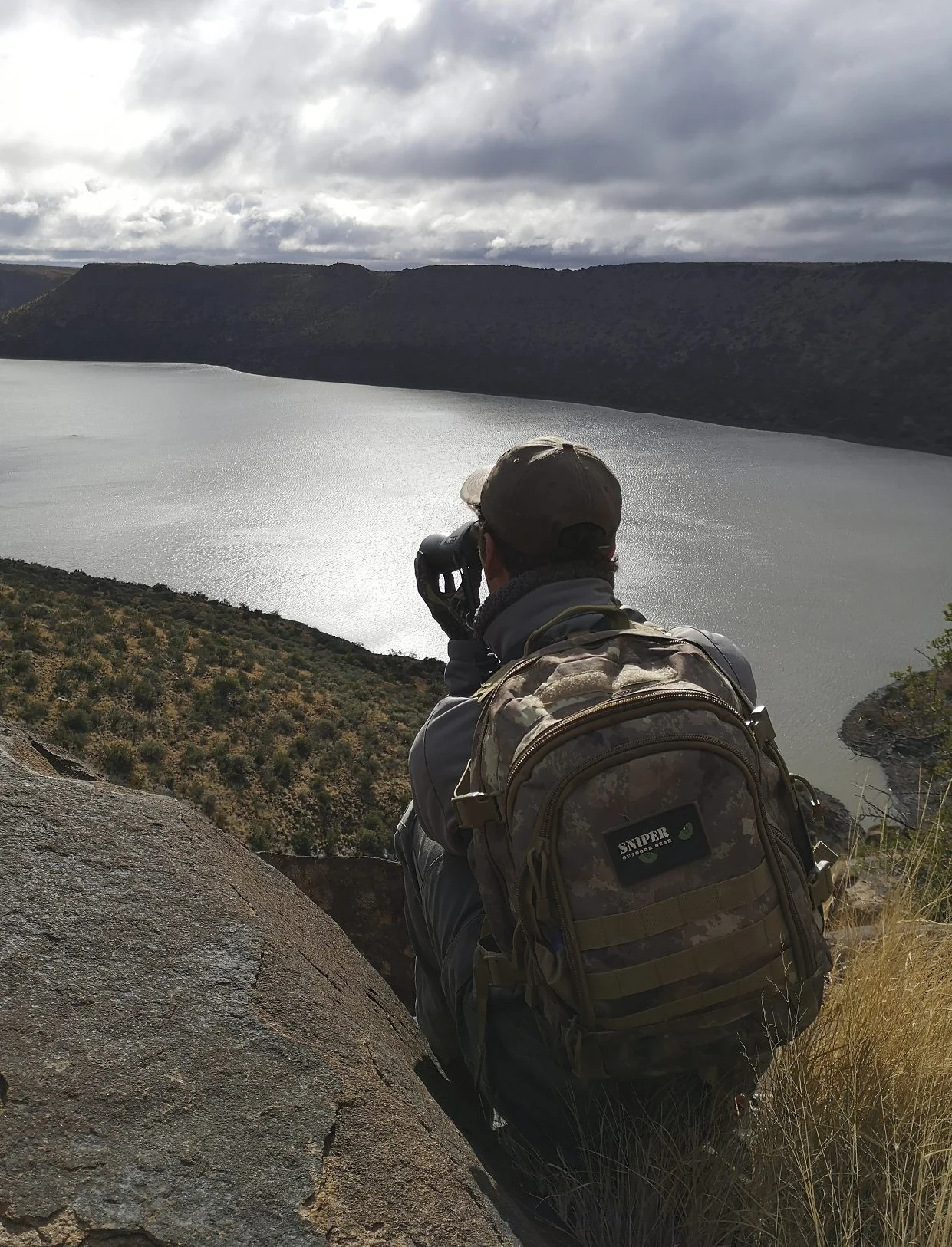
The dense bushveld of northern Namibia’s Otjiwarongo district requires glassing from a high vantage point.
This stopped him but did not put him down – my friend had to shoot him again. The farmer told me a client’s bullet once shot both front hooves off a gemsbuck bull; it got up and ran on the stumps! Such gemsbuck stories abound. Do not underestimate this animal’s hardiness, endurance and tenacity.
If you take a neck shot on a mature gemsbuck bull, be aware that he has an unusually deep muscle on top of his neck (above the neck bone). Unlike other antelope whose necks form a curve from the shoulders to the head, the profile of a big gemsbuck bull’s neck forms a straight line from his shoulder hump to his head.
Many hunters naturally fire for the centre of the neck to hit the spinal cord, but in this case, a central hit could go just above the spine or clip one of the dorsal bones atop the spine. This may drop him, but he will get up and you might never see him again. Rather take heart/lung shots.
Gemsbuck are dangerous – never take chances with them. Unlike kudu bulls, who use their horns as clubs, gemsbuck stab with theirs. I knew two game rangers who were gored by gemsbuck; one through the leg by a wounded bull that charged, and the other by an unwounded bull during a game-capture operation.
He was sitting in the driver’s seat of a Land Rover, while a captured gemsbuck lay beside it with its legs tied and a sack covering its eyes. The sack slipped down, enabling the bull to see the ranger, and it promptly stuck its horn through the aluminium door panel of the Land Rover.
The splintered horn tip passed through the soft under-flesh of the ranger’s upper thigh and deep into his scrotum. The bull then violently shook his head to free his horn from the door, his horn tip describing circles inside the ranger’s scrotum.
If your gemsbuck is not dead, shoot it again. If it appears dead, stand back and watch it – at the moment of death, the hairs of its coat will stand up and bristle for a few seconds.
Gemsbuck meat makes good table fare, though I find the biltong somewhat bland. Its meat often has a thin layer of surface fat, making it good for roasting. A favourite of mine is a “log” of gemsbuck rugstring (sirloin or backstrap), dusted with hot English mustard powder, then entirely wrapped in streaky bacon and roasted over kameeldoring coals.
(This article was published in the September – Oktober 2023 edition of SA JAGTER/HUNTER)


