





4 November 2026
What Is Bisley Shooting? A Guide to the Different Classes
Discover how Bisley shooting works, including the traditional Bisley, F-Class and Hunters Bisley disciplines, equipment, calibres and target scoring. – BY SCHALK VERMEULEN

In the traditional form of Bisley shooting, rifles with aperture sights are used.
Bisley, as a target shooting sport, is practised at distances of 300, 500, 600, 700, 800 and 900 m, with shooters firing at black, circular paper targets. There are several classes, each with its own rules and equipment. Military shooting ranges that have the necessary distances are mostly used for competitions.
South Africa has a rich target shooting history that dates back as far as 1686. Yes, that is correct: the first organised shooting competition in our country was held in Stellenbosch from 1 to 14 October 1686.
The target was a wooden parrot, and prizes were awarded to shooters who shot off different parts of the target. The main prize of 25 riksdaalders (approximately R10) was awarded to the person who managed to shoot the body of the parrot to pieces.
Informal shooting competitions were held over the years, but it was only in the 20th century that Bisley shooting was professionally organised in South Africa. Target shooting competitions were already very popular in Britain and America in the 1800s, where the Bisley and Palma shooting competitions originated (see explanation of the origins of these competitions).
The origins of the South African Bisley Union (SABU) can be traced back to 16 January 1929, when the first meeting of the South African National Shooting Association took place in Cape Town. The first competition was held on 7 October 1929. Today, the South African Bisley Union is the governing body of the sport. There are nine provincial unions, each with its own clubs. Their shooting competitions are held regularly. In addition to the annual South African Championships, international competitions are also regularly hosted in our country. Most of these, as well as the SA Championships, are usually held at the Hamilton range outside Bloemfontein.
THREE CLASSES
Bisley shooting in South Africa is currently offered in three different classes: the traditional Bisley class, F-Class and Hunters Bisley. Shooting is done exclusively from the prone position.
In the traditional class, only two calibres are permitted, namely the .308 Win/7.62 NATO and the .223 Remington. In the traditional Bisley class, only aperture sights may be used on rifles; telescopic sights are not permitted. In other words, this is the old open-sight class. From the prone position, the shooter’s rifle must rest against the shoulder, and the only other support is the elbows. No part of the rifle may touch the ground.
Rifles suitable for the traditional Bisley class are no longer readily available commercially (at least not in South Africa). Most Bisley rifles are therefore custom-built from quality components. For many years, our locally manufactured RSA target shooting actions were used, but these are also becoming scarce.
Shooters currently use imported single-shot actions such as the Barnard, Millennium, RPA, Nesika, Stolle Panda and others. In earlier years, Musgrave, Ferlach and Vektor barrels were used. Nowadays, stainless-steel barrels from Krieger, Bartlein, Border, Shilen, Broughton, Maddco, Walther and many others are popular. The final barrel length is 30” to 32”, with a twist rate mostly of 1 in 12” or 1 in 13”. Chambers are cut using special competition reamers.
ALSO READ: The Tikka T3x TACT A1 goes long-range: A review
In earlier years, only issued military ammunition firing a 143gr full-metal-jacket bullet was permitted. Nowadays, shooters may load their own ammunition, but the maximum bullet weight for the .223 is 81gr and for the .308, 156gr. The .308 is much more popular than the .223 because the latter’s lighter bullet is affected too much by the wind, particularly at the longer distances (700, 800 and 900 m).
Shooters usually load 155gr competition bullets for their .308s to achieve muzzle velocities of between 2 900 and 3 000 fps. S335 and S355 are the two popular propellants for the .308 Win. Only high-quality cases are used, and shooters aim to achieve ½ MOA, ten-shot groups (that is, 10 shots in approximately 14.5 mm at 100 m or 44 mm at 300 m). Note: this applies only when using open or aperture sights.
Stocks are made from wood or fibreglass, and laminated wooden stocks have also become popular. Most stocks have adjustable cheekpieces, the actions are bedded, and the barrels are free-floating (they do not touch the fore-end anywhere). There is a restriction on trigger pull weight – triggers may not break at less than 500 g. A popular trigger for the RSA action is the Australian-made Davies two-stage trigger.
Aperture sights are highly sophisticated nowadays. Because shooting is done at circular targets, shooters use an aperture for both the front and rear sights. The size of the apertures can be adjusted (adjustable irises), and they can accommodate a lens to compensate for shooters’ vision defects. Lenses are permitted in both the front and rear sights.
Popular brands include RPA Trakker, Warner and Central sights, as well as the RightSight front sight. They generally adjust in ¼ MOA increments. In other words, one click moves the point of impact of the bullet by approximately 7 mm at 100 m.
There is no restriction on rifle weight, but because the rifle is fired from the shoulder with only the shooter’s elbows providing support, very heavy rifles are undesirable. Most shooters therefore limit the weight to approximately 6 or 6.5 kg.
The so-called spotting scopes (high-magnification telescopes) are permitted so that shooters can easily monitor the fall of their shots. After each shot, the target is marked once the previous shot hole has been patched. A sticker or marker is placed over the bullet hole to inform the shooter exactly where the shot struck, allowing them to compensate with the next shot (this is done in all Bisley classes). An indicator is also displayed on the edge of the target frame to show the score value of the shot.

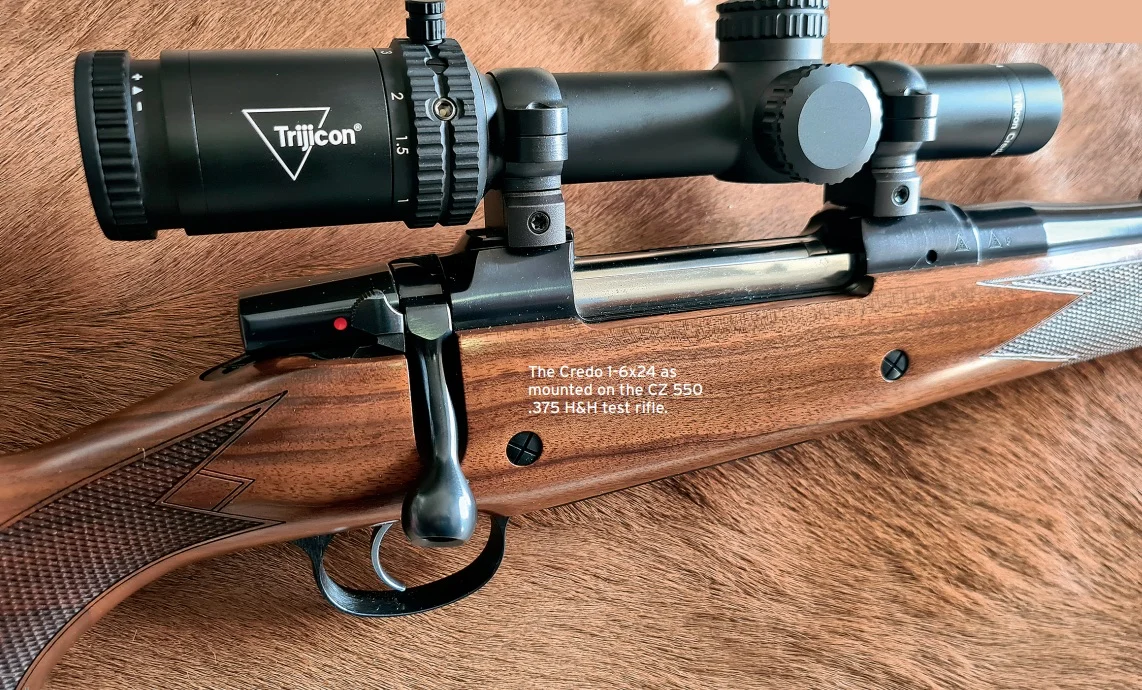
In the F-Class divisions, telescopic sights may be fitted to rifles.
F-CLASS
F-Class Bisley originated to accommodate people who could no longer shoot competitively with traditional aperture sights because of vision defects. The original plan was simply to fit telescopic sights to traditional aperture-sight rifles and allow people to shoot over a rest.
However, this class became so popular that it was no longer only people with poor eyesight who wanted to participate. Today, F-Class is a fully fledged discipline with two divisions: F-TR and F-Open.
Optical sights (rifle scopes) are permitted, and there is no restriction on magnification. Shooters use scopes with a wide adjustment range and special scope mounts (to provide sufficient adjustment for shooting out to 900 m). Naturally, scope brands that offer very accurate and reliable adjustments are preferred.
F-TR is currently the fastest-growing division of Bisley. As in the traditional Bisley class, only the .223 Rem and .308 Win calibres are permitted. Unlike the traditional class, there is no restriction on bullet weight. Rifles may be fitted with a bipod rest beneath the fore-end, and a sandbag may be used beneath the stock at the recoil pad as a rear rest. Shooting is also done exclusively from the prone position, and the weight limit for the rifle is 8.25 kg.
F-Open is described as the Formula 1 of Bisley shooting. In this class, any calibre up to and including 8 mm may be used, and any type of front rest is permitted, while sandbags are standard as a rear rest. The front and rear rests may not be attached to each other, so so-called rail guns are not permitted.
A weight limit of 10 kg applies to F-Open rifles.
Popular calibres include the 6.5-284, .284 Win and .300 WSM. Bullets with high BC values (streamlined bullets) that ensure less wind drift are very popular among these shooters.
I should perhaps just mention that there are still Bisley classes for the old .303 Lee Enfield and even black-powder rifles. These are also restricted to aperture sights.

Hunters Bisley is a newer class that was introduced. Hunting rifles are used, and shooters fire at game animal targets with designated scoring areas.
HUNTERS BISLEY
Hunters Bisley was launched a few years ago and is also shot from the prone position, but with hunting rifles fitted with telescopic sights. Shooting takes place at only three distances, namely 300, 500 and 600 m, and the targets are full-colour springbok, blesbok and blue wildebeest. Scoring areas are marked on the targets where the animals’ vital organs would be in real life.

This is what the target used for shooting looks like.
BISLEY TARGETS
Three different target sizes are used: one target for 300 m, one for the 500 and 600 m distances, and one for the long distances (700, 800 and 900 m). A bullseye scores five points, while the subsequent scoring circles count four, three and two points respectively. The ring that scores five points has a smaller circle inside it, marked with a dotted line. This is the V-bull and is used to determine the winners in the event of a tie – the person with the most V-bulls wins.
The V-bull for the F-Class divisions is half the size of that for the traditional Bisley class. For F-Class, it measures 35 mm at 300 m, 80 mm at 500 and 600 m, and 127 mm at 700, 800 and 900 m.
The greatest challenge for Bisley shooters is to read the conditions (wind and mirage) correctly and compensate for them in order to place their shots within the scoring areas. It is a very challenging sport, and hunters would benefit greatly from participating in this shooting discipline. World Championships are held every four years.
For more information about Bisley shooting, contact SABU on 012-361-4966 or visit its website at www.sabisley.com.
(Source: KOLSKOOT 2020)